Honoring Excellence in Professional Football: A Comparative Analysis of the Pro Football Hall of Fame and the NFL Pro Bowl
Abstract:
This paper provides a comprehensive examination of two major institutions of recognition in professional American football: the Pro Football Hall of Fame (PFHOF) and the NFL Pro Bowl. We explore the historical development and governance of the PFHOF since its founding in 1963, detailing the secretive selection committee process and recent controversies surrounding Hall of Fame inductions. We analyze the socio-political factors that influence Hall of Fame voting, including the 2026 first-ballot snub of coaching icon Bill Belichick and past instances of candidates being deferred or "blackballed" due to off-field issues or media relations. The economic implications of Hall of Fame induction — such as post-career earnings, the 2018 “Hall of Famer salary” proposal, and the market premium for Hall of Fame memorabilia — are also discussed.
In parallel, we trace the evolution of the NFL Pro Bowl (the league’s annual all-star game) from its origins in the 1938 All-Star game and formal establishment in 1950, through its heyday and into its modern decline in relevance. We examine changes in the Pro Bowl’s format (including the integration of skill competitions and flag football in 2023) and the factors contributing to waning player participation and fan interest. Special attention is given to the Pro Bowl’s selection process, the proliferation of alternates due to player opt-outs, and the NFL’s recent decision to integrate the Pro Bowl “Games” into the Super Bowl week starting in 2026. Through a scholarly lens, this article connects how the Hall of Fame and Pro Bowl each reflect different dimensions of how the NFL honors player excellence — one as a lifetime achievement memorialized in Canton, and the other as a contemporaneous but increasingly problematic exhibition of star talent.
Introduction
In the landscape of American sports, the National Football League (NFL) has established multiple platforms to recognize and honor player achievement. Two of the most prominent are the Pro Football Hall of Fame – a lifetime honor marking the pinnacle of career achievement – and the NFL Pro Bowl – an annual all-star event intended to showcase the league’s top players of that season. Each institution carries unique historical origins, selection criteria, cultural significance, and controversies. Understanding their development and current challenges offers insight into how professional football balances historical legacy with contemporary spectaclein celebrating excellence.
The Pro Football Hall of Fame (PFHOF), located in Canton, Ohio, serves as a museum and shrine, immortalizing players, coaches, and contributors who have made outstanding contributions to the sport. Since its inaugural enshrinement class of 1963, the Hall of Fame has grappled with the task of measuring greatness, often under subjective and secretive conditions. Over the decades, debates have intensified regarding the fairness and transparency of its selection process, epitomized by recent events in 2025–2026 that saw even a six-time Super Bowl-winning coach, Bill Belichick, initially fail to gain induction. Concurrently, the Hall’s role as an institution has expanded beyond mere recognition; it now influences the post-retirement economic opportunities of inductees and faces scrutiny over how to handle members (or prospective members) with off-field notoriety.
The NFL Pro Bowl, by contrast, is a celebration of current star players – historically an exhibition game pitting conference all-stars against each other after each season. Over time, the Pro Bowl’s format and reputation have dramatically evolved. Once considered a prestigious showcase of elite talent (with players treating it as a genuine competition), the Pro Bowl has in recent years been criticized for its lack of competitiveness and declining intensity, prompting the NFL to institute major changes. The traditional game has transformed into a multi-day “Pro Bowl Games” event featuring skill contests and flag football. The trajectory of the Pro Bowl reflects broader issues in professional sports all-star games, such as injury risk aversion, player engagement, and fan interest in an era of skyrocketing salaries and entertainment alternatives.
This article will analyze both the Hall of Fame and the Pro Bowl, delving into their histories, selection processes, internal politics, and the socio-economic nuances that define them. By comparing these two institutions – one rooted in historical legacy, the other in annual performance – we highlight the NFL’s multifaceted approach to honoring its athletes and the challenges inherent in each approach.
Pro Football Hall of Fame: History and Selection Process
Origins and Early Challenges
The Pro Football Hall of Fame was established in Canton, Ohio and officially opened on September 7, 1963. Canton’s selection was symbolic: the city was the birthplace of the NFL (originally the American Professional Football Association in 1920) and home to the early powerhouse Canton Bulldogs. The inaugural enshrinement, known as the “Charter Class,” consisted of 17 inductees, including such legends as Sammy Baugh, Bronko Nagurski, and Jim Thorpe. However, this first class was whittled down from a much larger pool of deserving candidates spanning the NFL’s first four decades. Contemporary accounts indicate the selectors initially considered around 80 all-time greats for 1963, meaning that dozens of worthy candidates were left out due to class size limits. This immediate backlog – sometimes dubbed the “Original 80” problem – meant that many luminaries had to wait years for induction despite obvious Hall-worthy credentials. For example, Pittsburgh Steelers founder Art Rooney Sr. was not honored until 1964, and star quarterback Otto Graham (who led his team to ten straight championship games in the 1940s–50s) had to wait until 1965 to get in, despite his legendary status.
This early backlog set the tone for the Hall of Fame’s chronic balancing act between exclusivity and recognition. From the outset, the Hall’s goal was to preserve only the most exceptional careers for posterity, but the definition of “exceptional” often lay in the eyes of the selectors. Moreover, limiting the number of inductees per year meant that some all-time greats could be (and were) snubbed initially – a dynamic that continues to spark debate in modern times (the concept of “first-ballot Hall of Famers” versus those who only get in after years of eligibility).
The Modern Selection Committee and Process
Hall of Fame inductees are chosen by a Selection Committee that has evolved into a 50-person panel of experts. This committee is deliberately kept small to ensure rigorous debate, and it operates with strict confidentiality. As of the 2020s, the committee’s composition includes one media representative from each of the 32 NFL franchises (with historically two each from New York and Los Angeles due to their multi-team markets), plus 17 at-large members (national media or football historians) and one representative of the Pro Football Writers of America[1]. Many members are veteran NFL reporters or commentators, and some are Hall of Fame players or executives themselves (e.g., Bill Polian, Dan Fouts, James Lofton have served as at-large voters)[1]. Notably, there are no term limits for committee members, so some have participated for decades, leading to an insular culture often criticized as being a “club” of gatekeepers.
Nomination and Reduction Stages: The selection process is a year-long funnel that narrows the field of candidates through multiple stages[2]:
Preliminary Nominees: Over 100 eligible names (players who have been retired at least 5 full seasons, or coaches/contributors, as discussed below) are initially nominated.
Semifinalists: A screening subcommittee selects 50 nominees who are announced as semifinalists around October.
Finalists: The full committee then votes by mail to trim the list to 25 semifinalists by November, and subsequently to 15 Modern-Era finalists by early January. (Per Hall rules, any Modern-Era candidate who was a finalist in the previous year and did not get elected is guaranteed a spot among the final 15 the next year[3], to avoid perennial logjams.)
Selection Meeting: The climax is an in-person (or virtual) meeting of the 50 voters, typically held on the Saturday before the Super Bowl. This meeting can last 8–10 hours, during which each of the 15 Modern-Era finalists is discussed. A presenter (usually the media voter from the candidate’s city or a relevant at-large member) makes the case for each finalist, followed by group debate. After discussions, a series of secret ballots are conducted. First, the list of 15 is cut down to 10, then from 10 down to 5. Finally, the remaining 5 candidates are voted on individually with a yes/no decision for induction[4]. To be elected, a finalist must receive at least 80% affirmative votes from the committee (i.e. 40 out of 50 voters)[4]. Typically, between 4 and 8 new members are inducted each year under this system.
Historically, this process produced an upper limit of five Modern-Era inductees per year (since only five would make the final yes/no up-or-down vote). However, as of 2023–2024, the Hall of Fame implemented new voting rules intended to make elections more challenging. Instead of automatically advancing five Modern finalists to the yes/no stage, the committee now only advances to a “final 5” by first voting down from 15→10 and 10→7, and then voting for a maximum of 5 names among those 7[5]. In other words, each voter can only endorse five candidates in the final ballot, effectively meaning even if all 50 voters agree on the top five choices, the 6th and 7th candidates could receive at most 45% support (since voters are limited to five picks each). Under this system, if there are more than five extremely strong candidates, some will inevitably fall short of the 80% threshold simply due to vote-splitting. This is exactly what happened in the Class of 2025 (the first year under the new rules): only three Modern-Era players were elected (a historically small class)[6][7]. The Hall of Fame noted it was the smallest class in 20 years, illustrating the increased difficulty of achieving induction under the revised voting process[8][9].
Distinct Categories – Modern vs. Seniors/Coaches/Contributors: To ensure older players and non-players get fair consideration, the Hall maintains separate selection categories:
Modern-Era Players: Those who retired less than 25 years ago. This is the main pool (15 finalists each year, as described).
Seniors: Players whose careers ended more than 25 years ago and who were not inducted during their Modern-Era eligibility. Given the Hall’s early backlog and continued bottlenecks, a special Seniors Committee nominates typically up to 3 senior candidates each year, who are voted on separately.
Coaches and Contributors: Historically, coaches and owners/executives were considered together with players, but starting with the Class of 2025, the Hall made procedural changes. They eliminated the standard five-year waiting period for coaches (allowing legendary coaches to be considered as soon as one year after retirement) and created a dedicated coach finalist slot[10][11]. However, in the final voting, the coach nominee and a contributor nominee are voted on alongside the senior nominees, in a grouping separate from the Modern players[12][13]. Under current rules, the selection committee can vote for up to 3 of those combined “other” finalists (senior/player, coach, contributor), with any who get 80% approval being inducted[14]. In the Class of 2025, for example, only one of the five combined non-Modern finalists (Sterling Sharpe as a senior candidate) met the 80% threshold, while others (including coach Mike Holmgren and contributor Ralph Hay) fell short[14].
Secrecy and Integrity: The Hall of Fame selection meetings are conducted behind closed doors, and members of the committee are bound by confidentiality bylaws not to disclose deliberations or voting decisions. The final vote results are revealed to the public during the televised NFL Honors ceremony (typically held in the evening on the Thursday before the Super Bowl). Until that announcement, the outcomes are supposed to remain strictly secret. (In practice, inductees themselves are quietly informed a few days beforehand via a phone call or the famous “knock on the door” by a Hall official, but they too are instructed to keep the news embargoed until the official reveal.)
Hall of Fame 2026: Case Study of a Controversy – The Belichick “Snub” and Aftermath
The tension between objective achievement and subjective selection was put under a spotlight in the Class of 2026 voting cycle. Bill Belichick, the iconic head coach who won six Super Bowls with the New England Patriots (the most by any head coach in NFL history), became eligible for the Hall of Fame for the first time. (The Hall had fast-tracked coaches by waiving the typical 5-year post-retirement wait; Belichick “sat out” the 2025 season and thus was considered retired for Hall purposes[10].) To the astonishment of many observers, reports emerged that Belichick did not receive the required 80% vote from the committee, meaning he would not be inducted in his first year of eligibility[15].
This leaked result – effectively a first-ballot rejection of a slam-dunk candidate – sparked immediate controversy and debate about the Hall of Fame process. While the Hall of Fame does not officially comment on voting specifics before the announcement, multiple media outlets (including ESPN, the Associated Press, and others) ran stories analyzing why “at least 11 of the 50 voters” might have withheld support from one of the sport’s most accomplished coaches[16]. Several factors were posited:
The “Spygate” Effect: Belichick’s legacy, while glittering with championships, is not without scandal. In 2007, the NFL caught the New England Patriots illegally videotaping opponent defensive signals (the “Spygate” incident), resulting in league fines and a smear on Belichick’s reputation. Some Hall of Fame voters may have treated this transgression as seriously as baseball Hall of Fame voters treat steroid use – i.e. as a stain on the integrity of accomplishments. Indeed, commentators drew parallels that Belichick’s role in Spygate could be analogous to the steroid cloud keeping baseball legends Barry Bonds and Roger Clemens out of Cooperstown[17]. In other words, a subset of voters possibly “blackballed” Belichick on ethical grounds, despite the Hall’s official stance that only on-field factors should be considered.
Voter Frustration and Rule Changes: As mentioned, the Hall recently changed its rules to integrate coaches into the seniors’ pool and eliminated their waiting period. Belichick was effectively fast-tracked onto the 2026 ballot after only one year out of coaching[18]. There is speculation that some voters resented this change – feeling it was a bending of rules to accommodate one person (Belichick) – and reacted by denying him the honor on principle[18]. Moreover, because coaches now compete directly against senior players for a finite number of induction slots, some voters might have prioritized an older player candidate (believing Belichick, still living and recently active, could wait another year).
Personal Relations: Hall of Fame voters are all human, and many are members of the media who have interacted with Belichick over the years. It is well-known that Belichick often had a curt, uninformative, or even antagonistic demeanor in press conferences and interviews. Some insiders suggested that a few voters with personal grudges or who disliked Belichick’s treatment of the media may have been disinclined to give him a first-ballot honor. This touches on a broader, if uncomfortable, truth about Hall voting: personalities can sway decisions, even if unofficially. (A parallel often cited is wide receiver Terrell Owens’ case – see Section I.d below – where media members delayed his induction ostensibly due to his off-field personality and locker-room reputation.)
The Hall of Fame’s reaction to the Belichick leak added another layer of drama. On January 28, 2026, the Hall of Fame issued a rare public statement strongly rebuking the breach of confidentiality. Without naming Belichick, the Hall emphasized that any member of the 50-person committee found to have violated the selection process bylaws (e.g., by leaking voting results or their own votes) could be removed from the committee[19][20]. Hall of Fame President Jim Porter reminded all involved that serving as a selector is an “honor” and that the integrity of the process is paramount[21][22]. This was an unprecedented warning – essentially threatening to fire Hall of Fame voters – and underscored how contentious the 2026 situation had become.
It later emerged through reporting that the leaks might have originated from multiple sources: Belichick himself had apparently not stayed quiet after being informed of his non-selection (he “was supposed to say nothing to anyone” but did tell others), and some selectors anonymously spoke to ESPN to explain the deliberations, while others publicly revealed their individual votes in the immediate aftermath[23]. This confluence of breaches led to the Hall’s stern response. Analysts like Mike Florio criticized the Hall of Fame’s stance, noting that the committee members are unpaid volunteers devoting their expertise, and suggesting that blaming the voters (or threatening them) for a controversy largely “created by a spurned finalist who didn’t honor the commitment to keep his mouth shut” was misdirected[24]. In short, the Belichick saga has prompted calls for the Hall to perhaps re-evaluate its secrecy and voting procedures, as such a high-profile “snub” (if indeed motivated by off-field or personal factors) risks damaging the Hall’s credibility in the eyes of fans and even some Hall of Famers. Notably, several current Hall of Fame members, including outspoken ones like Terrell Owens and Deion Sanders, publicly criticized the decision to omit Belichick, seeing it as evidence of bias or flawed logic in the selection process.
Criteria and Controversies: “On-Field Only” vs. Character Judgments
Formally, the Hall of Fame’s bylaws instruct voters to consider only a person’s contributions to the game on the field (or in their football role) – not their off-field behavior, personal life, or moral character[25]. The Hall of Fame is explicit that it is not an honor for “good guys” but for great players; as one Hall official put it, “It’s not the Hall of Saints, it’s the Hall of Fame.” Consistent with this, once a person is elected, there is no mechanism to remove them from the Hall for any reason[26][27]. “Nothing in the Pro Football Hall of Fame’s bylaws allows for the removal of a Hall member once elected,” confirmed Hall spokesman Rich Desrosiers in 2020[28]. This policy has been tested in the public eye mainly by the case of O.J. Simpson. Simpson, inducted in 1985 for his on-field achievements, was later tried (and acquitted) for murder in 1994–95 and convicted of armed robbery in 2008. Throughout these highly publicized legal troubles, the Hall of Fame maintained that Simpson’s bust would remain in Canton, stating that they “preserve the history of what players did on the field” and do not judge post-career behavior[29][27]. Even after Simpson’s death in 2024, the Hall reiterated that his on-field feats (e.g., being the first 2,000-yard rusher in a season) are part of NFL history and thus his Hall of Fame status stands[29]. In short, a Hall of Famer’s enshrinement is for life, with no asterisk or expulsion for misconduct beyond the gridiron.
However, before induction, the voters themselves have occasionally allowed character judgments to influence their decisions, despite the official guidelines. The aforementioned case of wide receiver Terrell Owens is illustrative. Statistically, Owens was unquestionably Hall-worthy (2nd all-time in receiving yards at his retirement). Yet, he was not selected in either his first or second year of eligibility (2016 and 2017 ballots). Many voters later admitted, and writers openly opined, that Owens’ well-known reputation as a divisive teammate and his conflicts with the media led to his snubbing those years[30][31]. As one Hall voter put it candidly in 2017: “anybody who didn’t vote for [T.O.] had to do it solely for personal reasons. It’s their way of getting back at guys who didn’t give them interviews or weren’t good with the media... And that’s a travesty.”[30][32]. Owens was ultimately inducted on his third try (Class of 2018), but he felt so aggrieved by the process that he famously refused to attend the Canton ceremony, instead celebrating on his own at a separate event. The Owens saga underscored the subjective human element in Hall voting: while some players with off-field troubles (e.g., Lawrence Taylor, who had multiple drug suspensions but was gregarious with reporters) sailed in on the first ballot, others perceived as “hard to work with” faced extra hurdles[33][34].
An even starker example is Darren Sharper. Sharper, a former All-Pro safety, retired after the 2010 season with a résumé that would typically merit Hall of Fame consideration (five Pro Bowls, Super Bowl champion, and near the top of the all-time interceptions list). However, after retirement he was convicted as a serial rapist, receiving a long prison sentence. When Sharper became eligible for Hall consideration, the committee simply never seriously discussed him, effectively ostracizing him from consideration entirely. This is an unwrittenpractice – there is no official “banning” of Sharper, but voters have made clear they will not elect someone whose name is synonymous with horrific criminal behavior. Such a candidate does not advance past the preliminary nominee stage.
Thus, while officially “on-field only” is the rule, in practice the Hall selectors sometimes act as moral gatekeepers at the candidacy stage. Importantly, once a person is in the Hall, subsequent misdeeds do not trigger removal. For instance, O.J. Simpson’s bust stays in Canton, and other troubled individuals who were elected based on football (like Lawrence Taylor or Marvin Harrison) remain honored despite later legal issues or allegations. The Hall’s stance is to keep these acknowledgments as historical facts – e.g., Simpson’s Hall of Fame plaque details his rushing records, not his legal issues. Some have argued the Hall could provide context (as a museum might) about inductees’ full stories, but as of now the institution largely “separates” the player’s on-field legacy from the individual’s off-field life[35].
Economic and Social Significance of Hall of Fame Induction
Being elected to the Hall of Fame is not only a prestigious honor, but it also carries substantial economic benefits and responsibilities for the inductees.
Financial Windfall – “Gold Jacket Premium”: Induction often confers a marked increase in a former player’s marketability. Hall of Famers (often called “Gold Jackets” informally, after the distinctive blazer they receive) can command significantly higher fees for appearances such as autograph signings, speaking engagements, and product endorsements compared to equally famous players who have not been inducted. Sports economists and memorabilia experts note that a player’s autograph often takes a “healthy price hike” once they join the Hall of Fame fraternity[36]. Collectors specifically seek out Hall of Fame signatures and will pay a premium for items associated with induction. For example, after a new Hall class is announced, there is typically a surge of interest in obtaining those players’ autographs or rookie cards, driving prices up permanently for those items[36][37].
Beyond collectibles, the speaking circuit is lucrative for Hall of Famers. A Hall inductee might earn tens of thousands of dollars for a single corporate speaking appearance, far above what a non-Hall former Pro Bowler might get. This is partly due to the perceived imprimatur of greatness the Hall of Fame gives – companies and event organizers covet the presence of a Hall of Famer to draw crowds. It’s difficult to quantify precisely, but anecdotal reports suggest Hall of Famers easily fetch 2-5 times higher fees for signings and appearances than they did prior to induction (or than non-inducted peers).
The NFL itself also involves Hall of Famers in official capacities (branding them “Hall of Fame Legends” for events), often with compensation. For instance, Hall of Famers are regular honorary captains at Super Bowls, and the league may pay stipends for such appearances or for participating in documentaries, NFL Network shows, etc.
Contract “Hall of Fame Bonuses”: As a modern twist, some active player contracts now include conditional bonuses payable upon Hall of Fame induction. Especially for players considered likely Hall candidates, teams have written clauses (sometimes called “Heritage” or “Legacy” bonuses) that reward the player if they are enshrined in Canton. For example, it has been reported (hypothetically) that a star quarterback’s contract might say: “If elected to the Pro Football Hall of Fame within X years of retirement, the club will pay $2 million.” Such clauses, while not publicized widely, reflect teams’ willingness to honor and maintain goodwill with their iconic players. Owners like Jerry Jones or Robert Kraft, who themselves might end up in the Hall under the “Contributor” category, often view Hall induction of their players as a point of pride for the franchise and don’t mind allotting a small portion of salary cap or team funds for this purpose.
Pension and the “Dickerson Demand”: In 2018, a group of Hall of Famers led by running back Eric Dickerson sent a letter to the NFL and Hall of Fame management, essentially lobbying for improved benefits for inductees. They demanded two primary things: lifetime health insurance for all Hall of Fame members, and an annual $300,000 salary for each Hall of Famer[38]. Dickerson and his cohorts (which initially were said to include Jerry Rice, Lawrence Taylor, and others, though some distanced themselves later) argued that the NFL was a $14 billion/year industry and that Hall of Famers, who “sacrificed their bodies and minds” to build the league, deserved a share of that revenue in retirement[39][40]. They pointed out that $300k per Hall of Famer would amount to around $95 million per year if roughly 318 Hall of Fame members were eligible – a figure they characterized as a drop in the bucket (less than 0.7% of league revenue)[41][42].
This proposal was highly controversial. Many in the media and even some Hall of Famers criticized it as elitist, noting it ignored the thousands of other retirees (non-Hall of Famers) who struggle with health and financial issues. NFL writer Jim Trotter remarked that it “reeks of selfishness” to demand benefits for only the Hall of Fame club and not fight for all retired players[43]. The NFL did not accede to the $300k salary demand, and no boycott of the Hall of Fame induction ceremony (which Dickerson had threatened) materialized after some signatories pulled back. However, the episode did put a spotlight on retired player pensions. Currently, NFL pensions are based on years of service, not accolades – meaning a Hall of Famer with 10 seasons gets the same base pension as a role player with 10 seasons. In response to pressure (including that from the Hall of Famers’ letter and ongoing players’ union negotiations), the NFL in 2020 did significantly increase pension amounts for older retirees and introduced additional benefits for players from prior eras. But they did so for all eligible retirees, not just Hall inductees.
In summary, Hall of Famers do not receive a direct stipend from the Hall or NFL for being inducted (aside from the symbolic gold jacket, ring, and a one-time appearance at the enshrinement ceremony). But the status virtually guarantees opportunities to monetize their fame. It is telling that when one becomes a Hall of Famer, they join a fraternity that often looks out for its own in business: for instance, Hall of Famers are often invited to Hall-sponsored autograph shows (especially during Enshrinement Week each year in Canton) where they can make tens of thousands in a weekend, and companies like Panini (trading cards) or Fanatics will produce special Hall of Fame edition merchandise that provides royalties.
Hall of Fame Traditions and Social Role: Being inducted also carries a responsibility to represent the sport. The Hall of Fame inductees are often called upon as “ambassadors” for the game at various functions. One cherished tradition is the private Ray Nitschke Luncheon, held each year during Enshrinement Week. At this closed-door event (named after Hall of Fame linebacker Ray Nitschke), all returning Hall of Famers meet with the new inductees – no media or outsiders are allowed. The rule is that the new members (“rookies”) cannot speak; they are there to listen. Veteran Hall of Famers share advice, tell stories, and sometimes playfully “haze” the newcomers as a form of initiation. It’s reputed to be an emotional experience – a rare moment of camaraderie spanning generations of football greats. As described by one Hall of Famer, the luncheon is an opportunity for the legends to explain to the incoming class “what being enshrined will mean to them”[44]. It reinforces the sense of brotherhood (and now a few sisterhood members, as there is one female Hall of Famer: administrator Gail Halvorsen) and the idea that induction is not the end of one’s contributions. Many Hall of Famers use their stature to advance charitable causes, leveraging the credibility and access that the Hall honor gives them.
Symbols of Immortality: Gold Jacket, Bronze Bust, and Ring
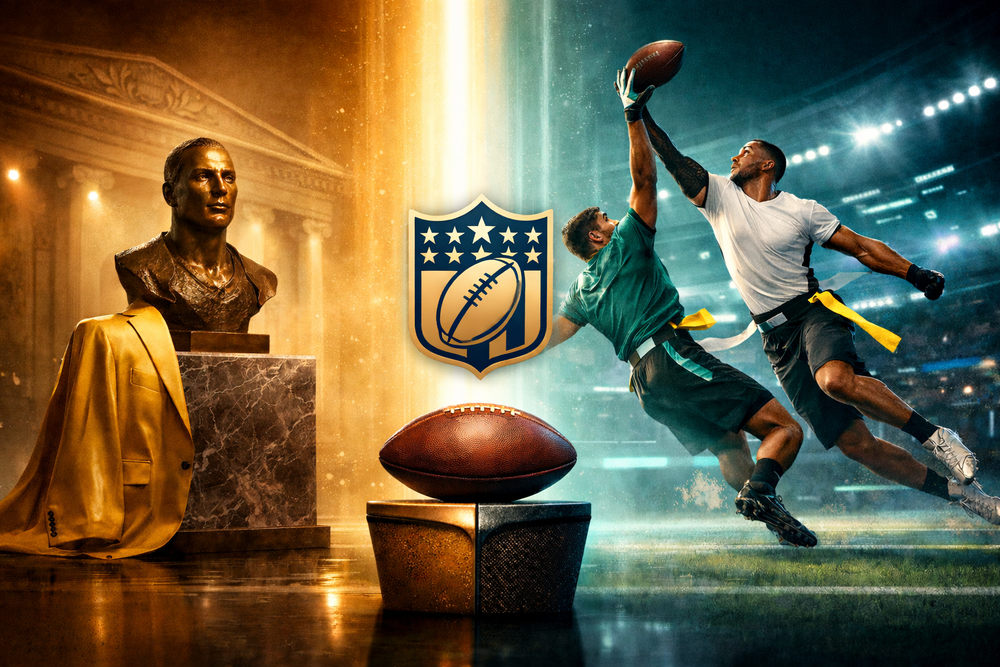
The Gold Jacket is the most visible symbol of Hall of Fame membership. Since 1978, every inductee has received a custom-made gold blazer during the Enshrinement ceremony, and they are often seen wearing it at official events. (Prior to 1978, inductees were given a generic blazer or no jacket at all; the switch to a standardized gold jacket was part of creating a distinct “uniform” for Hall members.) The clothing manufacturer Haggar has been the official producer of the Hall of Fame gold jacket for over four decades[45][46]. The particular shade of gold is proprietary – a closely guarded formula that is not a standard color available publicly and is meant to be unique to the Hall of Fame[47][48]. Interestingly, Haggar updated the jacket’s color around 2014 to a slightly deeper gold (tinged with red) to look better on high-definition television broadcasts[49]. This exemplifies how even the Hall’s traditions adapt to modern media. Each jacket is personalized with the inductee’s name and Hall of Fame induction number on an interior label, and the buttons bear the Hall’s crest[50]. Inductees are instructed to wear the jacket whenever they are representing the Hall or at official functions, and photos of non-Hall individuals wearing a Hall of Fame jacket are strictly forbidden[51]. The gold jacket, in sum, is both a status symbol and a unifying emblem – no matter the era or team, all Hall of Famers share the gold jacket.
Each inductee is also honored with a bronze bust, a one-of-a-kind sculpture of their likeness, which is unveiled during the induction ceremony. These busts are permanently displayed in Canton’s Hall of Fame gallery. Since the 1980s, sculptor Blair Buswell has created the majority of Hall of Fame busts, and he consults with each inductee on details (hair style, facial expression, etc.). The busts are significant in that they physically place the inductee among the pantheon of all-time greats. They remain on display long after the inductee has passed away, effectively granting a form of immortality in the Hall’s “gallery of busts.” One anecdote reflecting the personalization of the busts is that when cornerback Deion Sanders was inducted in 2011, Buswell even incorporated a sculpted bandana on Sanders’ bust (Sanders often wore a bandana under his helmet), the first time such an accessory was included, illustrating that the Hall allows creative liberty to capture a player’s persona.
Finally, since 1963 the Hall of Fame has issued an official Hall of Fame ring to each inductee (the design has varied over time, with major updates in recent decades). The current Ring of Excellence, produced by Kay Jewelers, is usually presented to inductees at a home stadium ceremony during the NFL season following their induction. The ring, jacket, and bust are collectively referred to by Hall officials as the “three icons” of membership[52]. They symbolize the honor (the jacket to wear, the ring as personal jewelry, the bust in the museum).
In the cultural sense, these symbols have meaning beyond the NFL: “Hall of Famer” becomes a permanent title of address for inductees, and they are often introduced with that honorific in all walks of life. The gold jacket in particular has taken on an aura; as one article noted, no other coat in sports quite has that significance, and the Hall of Fame even buried some deceased inductees in their jackets as a sign of eternal respect[47][53].
The NFL Pro Bowl: Evolution, Significance, and Challenges
Historical Overview of the Pro Bowl
The concept of an NFL all-star game predates the term “Pro Bowl.” The league’s first all-star exhibition can be traced back to 1938, when the NFL staged the “Pro All-Star Game” in Los Angeles, matching that season’s champion against a team of all-stars from the other teams[54]. This format (champions vs. all-stars) ran annually until 1942, then was discontinued during World War II[54]. After the war, the NFL revived an all-star game in a new form: starting with the 1950 season, the game we now know as the Pro Bowl began, featuring two teams of all-stars (initially named Eastern vs. Western Conference All-Stars, later AFC vs. NFC after the 1970 merger).
From 1951 through 1972, the Pro Bowl was held in Los Angeles every January, typically one week after the NFL Championship/Super Bowl (i.e., as a post-season finale)[55]. The location then rotated in the 1970s (with games in cities like Miami, New Orleans, etc., from 1973–1979). In 1980, the Pro Bowl found a long-term home at Aloha Stadium in Honolulu, Hawaii. For the next 30 straight years (1980–2009), NFL players regarded a Pro Bowl trip as a quasi-vacation honor – an all-expenses trip to Hawaii in the dead of winter to cap the season. The game was still played after the Super Bowl, so it did not conflict with the preparation of the Super Bowl teams (meaning, all selected players could theoretically participate, since their season was over).
This Hawaii era is often seen as the Pro Bowl’s golden age in terms of player participation and at least moderate competitiveness. Many stars happily showed up to mingle in Hawaii and play in a relaxed game. While the intensity was lower than a regular game, through the 1990s players still gave a reasonable effort (tackling, blocking, etc.), and memorable moments – like MVP performances or the late Sean Taylor’s famous hit on a punter in the 2006 Pro Bowl – occasionally occurred. In fact, the late 1990s saw an uptick in fan interest due to televised skill competitions such as the Quarterback Challenge, where top QBs competed in throwing drills, and strength challenges for other positions[56][57]. Such events added entertainment and drew viewers, complementing the game itself.
However, signs of trouble emerged by the early 2000s. As player salaries and awareness of injury risks grew, fewer players were inclined to treat the Pro Bowl like a real game. The turning point is often identified (perhaps apocryphally) as the 2007 Pro Bowl, when the late safety Sean Taylor delivered a highlight-reel level tackle on Bills punter Brian Moorman, knocking him off his feet. The hit was celebrated by fans (hungry for intensity) but reportedly spooked many players, who realized there was nothing at stake worth risking one’s body in an exhibition[58]. From that point on, players became noticeably more cautious. By the end of that decade, the gameplay had deteriorated to a “two-hand touch” style of play – a phrase actually used to describe the Pro Bowl in later years[59]. Defensive players would make only token efforts at tackles, and ball-carriers would go down or out-of-bounds with minimal contact to avoid injury[59].
Another major change came in 2010, when the NFL, in an effort to generate higher TV ratings, moved the Pro Bowl to the week before the Super Bowl (and held that year’s game in Miami, the Super Bowl host city)[60]. This break with tradition (playing before the championship) was significant: it meant that players from the two Super Bowl teams could no longer participate, since they were preparing for the Super Bowl (and were automatically replaced if selected). The NFL hoped that putting the Pro Bowl in the bye week before the Super Bowl would capture fans’ attention at a time with no other football, but it also further diluted the rosters and perhaps the appeal to players (since a trip to Hawaii after the season had been an incentive, whereas now it might be a quick detour before the Super Bowl). The Pro Bowl returned to Hawaii from 2011-2014 but continued to be scheduled the week before the Super Bowl.
By 2012, the situation reached an embarrassment: that year’s Pro Bowl game was widely criticized for “lack of quality play” – essentially, players going through motions with almost no blocking or tackling[61]. It was so egregious that Commissioner Roger Goodell said publicly that if the 2013 Pro Bowl didn’t show more effort, he was “not inclined to play it anymore”[61][62]. In response, the NFL Players Association pleaded to keep the game (players still valued the accolade and the free trip), and the league agreed but sought to revamp the format. Thus, in 2014, they dropped the familiar AFC vs NFC format and experimented with an “unconferenced” Pro Bowl: players were all pooled and two team captains (Hall of Famers) “drafted” the teams in a fantasy draft style[63]. This was tried for the 2014, 2015, and 2016 Pro Bowls, with notable retired stars (Jerry Rice, Deion Sanders, Michael Irvin, etc.) acting as figurehead captains. While novel, it had mixed results in generating fan excitement and did not notably improve the quality of play.
After 2016, the NFL reverted to AFC vs NFC format (for the 2017 game onward)[64], acknowledging that fans identify more with conference rivalries than arbitrary mixed teams. They also moved the location to Orlando, Florida (Camping World Stadium) from 2017–2020, ending the long association with Hawaii, partly to make it a more accessible event for fans and to try integrating it with Disney/ESPN (the game’s broadcaster) tourist opportunities.
Selection Process and “Nuances” of Pro Bowl Honors
The Pro Bowl selection process has its own complexities that distinguish it from the Hall of Fame. Pro Bowl rosters (typically about 44 players per conference in the traditional format) are determined by a three-part ballot: fans, players, and coaches each contribute one-third of the vote[65]. Since 1995, fan voting has been included (conducted online at NFL.com in modern times), giving the general public a direct voice in choosing all-stars. Prior to 1995, only players and coaches selected the Pro Bowl, which sometimes meant more nuanced peer evaluation; the introduction of fan voting turned it into a popularity contest to some degree, where fan bases could rally behind their favorites. Nonetheless, having players and coaches vote as well helps counterbalance pure fan sentiment, theoretically resulting in a consensus of who is most deserving.
Once the initial Pro Bowl rosters are announced (typically in December each year), a significant nuancecomes into play: alternate selections and replacements. Because the game occurs at the end of the season (or used to after the season, now just before the Super Bowl), many selected players end up not playing due to various reasons: injury, personal choice, or because they reach the Super Bowl (players in the Super Bowl are excused from the Pro Bowl and replaced). These vacancies are filled by the next-highest rated players at those positions (the voting process essentially creates a rank order). Over the years, this has led to dozens of additional players being dubbed “Pro Bowlers” each season as alternates.
The NFL’s official stance is that a player counts as a “Pro Bowler” for that season if and only if: (a) he was originally voted in, or (b) he was named as a replacement and accepted the invitation and participated. If an alternate is invited but declines, he is not credited as having made the Pro Bowl[66]. Also, if a player would have been an alternate but can’t play because he’s in the Super Bowl, he still gets credit (the NFL treats that as if he would have been invited)[66]. This technical definition matters for record-keeping and contract incentives. It has created odd scenarios, like a player with modest stats getting a Pro Bowl nod because many above him bowed out.
An extreme example that highlights the dilution of the honor was the 2016 Pro Bowl: that season saw an NFL-record 133 players ultimately named to the Pro Bowl roster at least as initial or replacement picks[67]. Essentially, what should be an elite group was nearly 25% of the league’s starters. In that year, so many star quarterbacks withdrew that the only QB originally voted in by fans who actually played in the game was Russell Wilson – big names like Tom Brady, Aaron Rodgers, and Ben Roethlisberger all skipped the game (some citing injury, others simple disinterest)[67]. Such mass drop-outs underscored that by the mid-2010s, for many top players, the Pro Bowl was not a priority; they preferred rest or avoiding injury risk to playing in a low-stakes exhibition.
The incentive structure for the game has always been limited: winners of the Pro Bowl receive a larger bonus than losers, but the amounts (on the order of $70,000 to winners per player in recent years, and about half that for losers)[68][69], while nice, are trivial to most star players who often make that per regular-season game or more. Thus, financial motivation to play hard is minimal. For many, the honor of being named is what matters, not actually appearing.
Pro Bowl selections (the accolade itself) still carry weight in legacy discussions and contract incentives. Being voted to multiple Pro Bowls can help a player’s Hall of Fame case, for instance, as it’s a proxy for being among the best in the league in a given year. Teams often give bonuses to players for making the Pro Bowl (e.g., $50k bonus for being selected), and some contracts escalate if a player makes several Pro Bowls. However, given the aforementioned alternate issue, sometimes a player who wasn’t top-three at his position can still say “I’m a Pro Bowler” because he was an alternate – which complicates using Pro Bowls as a strict performance metric.
The Decline of the Pro Bowl’s Competitiveness and Popularity
By the mid-2010s, public perception of the Pro Bowl had deteriorated. Fans on social media and sports radio mocked the game for its lack of tackling and seriousness. This culminated in the 2012 game that provoked Goodell’s threat to cancel the event entirely[61]. Although cancellation did not happen, that moment was effectively an acknowledgment that the Pro Bowl in its traditional form was broken.
From 2014-2016, experiments like the fantasy draft format tried to spice it up. While those games still had low intensity, they did produce some interesting mixed-conference teammate pairings and situations (which had novelty value). But ultimately they didn’t solve the fundamental issue: players did not want to risk injury, and fans could see the effort level was low. Television viewership for the Pro Bowl, while not zero by any means, saw a decline. In the early 2010s, the Pro Bowl could draw around 8–12 million viewers (often making it the most-watched all-star game of the big sports, surprisingly beating NBA or MLB some years), but by 2019-2020 the numbers fell to near 7 million, and in 2022 it reportedly hit a record-low that was down ~18% from the previous year[70]. In short, fans were tuning out.
Another aspect was player participation and substitution reaching farcical levels (as seen in 2016 with 133 participants total). By then, the label “Pro Bowler” had been watered down in fans’ eyes – many joked that “everyone ends up a Pro Bowler after all the replacements.” In 2016, for example, even a player with very modest season stats (like a third-string quarterback) might get an invite if enough others bowed out. This flurry of alternates was indeed at its peak that year, which one college newspaper writer called “the exodus of players opting out in 2016” leading to “nothing short of a steady decline in participation” thereafter[71].
The NFL tried to salvage the Pro Bowl’s relevance by increasing the integration of skill competitions. Starting around 2017, they formally added a “Pro Bowl Skills Showdown” a couple days before the game[72]. This included events like precision passing contests, relay races, dodgeball, and other light-hearted challenges. These events were moderately well-received, as they showed players having fun and displaying talents in a casual environment, and clips often went viral (for instance, Jarvis Landry’s impressive catches in a best-catch contest, or a big man catching punts, etc.). It was a step toward acknowledging that pure football simulation was not working.
Then came the COVID-19 pandemic, which caused the cancellation of the 2021 Pro Bowl game entirely (instead, the NFL did a virtual Madden videogame event with players and celebrities)[73]. By 2022, even the NFL’s top brass were openly questioning if the Pro Bowl game made sense anymore. Roger Goodell said in May 2022 that the Pro Bowl “doesn’t work” and that the league needed “another way to celebrate the players”[74]. Later in 2022, the NFL announced a sweeping overhaul: the traditional Pro Bowl game would be replaced by the “Pro Bowl Games” – a multi-day event culminating in a flag football contest instead of tackle football[75].
The Pro Bowl Games Era: Flag Football and Integration into Super Bowl Week
The first iteration of this new format took place at the end of the 2022 season (Pro Bowl held in early February 2023). During the 2023 Pro Bowl Games, players participated in skill challenges (e.g., precision passing, best catch, dodgeball, and even an obstacle course), and the week ended with a series of three flag football mini-games on Sunday[76][77]. Points earned from the contests during the week carried over to the flag games to determine an overall winner (AFC vs NFC)[78][79]. The hope was that without the risk of tackling, players would compete harder in a flag context. Indeed, some competitiveness was observed, though it was still clearly more lighthearted than a real game.
The reviews for the new format were mixed. On one hand, it was generally acknowledged that the flag football was more entertaining than the half-speed padless tackle football had been. It showcased players’ athleticism without pretense of physicality. On the other hand, some players still got hurt – e.g., Cleveland Browns star defensive end Myles Garrett dislocated a toe during one of the 2023 Pro Bowl mini-games[80]. Garrett subsequently said he would decline any future Pro Bowl invitations, and suggested the event needed even more fan engagement or changes if it were to continue[81][82]. Fans, too, gave ambivalent feedback: some enjoyed the novelty of seeing players in a casual environment, but many others echoed the sentiment of a student interviewed in one report: “It’s just silly… we want to watch real football. Just make it AFC vs NFC [with real football]”[83]. Another simply said, “I think it’s a waste of time…It should be gone.”[84][85]. TV ratings for 2023’s flag football Pro Bowl remained relatively low, continuing the downward trend and ranking outside the top 10 Pro Bowls since 2000[86].
Amid these developments, the NFL made another bold move: starting with the upcoming 2026 Pro Bowl Games, the league will integrate the Pro Bowl into the Super Bowl week festivities. Announced in late 2025, the plan is for the Pro Bowl Games to be held in the Super Bowl host city (in 2026, San Francisco) on the Tuesday before the Super Bowl[87]. The 2026 Pro Bowl will thus take place on February 3, 2026, at the Moscone Center in San Francisco, as part of the NFL’s “Super Bowl Experience” fan event[88][89]. This means the Pro Bowl will no longer be a standalone weekend or in a separate destination; it will be folded into the media and fan frenzy of Super Bowl week. The event will be scaled to a television production inside a convention center, focusing on a prime-time flag football game between AFC and NFC all-stars, surrounded by the various skill contests[90]. The NFL’s logic is to make it a “must-see TV event” and to spotlight flag football – which will debut as an Olympic sport in 2028 – on its biggest stage[89][91]. By doing this on Tuesday, they avoid clashing with the later-week serious Super Bowl prep and can use the presence of many media and fans already in town for Super Bowl.
This integration could address some challenges (e.g., attendance for the Pro Bowl in person might be easier to secure when lots of fans are in town for the Super Bowl events; also, it keeps players more interested as part of the big week’s festivities). However, it also tacitly admits that the Pro Bowl on its own could not sustain interest. The league has essentially transformed the Pro Bowl from a competitive sporting event into a corporate entertainment and marketing showcase during Super Bowl week.
It remains to be seen if this new approach will stabilize the relevance of the Pro Bowl. The NFL has stated it is committed to keeping a form of all-star recognition, partly because being voted to the Pro Bowl still matters to players (contracts and legacies), and it’s a way to honor excellence each season. But the “game” as people knew it is gone, replaced by something more akin to an exhibition pageant of football skills.
Significance of Pro Bowl Selections vs. All-Pro Honors
In discussions of player achievements, it’s worth distinguishing the Pro Bowl from the All-Pro team. The Pro Bowl, as detailed, is a popularity and peer honor with large rosters and conference-based selections. In contrast, “All-Pro” typically refers to a much more exclusive honor (for example, the AP First-Team All-Pro) that designates the single best player at each position in the entire league in a given season. All-Pro teams are chosen by select panels of media or experts and do not involve fan voting. Many analysts consider All-Pro selections a more accurate barometer of true excellence (since you could be the second-best quarterback in the conference and go to the Pro Bowl, whereas only the top one or two QBs in the league might be All-Pro).
However, casual fans and even Hall of Fame resumes often cite Pro Bowl numbers. A player with, say, 10 Pro Bowls is undoubtedly seen as having had a consistently elite career. That being said, as the Pro Bowl has added so many alternates, some long streaks or high totals might be padded by a few lower-tier inclusions. For instance, a player might boast “5-time Pro Bowler” on his resume when a couple of those came as injury replacements.
The NFL’s recent changes may actually help refocus the conversation: by de-emphasizing the game itself, the honor of being named a Pro Bowler can stand separately. In the future, it’s conceivable the league might pivot to just naming a “Pro Bowl roster” (all-star team) each year and skip the exhibition entirely, if the current format doesn’t pan out. This would be analogous to how the NFL in 2020 still named a Pro Bowl roster even though the game was canceled by COVID[73]. The players still appreciated the nod, and fans still saw who was considered the best.
Conclusion
The Pro Football Hall of Fame and the NFL Pro Bowl represent two pillars of how the NFL recognizes excellence, yet they operate on vastly different principles and face distinct challenges in the modern era. The Hall of Fame is about historical immortality – a retrospective honor that is scarce, prestigious, and meant to be untouched by fleeting controversy (though, as seen with the 2026 Belichick incident, not immune to it). Its selection process, while often criticized for opacity or subjectivity, is a serious, deliberative affair that shapes the narrative of NFL history. Induction into the Hall has profound personal and economic implications for those enshrined, and the institution grapples with maintaining integrity and relevance as the sport’s history grows exponentially.
The Pro Bowl, conversely, is (or was) about immediate recognition – a way to celebrate the current season’s standout players in a fun setting. Its struggle has been to remain meaningful in a sport that is unsuited to low-stakes exhibition play. Over the decades, what was once a competitive game has transformed into a made-for-TV spectacle emphasizing player personality and skills more than win-loss or conference pride. The NFL’s willingness to overhaul the Pro Bowl – including turning it into a flag football event and moving it to the Super Bowl week – indicates that the league is prioritizing the celebration aspect (and perhaps ratings and sponsor content) over the traditional game format. In essence, the Pro Bowl has shifted from an athletic contest to a promotional entertainment product.
Despite their differences, there are some parallels. Both the Hall of Fame and Pro Bowl involve a selection process that mixes quantitative performance with qualitative judgment (media and peer votes). Both have been forced to address questions of fairness and credibility – the Hall in terms of who gets in and why (and whether personal biases play a role), and the Pro Bowl in terms of whether the honor means what it used to. Both are also reflections of the times: as the NFL grows and changes, so do its institutions of honor.
One could argue that the Hall of Fame stands somewhat as the antithesis of the Pro Bowl’s recent devolution. The Hall is exclusive, and getting more exclusive (with new voting rules limiting classes), and attaches great weight to legacy. The Pro Bowl was inclusive to a fault (with dozens of players rotating in) and, until reforms, was losing weight as a measure of talent. Now, with Pro Bowl selections divorced from an actual tackle game, it might regain some prestige as simply an “All-Star” designation, but it remains to be seen if players and fans will care about the pageantry in the long run.
In conclusion, the NFL’s twin honors – one for the best ever, one for the best now – continue to be integral to the sport’s culture, but each must continuously adapt. The Hall of Fame must guard against internal politics eroding its legitimacy and find ways to honor more of the game’s contributors without diluting its honor. The Pro Bowl must find a format that captures fan interest and player enthusiasm in an era where the traditional game no longer works. Both endeavors show that celebrating excellence in a violent, team-oriented sport is a complex task requiring balancing respect for the game’s competitive integrity with the realities of entertainment and human nature.
References:
Associated Press. “How are the inductees selected for the Pro Football Hall of Fame?” FOX Sports (Jan. 28, 2026)[92][16][18][8][9].
Associated Press. Hall of Fame Selection Committee Composition and Voting Process, via Boston.com (Jan. 28, 2026)[1][4].
Associated Press. Changes in Hall of Fame Voting Rules (2025), via FOX Sports (Jan. 28, 2026)[5][7].
Mike Florio. “Pro Football Hall of Fame threatens removal of voters for violation of bylaws.”ProFootballTalk, NBC Sports (Jan. 28, 2026)[19][23].
Jonathan Jones. “O.J. Simpson’s Hall of Fame spot ... Hall has no removal process.” CBS Sports (Apr. 11, 2024)[26][25].
Paul Rudder. “The reason why O.J. Simpson wasn’t removed from the Hall of Fame.” AS.com (Apr. 12, 2024)[27].
Reuben Frank. “Terrell Owens’ Hall of Fame snub unfair backlash for attitude.” NBC Sports Philadelphia (Feb. 5, 2017)[30][31].
John McClain. “On the NFL: Strahan faces stiff competition on 2013 Hall ballot.” Houston Chronicle (Aug. 3, 2012)[44].
Will Brinson. “Eric Dickerson thinks Hall of Fame players deserve $300K salary.” CBS Sports (Sep. 19, 2018)[38][41][43].
Sports Collectors Digest. “The Hall of Fame Factor.” (2010)[36].
Sam Carus. “OT: The NFL Pro Bowl continues to flounder.” The Butler Collegian (Jan. 30, 2024)[54][67].
NFL Communications. “2026 Pro Bowl Games moved to Tuesday of Super Bowl week in Bay Area.” NFL Operations Update (Oct. 22, 2025)[89][90].
Wikipedia. “Pro Bowl” – History and Rules (accessed 2026)[61][59][65][66].
AwfulAnnouncing.com. “Pro Bowl hits record-low as NFL struggles to find format.” (Feb. 2022)[70].
ESPN.com News Services. “Group of Hall of Famers demand health insurance and salaries.” (Sep. 18, 2018)[39][42].
[1][2][3][4][5][6][7][8][9][10][11][12][13][14][15][16][17][18][92] How are the inductees selected for the Pro Football Hall of Fame? | FOX Sports
[19][20][21][22][23][24] Pro Football Hall of Fame threatens removal of voters for violation of bylaws - NBC Sports
[25][26][28][29][35] O.J. Simpson's Hall of Fame spot may be assured, but there's no rule against some context - CBS Sports
[27] The reason why O.J. Simpson wasn’t removed from the Pro Football Hall of Fame - AS USA
https://en.as.com/nfl/the-reason-why-oj-simpson-wasnt-removed-from-the-pro-football-hall-of-fame-n/
[30][31][32][33][34] Terrell Owens’ Hall of Fame snub unfair backlash for attitude during career – NBC Sports Philadelphia
[36][37] The Hall of Fame Factor - Sports Collectors Digest
[38][39][40][41][42][43] Eric Dickerson thinks Hall of Fame players deserve $300K salary from NFL for playing days - CBS Sports
[44] On the NFL: Strahan faces stiff competition on 2013 Hall ballot
[45][46][47][48][49][50][51][53] Pro Football Hall of Fame's gold jacket stands as strong symbol
[52] Class of 2020 Gets First Look at Their Gold Jackets
https://www.profootballhof.com/news/2021/04/class-of-2020-gets-first-look-at-their-gold-jackets/
[54][55][56][57][58][67][71][76][77][78][79][80][81][82][83][84][85][86] OT: The NFL Pro Bowl continues to flounder | The Butler Collegian
https://thebutlercollegian.com/2024/01/ot-the-nfl-pro-bowl-continues-to-flounder/
[59][60][61][62][63][64][65][66][68][69][72][73][74][75][87] Pro Bowl - Wikipedia
https://en.wikipedia.org/wiki/Pro_Bowl
[70] Pro Bowl hits record-low as NFL struggles to find successful format
https://awfulannouncing.com/nfl/pro-bowl-hits-record-low-struggles-find-successful-format.html
[88] Super Bowl LX Week Events - Bay Area Host Committee
https://www.sfbayareasuperbowl.com/super-bowl-lx-events
[89][90][91] 2026 Pro Bowl Games Presented by Verizon Moved to Tuesday of Super Bowl LX Week in Bay Area | NFL Football Operations