The Florida State League and the Architecture of Modern Player Development: A 2026 Strategic Analysis
The professional baseball landscape in 2026 represents a sophisticated convergence of data-driven player development, localized commercial branding, and a restructured minor league hierarchy. At the epicenter of this evolution lies the Florida State League (FSL), a Single-A circuit that serves as the primary gateway for amateur talent transitioning into the rigors of professional play. Within this league, Roger Dean Chevrolet Stadium in Jupiter, Florida, occupies a unique position as the only facility in North America to host two Major League Baseball (MLB) Spring Training teams—the Miami Marlins and St. Louis Cardinals—and their respective Single-A affiliates, the Jupiter Hammerheads and the Palm Beach Cardinals. This report examines the historical, structural, and professional dynamics of the FSL from the perspective of an MLBPA Pending Agent, focusing on the 2026 season's opening festivities, the branding shift of the Palm Beach Frozen Iguanas, and the intricate journey of a player from the draft to the Major Leagues.
Historical Evolution and the Strategic Value of the Florida State League
The Florida State League was established in 1936, and for nearly a century, it has acted as a crucible for the sport's most promising talent. Historically, the league was characterized by its "Class A Advanced" or "High-A" status, but the 2021 restructuring of Minor League Baseball (MiLB) by Major League Baseball saw the FSL re-designated as a Single-A (formerly Low-A) circuit. This shift was not merely nomenclatural; it signaled a strategic pivot in how organizations utilize the Florida geography. By placing their youngest domestic professional talent in Florida, teams can leverage year-round access to state-of-the-art training complexes, mitigate travel fatigue, and maintain close organizational oversight.
The league's historical significance is deeply intertwined with the social progress of the game. Jackie Robinson Ballpark in Daytona Beach remains a cornerstone of the league, serving as a reminder of the FSL's role in the integration of professional baseball. In the modern era, the league continues to be a site of institutional milestones, such as the 2022 appointment of Rachel Balkovec as the manager of the Tampa Tarpons, the first female manager in the history of affiliated professional baseball.
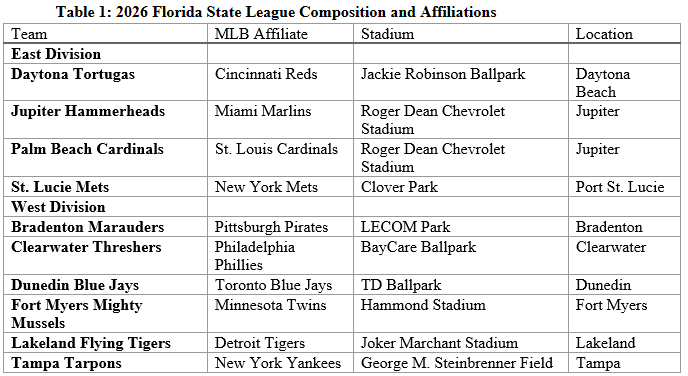
The 2026 season consists of 132 games, a schedule designed to simulate the daily grind of the Major Leagues while providing Monday off-days for physical recovery and technical instruction. This balance is essential for Single-A players, many of whom are experiencing their first 140-day professional season after graduating from the shorter schedules of high school or college baseball.
The Roger Dean Stadium Nexus: Dual-Affiliate Dynamics
Roger Dean Chevrolet Stadium represents a logistical and developmental marvel. The facility is the only one in the Minor Leagues to host two teams simultaneously in the same league: the Jupiter Hammerheads and the Palm Beach Cardinals.For an agent, this facility offers a unique "one-stop" scouting opportunity, where the developmental philosophies of the Miami Marlins and the St. Louis Cardinals can be observed in parallel.
The culture of the stadium is defined by its perpetual activity. During the Spring Training window, the facility is shared by the MLB parent clubs, allowing Single-A prospects to witness the professional routines of established stars. As the season transitions to April, the stadium becomes the home of the Hammerheads and Cardinals, who alternate home stands to ensure a consistent schedule of professional baseball for the Jupiter community.
The Palm Beach Frozen Iguanas: Commercial Innovation in Single-A
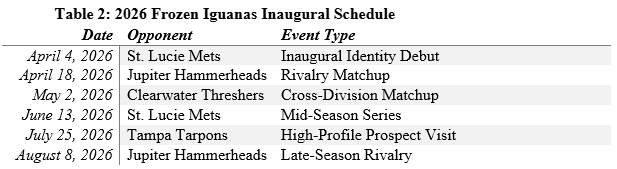
A significant development for the 2026 season is the launch of the "Palm Beach Frozen Iguanas," the first-ever alternate identity for the Palm Beach Cardinals. This rebrand, presented by the South Florida-based removal company IggyTrap, will be featured on 12 home Saturday games throughout the season. The identity is rooted in the local South Florida phenomenon where iguanas, which are cold-blooded reptiles, enter a dormant, "frozen" state and fall from palm trees when temperatures drop below 50 degrees Fahrenheit.
This branding exercise is more than a marketing gimmick; it represents a sophisticated attempt by the Cardinals organization to deepen its roots in the local community and drive merchandise revenue through "South Florida specific" storytelling. From an agent’s perspective, these alternate identities provide players with early exposure to the commercial and promotional side of professional sports, an increasingly important aspect of a player's "brand" in the era of social media and individual marketability.
The Mechanism of Assignment
From the Draft to Jupiter
The process by which a player is assigned to the Jupiter Hammerheads or the Palm Beach Cardinals is a function of organizational philosophy, draft position, and perceived maturity. In the modern MLB developmental hierarchy, there are five primary domestic levels: Rookie, Single-A, High-A, Double-A, and Triple-A.
The Entry Points: High School vs. College
Players drafted out of high school typically begin their professional journey in the Rookie-level Florida Complex League (FCL), where they can adjust to the speed of professional pitching without the pressure of a full-season schedule. Conversely, players drafted out of major college programs—often referred to as "polished" prospects—are frequently assigned directly to Single-A or even High-A to begin their careers.
The assignment to the Jupiter Hammerheads (Marlins) or Palm Beach Cardinals (Cardinals) signifies that an organization believes a player is ready for "full-season" ball. This means they possess the physical durability to play nearly every day for five months and the mental fortitude to handle the inevitable failures that come with a 132-game season.
Promotion and the Path to the Majors: The Marlins Blueprint
The journey from Single-A to the Major Leagues is rarely a straight line. Organizations utilize a "ladder" system, where players must reach specific developmental markers—such as walk-to-strikeout ratios for hitters or secondary pitch command for pitchers—before earning a promotion.
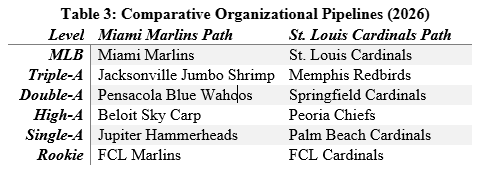
For the Miami Marlins, the path is geographically concentrated. After Jupiter, prospects often move to High-A Beloit before returning to Florida to play for the Pensacola Blue Wahoos (Double-A) and the Jacksonville Jumbo Shrimp (Triple-A). The proximity of these affiliates allows the Marlins' front office to maintain close communication with coaching staffs and ensures that prospects are acclimated to the Florida climate, which is vital for stamina and performance.
The "40-Man" Milestone and Player Options
As players ascend, they eventually face the "40-man roster" hurdle. When a player is added to the 40-man roster, they are protected from the Rule 5 Draft but become subject to "Minor League Options". Each player on the 40-man roster typically has three option years, which allow the MLB club to move them between the Major and Minor Leagues without subjecting them to waivers. Understanding these "options" is a critical part of an agent's duty, as it impacts a player's service time, earning potential, and career longevity.
Notable Marlins Alumni: The Jupiter Legacy
The Jupiter Hammerheads have been the starting point for some of the most iconic players in Marlins history. The ability of the Marlins to develop high-end talent in Jupiter is a testament to the facility and the organization’s specialized coaching staffs.
Miguel Cabrera: Before becoming a Triple Crown winner, Cabrera was a young prospect in the Marlins' system, honing his craft in the Florida State League.
Giancarlo Stanton: Stanton’s legendary power was first showcased to professional scouts during his time in Jupiter.
Christian Yelich: Yelich’s elite contact skills and athleticism were evident as he progressed through the Hammerheads roster.
José Fernández: The late, great right-hander dominated the FSL in his brief stint with the Hammerheads before his rapid ascent to the Major Leagues.
Other notable alumni include Dontrelle Willis, Josh Johnson, and Chris Coghlan, all of whom played significant roles in the Marlins' competitive history.
A Day in the Life: The Single-A Professional Routine
The reality of life in the Florida State League is often a stark contrast to the glamour of the Major Leagues. For a Single-A player, the day is structured around incremental improvement and physical maintenance.
The Home Game Routine
A typical home game day at Roger Dean Chevrolet Stadium begins in the late morning or early afternoon:
Morning Conditioning (10:00 AM - 12:00 PM): Players often engage in individual workouts, strength training, or agility drills. Pitchers may throw bullpen sessions or participate in "Pitchers Fielding Practice" (PFP).
Clubhouse Arrival (1:30 PM - 2:30 PM): Arrival at the stadium. Players change into practice gear and meet with coaching staff to review scouting reports on that day's opponent.
On-Field Practice (3:00 PM - 5:00 PM): Batting practice (BP) is the centerpiece of the afternoon. Hitters take rounds on the main field, while coaches monitor mechanics and exit velocities. This is followed by defensive drills and infield/outfield practice.
Pregame Meal and Mental Prep (5:00 PM - 6:30 PM): Players retreat to the clubhouse to eat, hydrate, and mentally prepare. This time is often used for video study of the opposing pitcher's tendencies.
Game Time (7:00 PM - 10:00 PM): The 132-game season is a test of consistency. Players are expected to maintain high effort levels despite the heat and the cumulative fatigue of the summer.
Post-Game Recovery (10:00 PM - 11:30 PM): Post-game meals, ice baths, and sessions with the training staff. Players often do not leave the stadium until nearly midnight, only to return approximately 12 hours later for the next day's work.
The Travel Grind: Bus Culture and Logistics
Unlike the private charters of the Major Leagues, FSL teams travel via bus. While Florida's geography keeps these trips relatively short—typically under four hours—the frequency of travel adds a layer of complexity to a player's recovery. Teams often travel late at night following a series finale to ensure they arrive in the next city for an off-day or the start of a new series.
The MLBPA Agent's Perspective: Strategy and Advocacy
As an MLBPA Pending Agent, my role involves navigating the economic and professional hurdles of the minor league experience. The representation of minor league players changed fundamentally in 2022 when they voted to join the MLBPA, leading to a centralized CBA that addresses wages, housing, and nutrition.
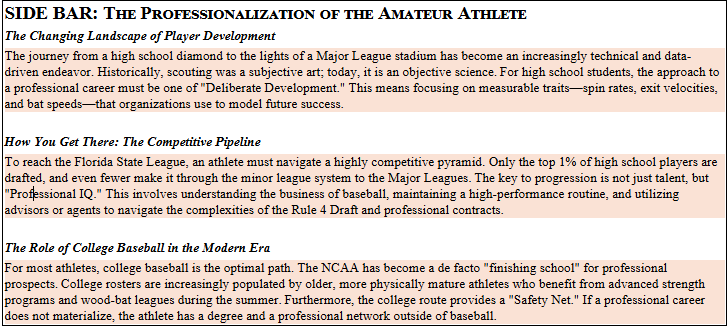
Representing the Amateur: Draft vs. College
When advising high school players, the primary consideration is "Signability." Organizations use a player's "College Commitment" as leverage during negotiations. If a player is a high-round talent with a strong commitment to a top-tier university, they have the leverage to demand a higher signing bonus.
The Signing Bonus Rule: As an agent, I emphasize that a signing bonus is more than just money; it is "Organizational Investment." A player who signs for $1 million will inherently receive more developmental opportunities and a longer "leash" than a 30th-round pick who signs for $10,000.
The NIL Variable: In 2026, the rise of Name, Image, and Likeness (NIL) collectives in college baseball has provided amateur players with a viable alternative to the low-level minor league grind. A player may find it more beneficial to attend a university, earn an education and NIL income, and re-enter the draft as a more polished, higher-valued prospect after three years.
Conclusions and Recommendations
The 2026 Florida State League season exemplifies the sophisticated infrastructure of modern professional baseball. From the dual-hosting culture of Roger Dean Chevrolet Stadium to the creative branding of the Palm Beach Frozen Iguanas, the league is no longer just a developmental outpost; it is a high-visibility platform for the sport's next generation.
For the professional observer and the athlete alike, the FSL represents a unique intersection of challenge and opportunity. The 132-game schedule serves as a physical and mental filtration system, identifying those with the durability for the Major League level. 1 As an agent, the recommendation for any young athlete is to embrace the "Single-A Grind" as a necessary professional maturation period. Understanding the logistics of assignment, the mechanics of promotion, and the commercial realities of the game is as vital as mastering the curveball or the inside-out swing. The road to the Major Leagues is paved with the humidity and the dust of the Florida State League, and the 2026 season in Jupiter is set to be one of the most revealing in recent memory.