MLB International Signing Period Explained: Buscones, Bonuses, and Bad Deals
Summary
This blog explores the emotional and complex world of the Major League Baseball International Signing Period, focusing on the experiences of young prospects who are on the verge of life-changing contracts. It delves into the cultural, economic, and personal dimensions of global amateur recruitment, highlighting the mix of joy, pressure, and uncertainty that defines the process for players, their families, and those who guide them. The narrative provides insights for fans and participants alike, serving as both a guide and a reflection on the hopes and realities of international baseball signings.
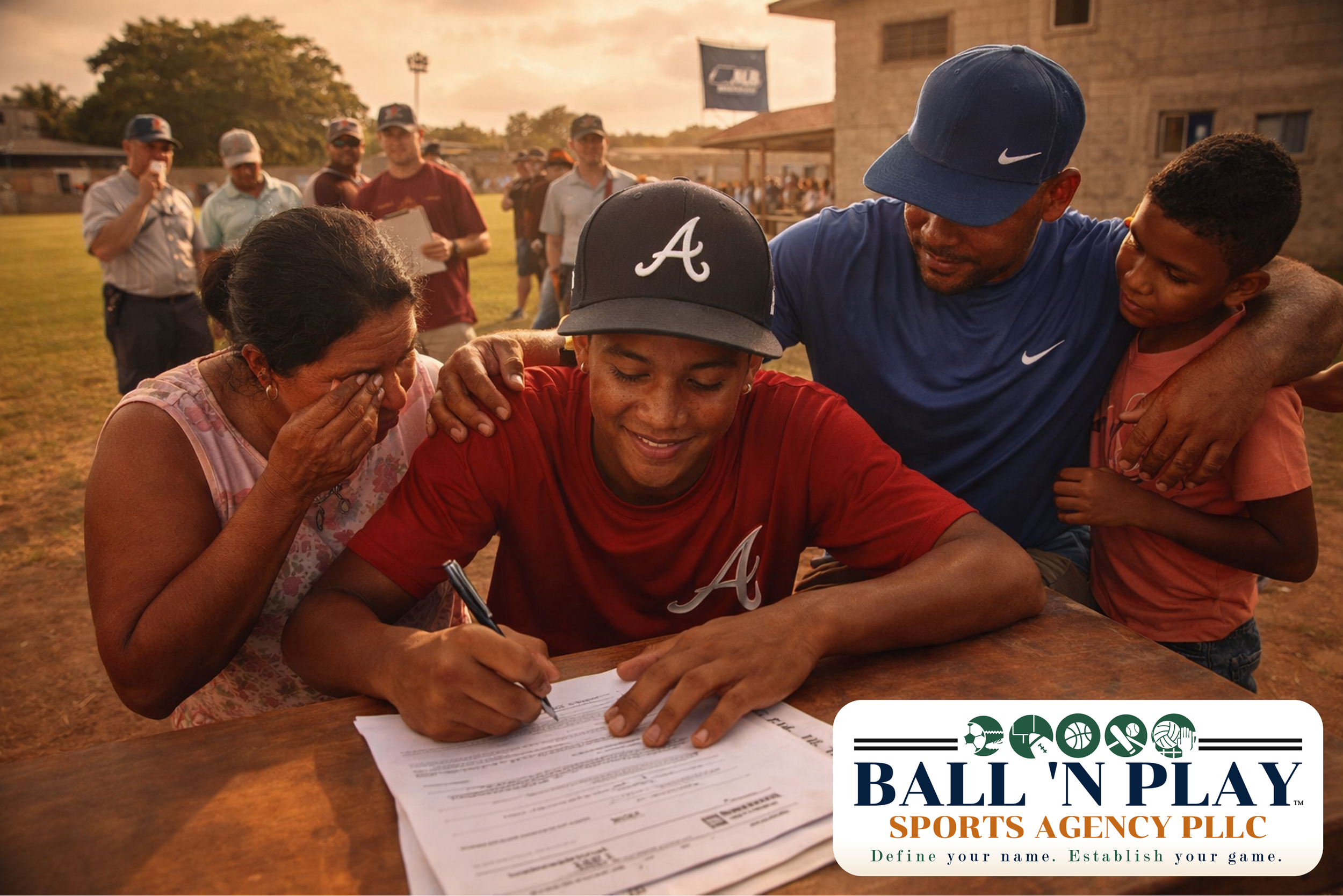
Imagine being 16. You have not seen your mother in months because you have been living at a trainer’s academy three towns over. On January 15th, you will sign a piece of paper that gives you more money than your entire neighborhood has seen in a decade.
It is a moment of immense pressure but also profound joy. When you see these kids wearing oversized MLB caps on signing day, crying and hugging their buscones, remember this is not just about "prospect capital." It is about a kid who spent ten years hitting rocks with a broomstick, finally reaching the mountaintop. It is goofy, it is grand, and it is glorious.
Greetings, my fellow aficionados of the diamond and seekers of sesquipedalian wisdom! As we stand on the precipice of January 15, 2026—a date etched in the firmament of baseball history as the opening of the Major League Baseball International Signing Period—I find myself overcome with a peculiar blend of scholarly fervor and goofy, sweet enthusiasm.
Gather 'round, for we are about to untangle the grand, Byzantine tapestry of global amateur recruitment. It is a world of million-dollar handshakes, shadowy trainers, and the palpable, heart-thumping dreams of sixteen-year-olds from Santo Domingo to Maracaibo.
The MLB international signing period is baseball’s most misunderstood marketplace: part scouting combine, part global recruiting pipeline, part high-stakes family decision… and sometimes, unfortunately, part cautionary tale.
If you are a fan trying to understand why 16-year-olds are “committed” years in advance, why teams obsess over bonus pool math, or why the word buscón can mean “mentor” in one sentence and “red flag” in the next—this is your map.
And if you are a player, parent, coach, trainer, or agent? This is your survival manual.
THE GREAT INFLUX: DEFINING THE PHENOMENON
In the simplest of terms (which I shall immediately complicate with unnecessary vocabulary), the International Signing Period is the annual window wherein MLB clubs are permitted to sign amateur players residing outside of the United States, Canada, and Puerto Rico. While domestic lads are funneled through the rigid structure of the Rule 4 Draft, our international friends exist in a Free Market Ecosystem. Well, a "free" market that is strictly capped, heavily scrutinized, and governed by "handshake deals" that often occur. So instead of entering the MLB Draft, these players can sign minor league contracts with MLB organizations during a designated window.
THE SIGNING PERIOD
The signing period runs January 15 through December 15 each year. Traditionally known as "J2" (for July 2nd), the date was shifted to January 15th a few years back with the 2020-2021 pandemic class, and the date shift was kept to better align with the academic calendars of Latin American nations and to give the league more time to investigate the... ahem... creative accounting sometimes found in these contracts.
ELIGIBILITY (THE AGE RULES MATTER)
A player is eligible to sign during the period if:
They turn 16 before signing, and
They turn 17 before September 1 of the following year, and
They are registered with MLB in advance.
This is why you will see signing classes described by birthdate ranges. MLB is very specific about it.
THE AGENT’S ANGLE: THE “90-DAY REGISTRATION” PRECIPICE
Now, for my fellow representatives of the athletic elite—this is the "Sweet & Sour" reality of the trade. I just mentioned that a player is eligible to sign during this period if they are registered with the MLB in advance – this is the 3-month rule, and oh, what a bureaucratic beast it is!
In the ISP universe, an international player must be officially registered with MLB at least 90 days (3 months) before the signing period begins. If you, as an agent, find a 100-mph throwing unicorn in November, you are already too late for the January 15th sweepstakes.
The Peril: If the registration paperwork—which includes identity verification (no more "creative" birth certificates, please!) and medical clearances—is not filed 90 days out, that player becomes a "Ghost of the Sandlot."
The Representation Trap: For an agent to have their commission and status as the "Agent of Record" recognized during the bonus payout, the paperwork must be pristine. If the agent has not been "on the books" for those 90 days, the team might legally be unable to cut the agent their slice of that sweet, sweet signing bonus pie.
THE MONEY: BONUS POOLS, HARD CAPS, AND SPREADSHEET WARFARE
Unlike MLB free agency—where an owner can decide to go full cartoon-villain and pay $300 million—international amateur signings are controlled by international bonus pools.
Each team gets a set amount of bonus money it can spend on international amateurs during that signing year.
Key rule: it is a hard cap
Teams cannot exceed their allotment by paying a tax. There is no “oops, we went over—here’s a penalty check.” It is a ceiling.
Teams can trade for bonus pool space, but:
Trades occur in $250,000 increments, and
A team can acquire no more than 60% of its original pool via trades
That 60% limit matters because it prevents the richest teams from simply buying the entire market every year.
Now there is a $10,000 rule (the sneaky detail people miss): Bonuses of $10,000 or less do not count against the bonus pool. This matters because it creates a “micro-market” for overlooked players and late bloomers.
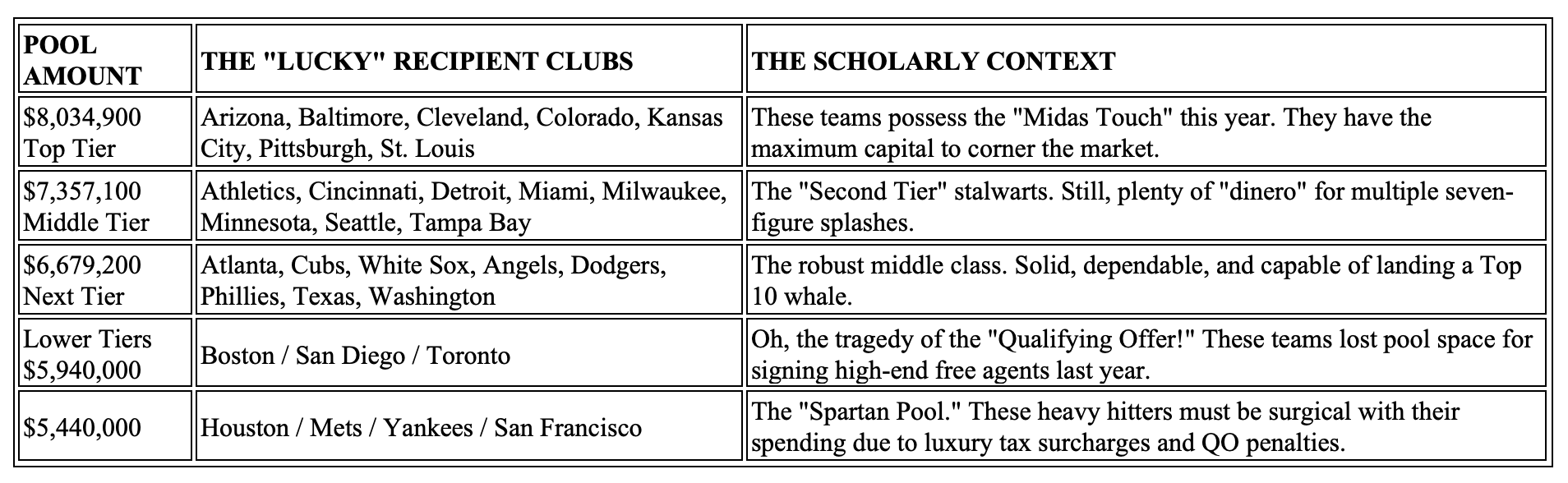
The Fiscal Architecture: The Five Tiers of the Bonus Pool
In the world of the International Signing Period (ISP), "Fairness" is enforced via a tiered system of Hard Caps. Unlike the luxury tax in the majors, these are not "suggestions"—if you spend a penny over your allotted pool, the Commissioner’s office will descend upon you like a swarm of pedantic hornets.
According to the latest scrolls (and Baseball America’s meticulous tracking), the 2026 pools are divided as such:
©2026 Ball 'N Play™ Sports Agency PLLC
Important Note for the Nerdy: Any player signed for $10,000 or less is considered "Pool Exempt." They are essentially a free gift from the baseball gods! Also, teams can trade for more pool space in increments of $250,000, but they can only acquire a maximum of 60% of their original allotment.
Why it matters: teams with smaller pools tend to:
target one big-ticket prospect + several smaller signings, or
spread money across a “volume” class, or
trade for pool space (if they can find a partner).
“TOP PROSPECTS” - WHO EVERYONE IS WATCHING IN THE 2026 CLASS
Every year MLB Pipeline releases a Top 50 international prospects ranking tied to the upcoming signing period. (MLB.com) so If you want to sound like a genius at the water cooler, memorize these names before the ink dries on the 15th:
1. Luis Hernandez, SS (Venezuela) – San Francisco Giants: The crown jewel. Baseball America raves about his "preternatural bat speed." He is the reason the Giants do not mind having a smaller pool—they are spending the lion’s share on this future star.
2. Francisco Renteria, OF (Venezuela) – Philadelphia Phillies: Standing 6’3” with a frame that suggests "future home run king." He is a physical specimen whose exit velocity makes scouts weep with joy.
3. Wandy Asigen, SS (D.R.) – New York Mets: Originally linked to the Yankees (the drama!), he has reportedly flipped to the Mets. He is a defensive wizard with a left-handed swing that looks like it was choreographed by a Renaissance master.
4. Angeibel Gomez, OF (Venezuela) – Kansas City Royals: A five-tool threat who could be a 30-30 player if the winds of destiny blow in his favor.
5. Johenssy Colome, SS (D.R.) – Athletics: Bloodlines matter! He plays with the savvy of a 10-year veteran despite being a literal child.
Two important notes:
These rankings are scouting-driven, not guarantees.
“Commitments” reported before Jan. 15 are often agreements in principle—the ink becomes real on signing day.
If you want the cleanest “who’s who,” MLB’s prospect hub is the easiest way to track the ranking over time.
WHAT IS A BUSCÓN? (AND WHY THIS WORD IS SO LOADED)
In the Dominican Republic (and in various forms elsewhere), buscones are independent trainers/handlers who find, develop, and market young players—often starting when the kids are very young.
A buscón might:
run a private academy,
provide coaching, nutrition, exposure, equipment,
connect players to scouts, showcases, and MLB teams,
take a negotiated cut of the signing bonus as compensation.
That last part is the flashpoint: some reports describe buscones taking substantial percentages, especially where families lack resources or bargaining power.
Why the system draws scrutiny
There is a long history of concerns in the international market: corruption, identity/age fraud, improper payments, and exploitation risks. Investigations and reporting have periodically spotlighted how messy the ecosystem can get when big money meets young age and limited oversight.
Reality check: “Buscón” is not automatically “villain.”
Many trainers are doing legitimate development work in places where baseball infrastructure is not funded the way it is in the U.S. The problem is the power imbalance: if the player is 15 and the adults control access, the deal dynamics can get ugly fast.
So basically, the Buscone is the most polarizing figure in this narrative. On one hand, they provide the nutrition, equipment, and coaching that impoverished families cannot. On the other, they are profit-seeking entities who might take 30–50% of a kid's signing bonus. It is a complicated, symbiotic dance—at once sweet (the paternal bond) and shadowy (the "bad deal" where a player is signed for peanuts while the trainer gets the steak).
HOW DEALS REALLY HAPPEN: THE “EARLY COMMITMENT” MACHINE
Fans often hear: “This kid is expected to sign with Team X for $Y million.” And then the natural question is: How is that even allowed if the signing period has not opened?
Here is the honest answer: the market operates on early verbal agreements, sometimes years before official signing day. Teams scout and develop relationships early; trainers/academies showcase early; families hear numbers early; and the “commitment” becomes a placeholder for what should happen when the window opens.
That is also why the system is controversial: handshake economies are vulnerable to pressure, misinformation, and opportunism.
The Bad Deals: Where People Get Burned (and How to Spot It)
Let us get painfully practical. The biggest “bad deal” categories are usually:
1. Bonus skimming and hidden compensation structures
If a player signs for $500,000 but only sees $250,000 after “fees,” “repayment,” “academy costs,” and “commissions” … somebody negotiated the wrong contract (or did not negotiate at all).
Red flags:
vague trainer agreements (“we will be compensated fairly”)
no written accounting of expenses
“loans” that magically become permanent claims on the bonus
2. Paperwork problems: age/identity/document issues
Age and identity fraud has been a recurring problem in some pipelines, and it can wreck a player’s career before it begins.
Red flags:
anyone suggesting “fixing” documents
inconsistent records, name spellings, birth certificates
pressure to avoid independent verification
3. Verbal promises with no safety plan
Because many “commitments” are informal, a player can be left exposed if:
the team changes strategy,
the pool money gets traded,
a new front office arrives,
a surprise signing candidate enters the market.
This is not theoretical. Even international pools can get distorted when unusual players enter the system—like how certain foreign professionals can be treated as “international amateurs” due to MLB rules, potentially pulling money away from teenage classes.
4. “Package deals” that sacrifice the player’s value
Sometimes a team spreads money across an academy class, and the top player’s bonus becomes the lever to get multiple signings. That can be fine—if transparent and voluntary. It becomes toxic when the kid is pressured into subsidizing others without realizing it.
5. “You don’t need a lawyer” energy
If the adults around a teenager insist independent counsel is “disrespectful,” that’s usually because counsel would ask questions that cost someone money.
THE INTERNATIONAL PLAYER ANGLE: WHAT A 16-YEAR-OLD (AND FAMILY) SHOULD PRIORITIZE
If I could tattoo a checklist on the inside of a family’s eyelids (metaphorically, calm down), it would be this:
Step 1: Understand what you are signing
International amateurs typically sign minor league contracts with a signing bonus. That bonus may feel like life-changing money—and for many families, it is—but the path from signing day to MLB is long and ruthless.
Step 2: Build a real support team (not just a hype circle)
You want:
development plan (training + health + rest)
education/language plan
immigration/visa planning support
financial plan + safeguards
legal review of any trainer/representation agreements
Step 3: Protect the money
This is not just “don’t buy a Lamborghini.” It’s:
safe banking
family boundaries
structured budgeting
independent accounting if multiple parties are claiming a cut
Step 4: Do not confuse “exposure” with “power”
A showcase is not a contract. A promise is not a plan. And nobody is entitled to your future.
THE AGENT ANGLE
Let us talk representation—because this is where the system either becomes a launchpad or a trapdoor.
A good agent (or sports attorney/agent hybrid) is not just negotiating the biggest number. The job is:
deal structure + protection
translation of leverage
risk management
long-term planning
paperwork hygiene (identity, registration, disclosures)
making sure the adult contracts do not cannibalize the player
I love the “3 months to sign a player” concept as a consumer protection standard:
A family should not feel forced to sign representation immediately.
Instead, treat representation like hiring a surgeon or selecting a fiduciary—do due diligence.
A practical model:
Month 1: interviews + references + track record review
Month 2: compare service models (development, legal, financial, immigration support)
Month 3: contract review + negotiation + finalize (or walk away)
That does not mean you wait three months to start learning. It means you do not hand your kid’s future to the first adult who feels confident on WhatsApp.
What families should demand from reps (minimum standards)
written scope of services
transparent fee structure
conflict-of-interest disclosures
a plan for education and transition support
a written explanation of who else gets paid and why
HOW TO WATCH THE “GREAT SIGNING”
While there is not a televised "Selection Show" (though we can dream!), here is your itinerary:
1. The "Baseball America" Tracker: Keep their live-blog open. It is the gold standard for verifying which "handshake deals" actually become "official contracts."
2. Social Media Sleuthing: Follow the hashtag #IFA2026. You will see heart-wrenching videos of kids in the Dominican Republic and Venezuela putting on MLB jerseys for the first time while their grandmothers cry in the background. It is the "Sweetest" part of the "Goofy" business.
3. Club "Welcome" Graphics: Every team from the Yankees to the Royals will post "Welcome to the Family" graphics. Note the smiles—they represent the culmination of 10 years of work for these kids.
Pro tip: if you want to understand a team’s strategy, do not just read the names—track the pool math. The money tells the story.
THE BIG PICTURE: WHY THIS MATTERS (EVEN IF YOU ARE “JUST A FAN”
International signings are where organizations try to buy future All-Stars at the earliest possible point in development. MLB Pipeline has repeatedly highlighted that many elite prospects and stars entered pro ball through this system—not the domestic draft. (MLB.com)
But it is also where the sport’s moral math gets hardest:
young age
large money relative to local economies
uneven education access
inconsistent oversight
and a global market that rewards speed and secrecy
That is why the best way to talk about this space is with two lenses at the same time:
Talent and opportunity, and
protection and accountability
Baseball is global. So, the duty of care has to be global too.
Remember, for every million-dollar bonus, there are 50 kids signing for $10,000. It is a world of staggering inequality and boundless hope.
Quick Legal/Business Disclaimer (because reality exists)
This is educational information, not legal advice. International signing involves country-specific contract issues, labor rules, immigration, tax, and compliance—families should get qualified counsel in the relevant jurisdictions.
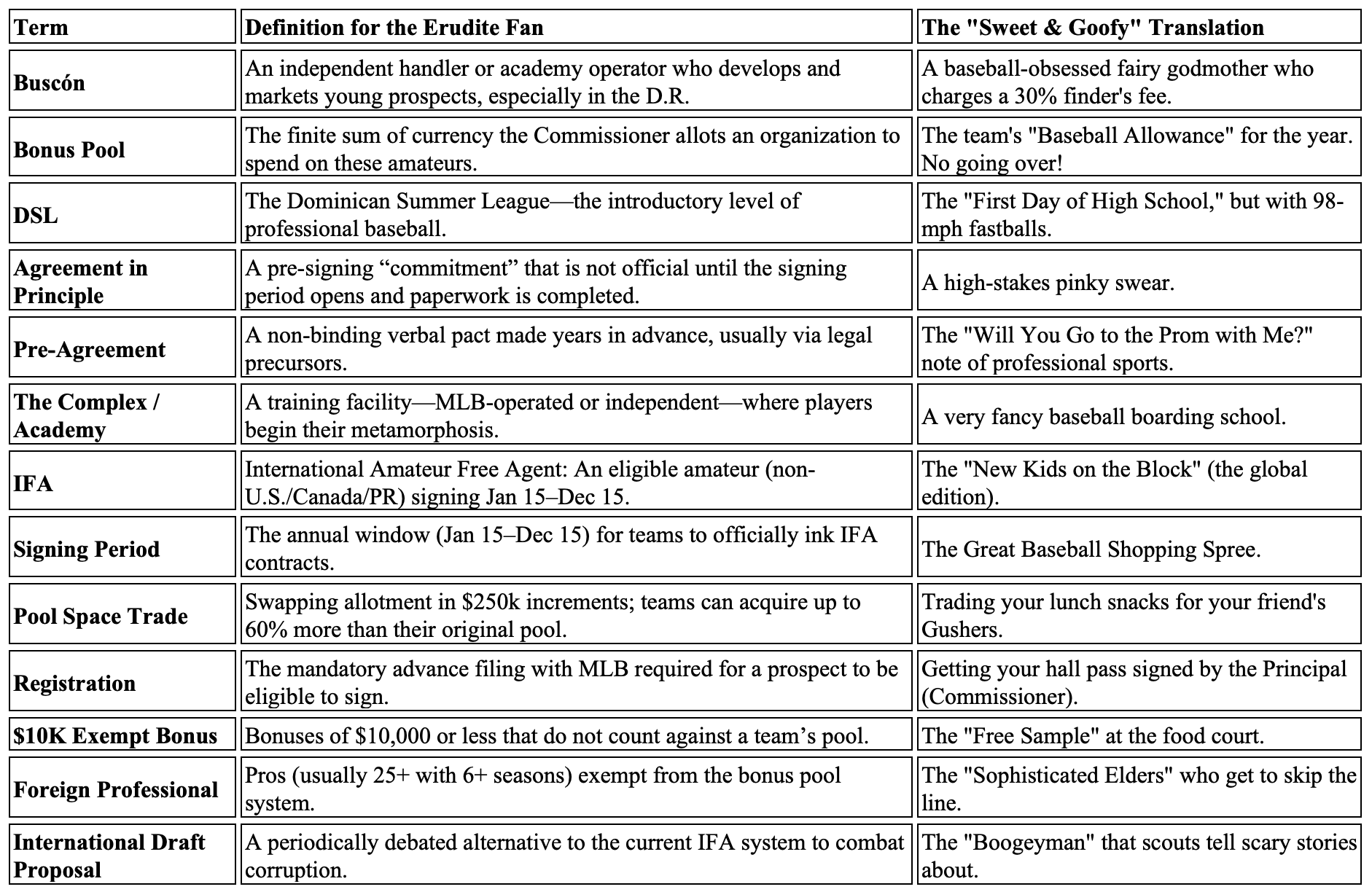
THE SESQUIPEDALIAN'S DICTIONARY OF TERMS
To navigate these waters, one must possess the proper nomenclature. Please refer to this humble glossary:
©2026 Ball 'N Play™ Sports Agency PLLC