2025-26 College Football Playoff: A Deep Dive into the Billion-Dollar PostseasonThe Semifinals, Championship Showdown, and the Economics Powering College Football’s Biggest Stage
The 2025-26 College Football Playoff (CFP) has delivered thrilling on-field drama and unprecedented financial stakes, reshaping the college sports landscape. As the playoff field narrows to the final two teams, the excitement of the semifinals merges with economic forces—from lucrative payouts and coaching bonuses to player gifts and major city windfalls. This blog post offers an in-depth look at the games, teams, and the business machinery behind this year’s CFP, making sense of how money and competition intersect on the road to Miami.
Semifinal Recap: Fiesta Bowl and Peach Bowl Deliver High Drama
The path to the 2025-26 CFP National Championship was set after two explosive semifinal showdowns, solidifying this season as one of the most memorable in recent history. With the dust settling from the Fiesta Bowl and Peach Bowl, the focus now shifts to the grand finale in Miami. All the while, the season’s economics—ranging from player “swag” to coaching bonuses—have reached a fever pitch, amplifying the stakes on and off the field.
The Road to Miami: Semifinal Results
On January 8 and 9, 2026, the CFP semifinals produced edge-of-your-seat action and set the stage for a historic championship clash:
· Fiesta Bowl (Glendale, AZ): No. 10 Miami continued its Cinderella run by upsetting No. 6 Ole Miss in a 31-27 thriller on Thursday night. Hurricanes quarterback Carson Beck clinched the win with an electrifying 18-yard touchdown run, leaving only 18 seconds on the clock. The upset not only stunned fans but also carried major ramifications for the season’s financial bonuses and the CFP’s narrative.
· Peach Bowl (Atlanta, GA): No. 1 Indiana remained undefeated (14-0), steamrolling No. 5 Oregon 56-22 on Friday night. The Hoosiers’ relentless offense proved too much for the Ducks, showcasing why Indiana is the nation’s top-ranked team and setting up a championship clash that promises fireworks.
· The Championship: The highly anticipated title game features No. 1 Indiana against No. 10 Miami on January 19, 2026 at Hard Rock Stadium in Miami Gardens, Florida. With both teams riding waves of momentum, the championship is set to be a can’t-miss event.
Economic Structures: How the CFP Payouts Work
Behind the pageantry of bowl season lies a sophisticated financial system that rewards performance and participation. The expanded 12-team playoff has significantly increased “broadcast inventory,” which in turn drives up performance-based payouts. Here’s a breakdown of how the money flows in the 2025-26 CFP cycle:
· Selection Base: $4,000,000 per team selected for the playoff field.
· Quarterfinal Performance: Teams receive an additional $4,000,000 for reaching the quarterfinals.
· Semifinal Performance: Advancing to the semifinals adds $6,000,000.
· National Championship Appearance: A further $6,000,000 is awarded for making the championship game.
· Total Potential Performance Payout: $20,000,000 per school for a title run (excluding travel stipends).
On top of these payouts, each participating team also receives a travel/expense stipend of $3,000,000 per game. For those hosting a first-round matchup on campus, this stipend turns into an immediate profit, as travel costs are minimal but the payout is fixed.
Conference Payout Models: Who Keeps the Money?
The CFP operates as a centralized clearinghouse, distributing funds based on team success. But how much each school ultimately keeps depends on conference bylaws, which vary widely:
· The ACC Model (Performance-Driven): After a 2024 settlement, the ACC allows schools like Miami to retain 100% of their CFP payouts (potentially $14 million through the semifinals).
· The Big Ten/Big 12 Model (Socialist-Equalitarian): These conferences pool all CFP revenue and distribute it equally among member schools, regardless of participation.
· The SEC Model (Hybrid): Teams receive fixed participation shares (e.g., $3.75 million for a semifinal), while surplus funds are redistributed to the conference at large.
The Coaching Carousel: Bonuses, Contracts, and Paradoxes
The postseason doesn’t just impact teams and schools—coaching contracts are also put to the test. This year’s playoff season spotlighted a unique phenomenon: the “External Bonus Liability.” In certain cases, a coach’s previous employer (or their new one) may be responsible for paying performance bonuses triggered by postseason achievements.
The Lane Kiffin / LSU Paradox
In one of the most unusual financial arrangements in college sports, LSU is paying bonuses to Lane Kiffin for Ole Miss’s playoff success—even after he left for Baton Rouge. When Kiffin departed Oxford on November 30, his exit agreement required LSU to assume responsibility for any postseason performance incentives he was due. After Ole Miss fell in the Fiesta Bowl semifinals, LSU’s obligation to Kiffin reached its final total.
Since Ole Miss was eliminated in the semifinals, LSU now owes Kiffin $900,000 within 30 days. This covers the bonus for reaching the semifinals. Had the Rebels advanced further, Kiffin could have pocketed an additional $750,000 for a title game appearance or $1 million for a national championship win—bonuses that LSU “saved” due to Miami’s upset.
As Ole Miss advanced under interim coach Pete Golding, Kiffin triggered several bonuses from LSU’s budget:
· $150,000 for the CFP bid.
· $250,000 for a first-round victory.
· $500,000 for the Sugar Bowl (quarterfinal) win.
Curt Cignetti and Indiana: The "Market Review" Clause
Indiana’s head coach Curt Cignetti also found his contract in the spotlight. Thanks to a “Good Faith Market Review” clause in his eight-year, $93 million deal, reaching the semifinals means Indiana must adjust his salary to match the nation’s third-highest-paid coach (about $13 million annually). If a new agreement isn’t reached within 120 days, Cignetti can leave without paying the standard $15 million buyout, giving the coach considerable leverage after Indiana’s stunning playoff run.
CFP Player “Swag”: 2025-26 Bowl Game Gift Suites
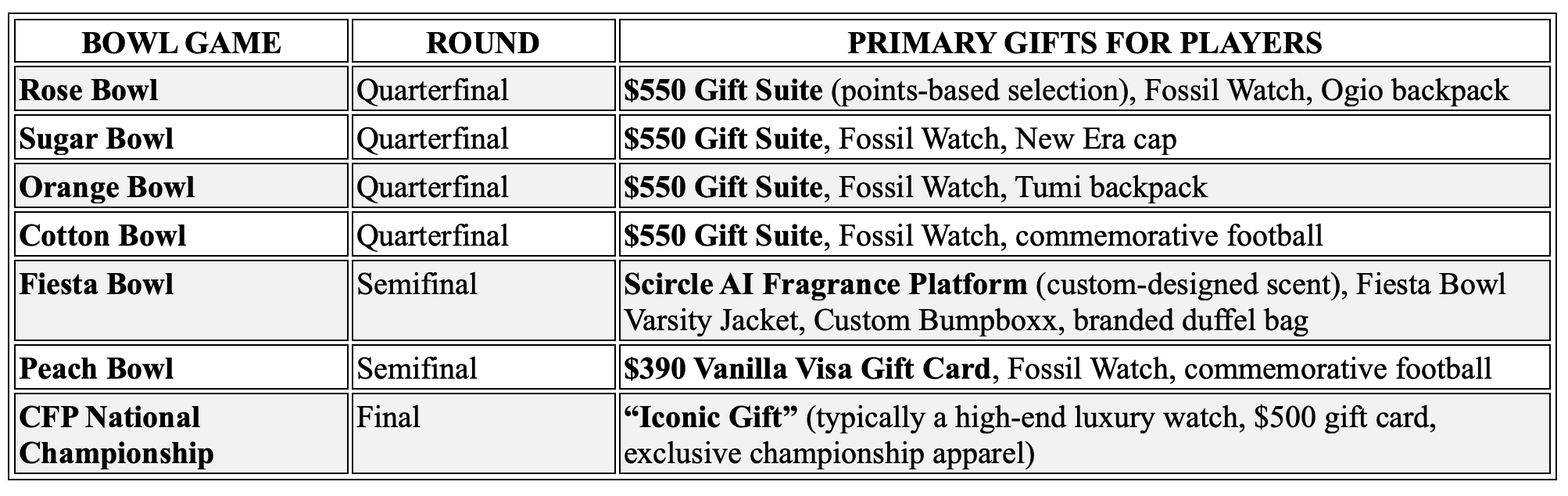
Beyond the scoreboard and contracts, players in the CFP receive their own slice of postseason rewards. Under NCAA rules, bowl committees may provide up to $550 in gifts per player. This year, the bowl gift suites leaned into tech and luxury, blending tradition with innovation. Here’s what the athletes took home:
©2026 Ball 'N Play™ Sports Agency PLLC
The GameAbove Sports Bowl: Where the NFL Meets College Football
While CFP bowls drive the majority of postseason revenue, the GameAbove Sports Bowl in Detroit stands out for its unique ownership and community impact. Formerly the Quick Lane Bowl, it is the only bowl game owned, hosted, and operated by an NFL franchise—the Detroit Lions.
Played at Ford Field, this bowl is a major marketing tool for the Lions and a pillar of Detroit’s sports economy. In the 2025 edition held on December 26, Northwestern defeated Central Michigan 34-7. Though not CFP-sanctioned, the bowl is a model for successful NFL-collegiate partnerships, blending local tradition with national exposure.
Economic Impact: Billion-Dollar Postseason for Host Cities
The expanded CFP has transformed bowl season into a traveling economic juggernaut. In 2025-26, the CFP bowl games are projected to inject over $1.3 billion into their host cities. The 12-team format means more games, more fans, and more economic impact—benefiting hotels, restaurants, and local businesses at every stop.
· New Orleans (Sugar Bowl): Led all quarterfinal hosts with an estimated $300 million in local spending.
· Pasadena (Rose Bowl): Generated approximately $245 million, buoyed by the tradition and tourist appeal of the classic game.
· Glendale (Fiesta Bowl): Projected to deliver $200 million in combined impact for Arizona, including earlier bowl events.
· Atlanta (Peach Bowl): The semifinal showdown contributed to an annual $130 million boost for the city’s sports tourism.
· Miami (Orange Bowl & National Championship): With both games in South Florida, the region anticipates a combined windfall exceeding $320 million.
Practical Takeaways for Fans and Stakeholders
For Schools: The CFP is more than a payout; it’s an investment in brand value, student applications, and future sponsorship opportunities.
For Cities: Focus on net economic impact, not just gross spending. Real gains come from out-of-market visitors and lasting exposure.
For Players: As NIL earnings and revenue-sharing become standard, sound tax planning is essential. The financial side of college football is increasingly professional.
Conclusion: The New Era of College Football Economics
The 2025-26 CFP has proven that college football’s “Path to the Top” is paved as much by financial acumen as by blue-chip recruiting. With billion-dollar impacts, evolving coaching contracts, and player experiences that blend tradition and luxury, the postseason is more than a series of games—it’s a showcase of modern sports business. As Miami prepares to host the national championship, the intersection of competition and commerce has never been more fascinating.
References
Dosh, K. "What Is The CFP Payout?" Forbes.
Christovich, A. "ACC Only Power Conference Giving CFP Teams 100% of Payout." Front Office Sports.
Schultz, N. "Curt Cignetti contract clause takes effect..." On3.
Ubben, D. "Path to the top of college football has changed." The Athletic.
Reuters. "Washington takes legal action against football player..."
Pasadena Tournament of Roses. "Rose Bowl Game Economic Impact Report."
City of Miami Beach. "Projected CFP 2026 impact and media value."