Is College Football Dying? NIL, Portal Chaos, Hidden Deficits, and the End of the Old Story: The Current legal, financial, and regulatory state of NCAA college football
College Football Isn’t Dead — But the Old Model Is Cracking
The Hidden Crisis in College Football: NIL, the Portal, and Financial Fragility
Executive summary
The current legal–regulatory posture of NCAA college football is defined by a rapid pivot from amateurism-era restrictions toward market-like athlete mobility (transfer portal), monetization (NIL), and a nascent “compliance-and-audit” approach that increasingly relies on third-party oversight tools and government enforcement—because traditional NCAA enforcement authority is legally constrained and operationally mismatched to a decentralized NIL marketplace. [1]
Since 2020, the most consequential policy inflection points include: (a) NCAA adoption of the one-time transfer exception (2021) enabling immediate eligibility for many transfers; (b) the NCAA’s “interim” NIL policy (effective July 2021) that effectively opened NIL activity under state-law variability; (c) repeated tightening and reconfiguration of football transfer windows (2023–2026) aimed at reducing roster churn and “tampering” while preserving litigation defensibility; (d) court- and state-AG-driven constraints on NCAA NIL enforcement actions; and (e) the House settlement framework (2024–2025 filings) that is reshaping the financial and governance model by enabling (and functionally pressuring) direct athlete compensation and centralized NIL transaction review. [2]
Trinidad Chambliss’s public record footprint, as of March 6, 2026, is primarily an eligibility-waiver dispute rather than a documented NIL fraud matter. Reuters reports that he sought an additional year of eligibility, was denied by the NCAA, and pursued relief in Mississippi[3] state court seeking to overturn the denial and preserve his ability to play (and, by implication raised in reporting, the economic value of continued participation). [4] Publicly accessible filings and investigative records referred to in media are not uniformly available without court-access systems or state public-records production; where the documentary record was not accessible in the retrieved sources, this report flags those gaps explicitly. [5]
Financially, the dominant reality is that most public athletic departments run structural deficits on an operating basis unless institutional transfers, student fees, and other university support are counted as “revenue.” This is visible directly in NCAA Membership Financial Reporting System (MFRS) reports, where “Direct Institutional Support,” student fees, and large “Expenses Not Related to Specific Teams” can be decisive drivers of net position. [6] Even among well-known football brands, the arms race in payroll-adjacent costs (coaching compensation, recruiting infrastructure, medical/sports science), facilities debt service, and “off-book” booster-funded NIL creates ongoing pressure for revenue growth and expense control. [7]
Actionable recommendations (high-level): (1) adopt standardized NIL contract and disclosure regimes tied to athlete-agent licensing and bonding; (2) create a multi-layer audit trail for NIL payments (school + collective + platform-level) with red-flag analytics; (3) implement transfer-related “anti-tampering” processes using enforceable contracts and narrowly tailored information barriers rather than broad NCAA prohibitions; (4) impose financial controls at the conference or subdivision level (spending bands, facilities debt reporting, buyout governance), and (5) prepare litigation-ready reform packages grounded in antitrust/labor preemption strategy and consumer-protection enforcement partnerships (FTC/State AG). [8]
Legal and policy timeline since 2020 affecting transfers, NIL, and agents
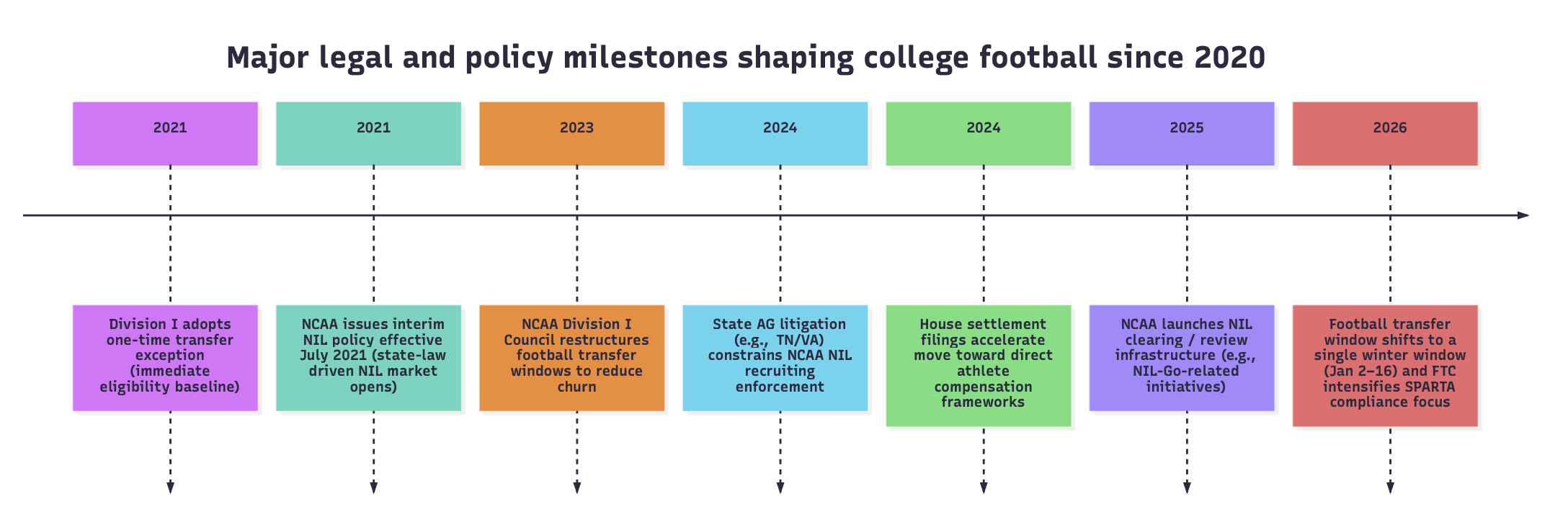
Timeline highlights and sources
The “center of gravity” shifted from NCAA rules as the primary constraint to a hybrid of (i) NCAA process rules (windows, disclosures, eligibility procedures), (ii) state/federal enforcement (AG actions; FTC agent oversight), and (iii) private litigation (settlement-driven redesign). [9]
Key steps since 2020:
· 2021 (April): One-time transfer exception adopted for Division I, allowing many athletes a single immediate-eligibility transfer (subject to sport-specific conditions and academic standing), accelerating roster mobility and increasing the role of advisors/agents in move strategy. [10]
· 2021 (July 1 era): Interim NIL policy issued as an “interim” framework, deferring heavily to state law and school policy and catalyzing the growth of NIL “collectives” and representative intermediaries. [11]
· 2023–2024: Transfer-window engineering becomes a primary administrative tool. For football, the NCAA Division I Council reduced and reconfigured windows (notably the 45-day structure referenced in coverage of Council actions), reflecting the NCAA’s attempt to curb exploitation and stabilize rosters without relying solely on substantive eligibility restrictions likely to be challenged. [12]
· 2024 (early): State AG litigation pressures NCAA NIL enforcement, illustrated by actions brought by Tennessee[13] and Virginia[14] officials challenging NCAA limits on NIL-related recruiting inducements, and judicial orders constraining enforcement posture. [15]
· 2024–2025: House settlement framework (filings and final agreement documents) formalizes movement toward direct athlete compensation and a more centralized NIL review/clearing approach, with downstream impacts on budgets, Title IX strategy, and the role of third-party representatives. [16]
· 2025–2026: Football transfer windows consolidated further, including the shift to a single winter window for football in January 2026 (Jan 2–16) reflected in NCAA transfer-window documentation, signaling the NCAA’s continued reliance on timing constraints as a non-price, non-compensation stabilizer.
· 2026 (January): FTC signals renewed attention to sports agent compliance under the Sports Agent Responsibility and Trust Act (SPARTA), including information requests to universities regarding agent practices and disclosures—an important lever for addressing “agent fraud” and deceptive practices outside NCAA disciplinary reach. [17]
© 2026 Ball 'N Play™ Sports Agency PLLC
The timeline entries above correspond to NCAA policy announcements and documents on transfers and NIL, state-AG litigation reporting/press releases, House settlement filings, and FTC SPARTA enforcement actions. [18]
Trinidad Chambliss case profile and related incidents
Known facts and timeline from credible reporting
Available mainstream reporting indicates that Trinidad Chambliss’s primary legal issue is an eligibility waiver disputerather than a publicly documented NIL fraud prosecution or NCAA infractions case.
· Eligibility dispute and lawsuit: Reuters reports that Chambliss filed suit after the NCAA denied his request to compete an additional year (often characterized in reporting as seeking a sixth year of eligibility) and sought injunctive relief in Mississippi state court to overturn or pause the denial so he could play. [4]
· Underlying leverage and stakes: While the reporting emphasizes eligibility, the modern context makes eligibility itself a high-value economic asset because the ability to play is now closely linked to NIL earning opportunities and transfer-market value. Reuters explicitly situates his dispute within this eligibility–economic value nexus by focusing on the consequences of the denial and the urgency of injunctive relief. [4]
Public records, NCAA investigations, and criminal exposure
As of the sources retrieved for this report:
· Court filings and docket materials: The Yahoo/Threads-style social posts and forum commentary that circulate about the case are not treated here as reliable. [19] The Reuters report confirms the existence of litigation and the injunctive posture, but in the retrieved corpus it does not include complete docket indexing, complaint PDF, or a published court order. [4]
· NCAA investigative actions: No retrieved primary NCAA enforcement notice or infractions case record specifically identifying Chambliss was found in the sources accessed for this response. The available reporting frames the matter as an eligibility-waiver/appeal denial rather than an infractions investigation. [5]
· Criminal investigations: No DOJ or state charging document, arrest report, or publicly documented criminal investigation tied to Chambliss was found in the retrieved sources. This does not prove none exists; it indicates that such records were not located in the sources accessed here and may require court-record access tools or public records requests. [5]
How Chambliss fits the broader regulatory story
Chambliss’s dispute is best understood as a case study in “eligibility as property-like economic value”: in an NIL era, a waiver denial can function as an economic de-licensing event. That reality increases litigation incentives and accelerates the shift from internal NCAA processes to external judicial review, especially when courts are already constraining NCAA enforcement approaches in adjacent NIL contexts. [20]
Because the retrieved sources did not provide a deep documentary record (complaint exhibits, medical records, NCAA waiver packet), this report does not speculate on evidentiary disputes. Instead, the report uses the case to illustrate the systemic legal exposure categories: due process/fairness arguments, state-law contract/tort theories (for private associations), and the practical necessity for NCAA and schools to design waiver processes as litigation-ready administrative records. [21]
Financial state of athletic departments and deficit drivers
Why athletic departments often show deficits
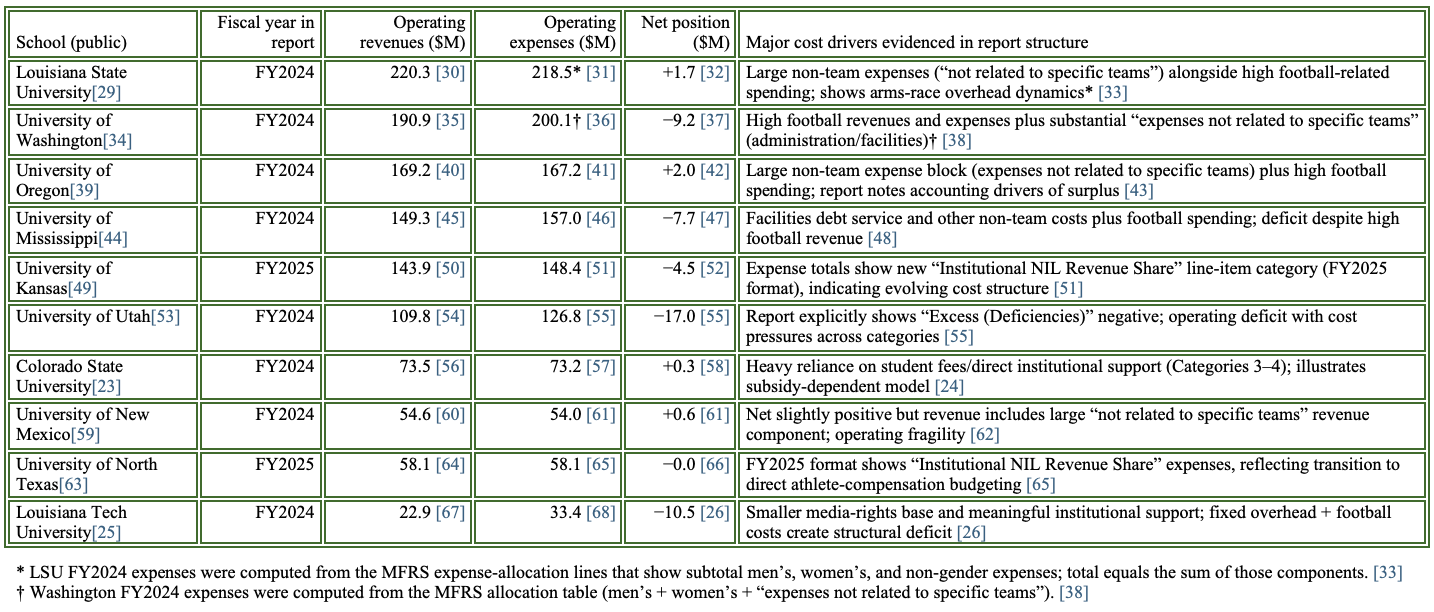
A central reason athletic departments “run deficits” is definitional: many programs are only net-positive after counting university support and student fees as athletics revenue, while simultaneously carrying large indirect/overhead costs and “non-team” expenses (administration, facilities, debt service, compliance operations) that scale upward with competition level. NCAA MFRS rules explicitly define categories like student fees and direct/indirect institutional support, and institutions must report them annually under agreed-upon procedures. [22]
Concrete examples from recent MFRS reports:
· Colorado State University[23] reports student fees and direct institutional support as major revenue categories (Categories 3–4), and indirect institutional support as well (Category 6), evidencing that a substantial share of athletic operations is subsidized rather than market-funded. [24]
· Louisiana Tech University[25] similarly reports direct and indirect institutional support categories as foundational components of its financial structure. [26]
· In high-revenue programs, large “expenses not related to specific teams” and facilities-related costs can still push net position negative even when media and ticket revenue are substantial—showing that the arms race can eat the margin.[27]
Comparative table of 10 programs
All figures below are Total Operating Revenues (Categories 1–19) and Total Operating Expenses (Categories 20–41A) as reported in NCAA MFRS reports (or computed from the MFRS expense-allocation table where the report excerpt provides subtotals). [28] Amounts shown in USD millions (rounded to 1 decimal) to enable comparability; net position is revenues − expenses.
© 2026 Ball 'N Play™ Sports Agency PLLC
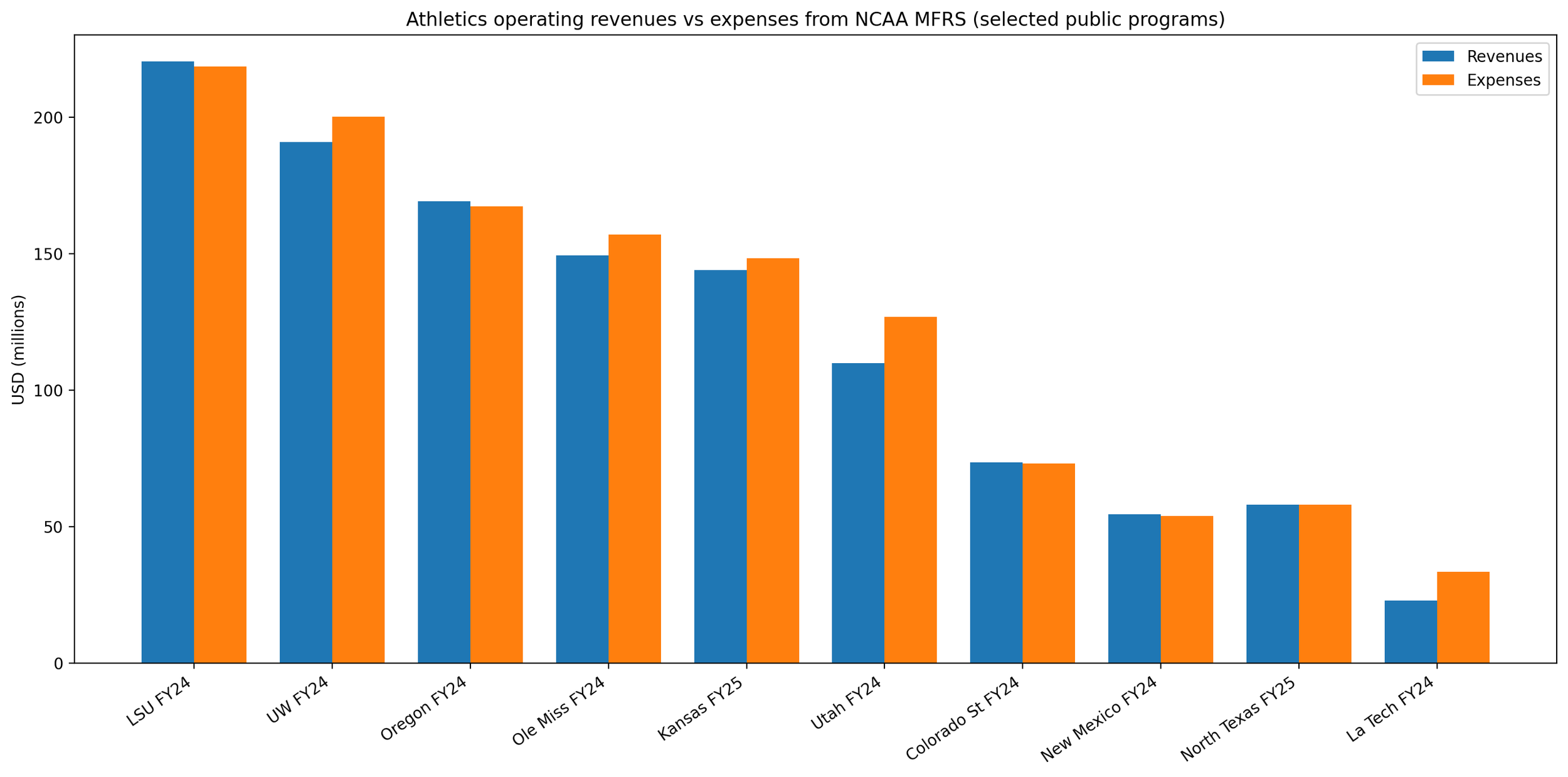
Visualization: revenues vs expenses for the 10-school sample
© 2026 Ball 'N Play™ Sports Agency PLLC
The chart above uses totals reported (or computed from allocation tables) in the cited MFRS reports. [69]
Transfer portal and NIL market dynamics, fraud patterns, & enforcement challenges
Transfer portal dynamics and common abuses
The transfer portal regime is best viewed as a labor-mobility market with time-based constraints (windows) and information asymmetries. NCAA actions repeatedly focus on window design as a regulatory “circuit breaker,” including shortening or consolidating windows and setting fixed opening/closing periods. [70]
Common abuse vectors:
1. Tampering and induced entry: third parties (boosters, agents, intermediaries) contact players before portal entry, offering conditional compensation or “soft landing” promises. NCAA’s ability to directly discipline non-member third parties is structurally limited, pushing enforcement toward schools/coaches and generating selective deterrence. [71]
2. Eligibility and waiver gaming: waiver requests and appeals (including medical/participation exceptions and hardship narratives) create litigation exposure when outcomes appear inconsistent, as illustrated by high-profile individual lawsuits like Chambliss’s. [5]
3. Rostering arbitrage: programs over-recruit knowing attrition is likely, externalizing the downside (lost roster spot, lost academic continuity) to athletes while maintaining competitive upside. Window consolidation is intended to reduce year-round poaching but can also concentrate bargaining power in narrow periods, increasing the risk of rushed, poorly papered deals.
NIL deal structures and fraud/abuse patterns
NIL arrangements commonly run along three channels: (a) licensing/endorsement deals with identifiable deliverables; (b) collective-funded “ambassador” payments; and (c) hybrid arrangements routed through marketing agencies or agent-like intermediaries.
Fraud/abuse risks that recur in the current ecosystem:
· Phantom deliverables and misrepresentation: deals where athletes are promised compensation without commercially reasonable deliverables, increasing the risk of consumer-protection scrutiny and contract unraveling. The NCAA’s interim NIL stance—because it is not a comprehensive federal system—does not by itself provide uniform contract standards. [11]
· Identity, tax, and money-flow opacity: payments routed through multiple entities (collectives, LLCs, marketing agencies) can mask the true source of funds and undermine compliance checks and tax reporting, especially where athletes are young and financial literacy varies. Moving toward NIL transaction review tools is, in part, a response to this opacity. [72]
· “Pay-for-play” inducement allegations and enforcement paralysis: AG litigation challenging NCAA actions in recruiting-inducement contexts contributes to a climate where the NCAA’s enforcement posture is disputed, increasing the incentive for aggressive third-party behavior. [15]
Agent fraud: regulatory tools and enforcement gaps
Agent fraud (and agent-adjacent misconduct) has escalated risk because the NIL market encourages representative intermediaries to operate earlier and with fewer professional licensing constraints than traditional pro-sports agency.
Key enforcement levers and constraints:
· Federal enforcement via FTC and SPARTA: The FTC’s outreach to universities and public messaging about SPARTA compliance shows an intent to treat sports-agent deception and poor disclosure practices as consumer-protection matters, creating a pathway to enforcement that does not depend on NCAA sanctions. [17]
· Institutional reporting/audit infrastructure (MFRS and NIL review tools): While MFRS is primarily a financial system, its agreed-upon procedures and standardized definitions highlight a regulatory model the sector is adopting: standardized reporting, third-party verification, and auditable trails. NIL review platforms can be seen as an extension of that model into athlete compensation flows. [73]
· Gaps: NCAA cannot directly license or discipline all “agents,” many of whom operate as marketers, brand managers, recruiters, or “advisors.” This produces a classic jurisdictional mismatch: the actors best positioned to commit fraud may be the least subject to NCAA discipline, making FTC/State AG involvement and state agent-licensing statutes more important. [74]
Viability outlook and scenarios for decline or stabilization
Does the current trajectory threaten college football’s viability?
The short answer is that the sport’s top end is financially resilient but the system-wide model is unstable due to legal and economic convergence: expanded athlete compensation obligations, rising fixed costs, and continued antitrust/labor litigation risk. [75]
Evidence from MFRS data supports a “barbell” story: high-revenue brands (e.g., LSU, Oregon, Washington) operate with massive budgets, but can still be near break-even or negative once full overhead and facilities costs are included; mid-tier and smaller programs face deficits that are only bridged through institutional support, student fees, or accounting transfers. [76]
Scenario analysis
Stabilization path (most likely if reforms are implemented coherently)
A regulated revenue-sharing framework (as reflected in settlement architecture and evolving reporting categories such as “Institutional NIL Revenue Share” in FY2025 MFRS forms) could normalize athlete compensation as a budget line item, reducing off-ledger collective dependence and enabling more predictable compliance. [77] Under this scenario, transfer windows remain the principal roster-stability mechanism, while legal risk shifts from raw antitrust exposure toward governance disputes over classification, Title IX allocation, and state-law conflicts. [78]
Managed contraction path (credible risk for mid-tier and smaller programs)
Institutions with structurally deficit athletic models may reduce football investment, drop divisions, or cut nonrevenue sports to fund compensation and escalating fixed costs—especially if institutional support becomes politically contested. The MFRS category structure shows how large direct/indirect support can be for many programs, indicating vulnerability if campuses restrict subsidies. [79]
Fragmentation or “breakaway” path (plausible at the very top)
If legal constraints continue to force compensation and mobility outcomes without a unifying federal statute or enforceable collective bargaining mechanism, elite programs and conferences may pursue separate governance arrangements. Settlement-driven changes may temporarily reduce pressure, but absent harmonized regulation, the top tier may still seek autonomy to enforce consistent rules and manage labor costs. [80]
Policy and legal proposals, stakeholders, and actionable recommendations
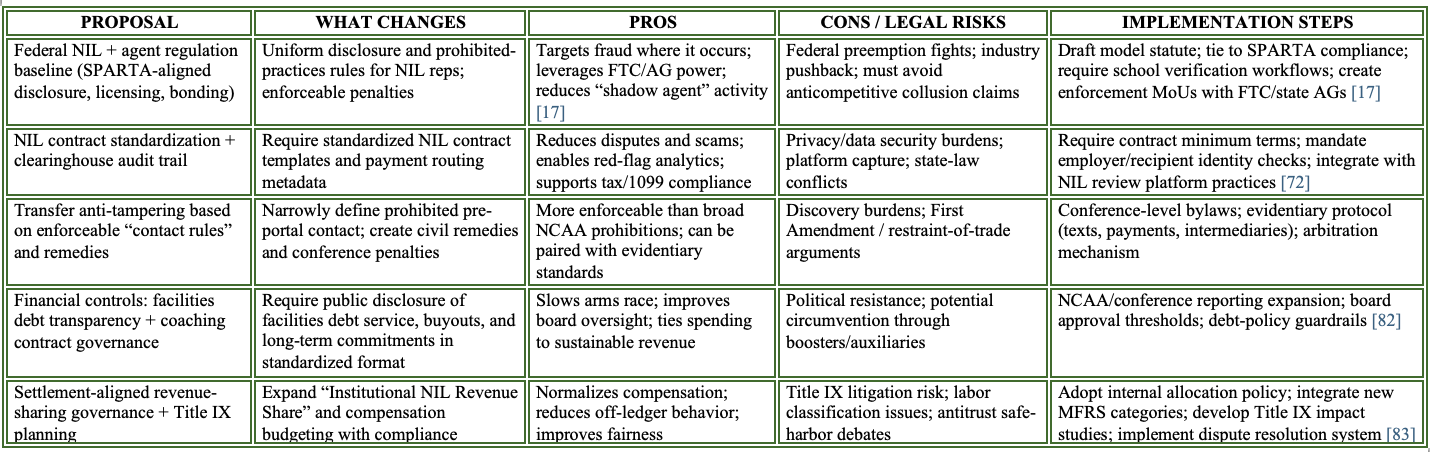
Reform proposals with pros, cons, and implementation steps
The proposals below are designed to be litigation-aware (antitrust/labor), enforceable against third parties, and auditable (money trails), reflecting the shift toward standardized reporting and federal consumer-protection involvement. [81]
© 2026 Ball 'N Play™ Sports Agency PLLC
Stakeholders, litigation risk map, and likely challenges
Key stakeholders include: athletic departments and university boards (financial sustainability and governance), athletes and collectives (earnings and mobility), conferences (media rights, competitive balance), regulators (FTC/AG), and courts (antitrust, due process, contract disputes). [84]
High-probability legal challenges to reforms:
· Antitrust: Any horizontal restraint on compensation, NIL pricing, or mobility must be justified under rule-of-reason analysis and crafted to avoid obvious cartel-like features; recent litigation pressures and settlement architecture show that this remains a central risk. [85]
· State-law conflicts / preemption: Divergent state NIL statutes and potential federal baselines can create compliance conflict; uniformity reforms invite preemption fights. [86]
· Administrative law–style fairness claims: Eligibility determinations and enforcement decisions can generate litigation when they appear inconsistent or inadequately reasoned, as the Chambliss dispute illustrates. [5]
· Title IX: Direct compensation budgeting and roster management can trigger Title IX allocation disputes; reforms should include compliance-by-design rather than retrofits. [87]
Actionable recommendations
FOR POLICY MAKERS:
Build a federal NIL/agent baseline anchored to FTC enforcement authority (SPARTA-aligned disclosures, misrepresentation bans, and school-facing compliance requirements). [17]
Incentivize standardized NIL payment metadata and audit trails through safe-harbor provisions for schools that adopt prescribed compliance systems. [72]
FOR UNIVERSITIES AND ATHLETIC DEPARTMENTS:
Treat NIL and transfer risk as enterprise risk: implement contract standards, required disclosures of agent/representative relationships, and documented eligibility-waiver records designed for litigation. [88]
Rebase budgets around “post-settlement” realities: explicitly model revenue-share expenses (as tracked in FY2025 MFRS categories) and stress-test subsidy dependence (student fees and institutional support). [89]
Strengthen board oversight on long-term liabilities: facilities debt service, buyouts, and non-team overhead (“expenses not related to specific teams”) should have hard approval gates. [90]
FOR LEGAL COUNSEL:
Develop a repeatable litigation response package for eligibility and NIL disputes: preservation letters, administrative record protocols, arbitration clauses where appropriate, and coordinated regulator engagement (FTC/AG). [91]
Draft and deploy “anti-tampering” compliance policies that rely on narrow, enforceable rules and measurable evidence, anticipating discovery and constitutional arguments.
Coordinate Title IX and employment-classification strategies with compensation planning rather than treating them as downstream issues. [92]
————————————————————-
[1][2][11][13][71][86] https://www.ncaa.org/news/2021/6/30/ncaa-adopts-interim-name-image-and-likeness-policy.aspx
https://www.ncaa.org/news/2021/6/30/ncaa-adopts-interim-name-image-and-likeness-policy.aspx
[3][35][36][37][38] https://gohuskies.com/documents/download/2025/1/17/FY24_NCAA_Report_Final.pdf
https://gohuskies.com/documents/download/2025/1/17/FY24_NCAA_Report_Final.pdf
[4][5][14][21][91] https://www.reuters.com/sports/ole-miss-qb-trinidad-chambliss-appeal-6th-season-denied-by-ncaa--flm-2026-02-05/
[6][22][28][73][79][81][82][88][90] https://www.ncaa.org/sports/2013/11/21/ncaa-membership-financial-reporting-system.aspx
https://www.ncaa.org/sports/2013/11/21/ncaa-membership-financial-reporting-system.aspx
[7][27][45][46][47][48] https://olemisssports.com/documents/download/2025/1/24/NCAAReport_FY24.pdf
https://olemisssports.com/documents/download/2025/1/24/NCAAReport_FY24.pdf
[8][72] https://www.buckeyesports.com/ncaa-approves-single-transfer-portal-window-from-january-2-16-for-2026/?print=print
[9][15][20] https://www.nilrevolution.com/2026/01/trinidad-chambliss-contract-based-challenge-to-ncaa-eligibility-decisions/
[10][18][23] https://www.ncaa.org/news/2023/10/4/media-center-di-council-approves-changes-to-notification-of-transfer-windows.aspx
[12][70] https://www.ncsasports.org/recruiting/ncaa-transfer-rules
https://www.ncsasports.org/recruiting/ncaa-transfer-rules
[16][75][77][80][85] https://www.espn.com/college-football/story/_/id/46524004/ncaa-adopts-jan-2-16-transfer-portal-window-fbs-fcs-26
[17][74][84] https://www.statepress.com/article/2025/09/sports-spring-portal-removal-ncaa-transfers
https://www.statepress.com/article/2025/09/sports-spring-portal-removal-ncaa-transfers
[19] https://www.facebook.com/groups/secsuperconference/posts/1345033900786758/
https://www.facebook.com/groups/secsuperconference/posts/1345033900786758/
[24][56][57][58] https://csurams.com/documents/download/2025/3/13/FY24_NCAA_Report.pdf
https://csurams.com/documents/download/2025/3/13/FY24_NCAA_Report.pdf
[25][29][39][49][50][51][52][59][83][87][89] https://kuathletics.com/documents/download/2026/1/15/FY_24-25_NCAA_Final_Report.pdf
https://kuathletics.com/documents/download/2026/1/15/FY_24-25_NCAA_Final_Report.pdf
[26][67][68] https://s3.us-east-2.amazonaws.com/sidearm.nextgen.sites/latechsports.com/documents/2025/3/28/FY24_NCAA_Financial_Report.pdf
[30][31][32][33][34][53][69][76] https://ath-ems.lsu.edu/prr/contracts/NCAA%20Financial%20Reports/NCAA%20Financial%20Report%20-%20FY24.pdf
[40][41][42][43] https://s3.us-east-2.amazonaws.com/sidearm.nextgen.sites/uoregon.sidearmsports.com/documents/2025/1/13/frs_report_FINAL_SUBMITTED_12.20.24.pdf?timestamp=20250113070823
[44][63][64][65][66]https://bloximages.newyork1.vip.townnews.com/dentonrc.com/content/tncms/assets/v3/editorial/7/76/7765433e-8646-4276-b587-82b11c4b7661/69896329ab59a.pdf.pdf
[54][55] https://utahutes.com/documents/download/2025/1/21/FY24_NCAA_Revenue_and_Expense_Report.pdf
https://utahutes.com/documents/download/2025/1/21/FY24_NCAA_Revenue_and_Expense_Report.pdf
[60][61][62] https://athleticscontracts.unm.edu/ncaa-financial-reports/fy24-ncaa-report.pdf
https://athleticscontracts.unm.edu/ncaa-financial-reports/fy24-ncaa-report.pdf
[78][92] https://badgerherald.com/sports/football/2025/09/18/football-ncaa-committee-eliminates-spring-transfer-portal-window/