NAVIGATING THE NFL DRAFT PIPELINE:A COMPLETE 2026 GUIDE FOR COLLEGE PLAYERS & FAMILIES
The journey from college football to the NFL Draft is an extensive, year-long process filled with crucial milestones. For a college athlete (and their family) aiming to play professionally, understanding this A-to-Z pipeline is both empowering and essential.
In the context of the upcoming 2026 NFL Draft, this guide breaks down every phase – from game tape evaluations and all-star showcases, through combines and pro days, to draft weekend itself – highlighting which parts repeat each year and how to navigate them.
Written from the perspective of a sports attorney and an athlete agent, the tone here is honest, clear, and encouraging. By the end, you’ll know exactly what to expect at each stage, what scouts and teams are looking for, how to stay compliant with NCAA rules and the Sports Agent Responsibility and Trust Act (SPARTA), and how to prepare for the life-changing moment of hearing your name called on draft day. Let’s dive in.
Checklist: Road to the NFL Draft
Use this step-by-step checklist to track progress through the NFL Draft pipeline. You can print this and literally check items off as you go.
GAME TAPE: WHERE THE DRAFT STARTS
Long before any all-star game or combine, an NFL prospect’s journey begins with their college game film. All 32 NFL teams employ scouts who watch countless hours of tape on college players throughout the fall. Your game tape is essentially your first résumé for the NFL. Scouts study how you perform in real competition – examining your athleticism, technique, consistency, football IQ, and even how you respond to adversity on the field. They note the quality of your competition (dominating lesser opponents isn’t as impressive as holding your own against top-ranked teams) and look for traits that might project well to the pros, such as size, speed, strength, and positional instincts.
Most NFL scouts organize their evaluations by region or conference and will visit campuses during the season. They might attend practices or games in person and speak with college coaches or trainers to gather background on a player’s work ethic and character. By the end of your final college season, teams have preliminary grades on you based largely on this game tape review. In many cases, the NFL Scouting Combine and other events are used to “validate what they’ve seen on film,” as one Combine official put it. In other words, your on-field performance in college is the baseline – everything else in the draft process either confirms or adjusts a team’s impression from the tape.
What to Do (Right Now)
Before the all-star games, before the Combine, before anything else—your film is your résumé. Make it loud.
ACTION STEPS
- Continue to focus on your development and performance during college – every game snap is a chance to impress (or worry) NFL scouts.
- Stack consistent, clean reps—effort and technique show up on film.
- It’s also wise to request feedback from the NFL’s College Advisory Committee (typically available to underclassmen considering early entry) to get an idea of your draft stock.
- Make “better tape” the mission! Ultimately, the better your game film, the easier the road ahead.
POST-SEASON ALL-STAR GAMES (SHRINE BOWL & SENIOR BOWL)
The East–West Shrine Bowl and the Reese’s Senior Bowl are the two most prestigious post-season all-star games for NFL hopefuls. Set in late January each year, these events bring select draft-eligible players (primarily seniors, plus a few graduated juniors) together to showcase their skills in front of hundreds of NFL coaches, scouts, and executives. The 2026 East–West Shrine Bowl will be held on January 27, 2026, at the Ford Center at The Star in Frisco, Texas, and the Senior Bowl follows on January 31, 2026, in Mobile, Alabama– these dates kick off the official NFL Draft season.
During Shrine Bowl and Senior Bowl week, players go through several days of practices and interviews before the all-star game itself. In fact, the practices (often run by NFL coaching staffs or personnel) are where most of the critical evaluations happen. Scouts love to see how players handle pro-style coaching, learn new plays, and compete against top-tier peers in drills. For example, one-on-one drills at these practices (such as wide receivers vs. defensive backs, or offensive vs. defensive linemen) can significantly influence a player’s draft stock. Teams are watching intently to see if a small-school prospect can hold his own against Power-5 conference talent, or if a heralded college star continues to shine among other all-stars.
The games themselves, played under NFL rules, are another chance to impress – but often it’s the body of work during the week that matters more to scouts. Players also undergo official weigh-ins (where arm length, hand size, etc., are recorded) and lots of face-to-face meetings. It’s common for each NFL team to conduct brief interviews with many of the all-star participants, getting a head start on the more formal interviews to come at the Combine or team visits.
Why it matters: These all-star showcases are often dubbed the “first step” in the draft process. The Senior Bowl even uses the slogan “The Draft Starts in Mobile”, and for good reason. A strong showing here can vault a player’s draft projection upwards, while struggles can raise red flags that teams will scrutinize further. Statistically, these games have a great track record of producing NFL players.
In the 2025 draft, 106 Senior Bowl players were drafted (50 of them in the first three rounds), and almost every player at the Senior Bowl earned an NFL roster spot either via the draft or as a free agent (99% of participants). The Shrine Bowl too has a storied history – legends like Tom Brady and Walter Payton once played in it – and it remains the nation’s longest-running college all-star game (2026 will mark the 101st Shrine Bowl).
What to Do (If You’re Invited)
Treat the Shrine Bowl or Senior Bowl like a job interview in pads. You’re being evaluated on performance, professionalism, and how you handle coaching—every rep, every meeting, every interaction. And remember, not getting a Shrine or Senior Bowl invite is not a death sentence for your NFL hopes – plenty of draft picks come from outside these events. If you don’t get an invite, focus on training for the next opportunities (Combine or pro day), which we discuss next.
ACTION STEPS
- Arrive in top shape and learn fast.
- Play hard, but also play smart – teams are watching how you practice, how you interact with teammates, and how you handle coaching instruction.
- Even if you don’t make every play, showing competitiveness, resilience, and coachability can leave a positive impression.
- Practice like it’s game day—effort and body language count.
- Be coachable: take corrections, apply them immediately.
- If no invite: pivot to Combine/pro day prep with purpose.
DECLARING FOR THE DRAFT: NCAA ELIGIBILITY AND AGENTS
For underclassmen (non-seniors) considering the NFL, a crucial early step is declaring for the draft. The NFL’s rule is that you must be at least three years out of high school to be draft-eligible. Each year, a deadline in mid-January is set for those underclassmen to apply for special draft eligibility. For the 2026 Draft, that deadline is January 14, 2026. By that date, juniors, redshirt sophomores, or other eligible underclassmen must decide whether to forego remaining NCAA eligibility and officially enter the draft pool. Seniors and others who have exhausted college eligibility are automatically eligible and do not need to “declare.”
Declaring for the draft as an underclassman is a serious decision because under NCAA rules it generally ends your college playing career. While there is a very narrow window for football players to withdraw their name and retain eligibility (an NCAA rule allows a one-time withdrawal within 72 hours of the declaration deadline if the player has not signed with an agent and is not drafted), in practice this option is rarely used. As a rule of thumb: once you decide to go pro, assume that chapter of college football is closed. Make the decision in consultation with family and coaches, and ideally after getting feedback from the NFL’s advisory panel about your projected draft range.
Equally important is knowing when and how you can sign with an agent. Under NCAA bylaws, a student-athlete cannot have an agent represent them (or even agree to represent them in the future) until their college eligibility is finished. This means no signing or even verbal agreement with an agent is allowed until after your final game of college – including any bowl game or playoff game. The rule is strict: if you (or your family) even “agree…orally or in writing” to let someone represent you for marketing your athletic ability, you become ineligible for NCAA competition. The same goes for accepting any benefits or gifts from an agent or a would-be agent – that’s not allowed while you’re an NCAA athlete. So, to avoid jeopardizing your eligibility, do not sign with or take money/valuable favors from an agent until you are done playing college football.
Once your season is over (for seniors, after your last game; for underclassmen, after you’ve declared and effectively given up remaining eligibility), you are free to sign a contract with a certified agent. This is a big step: a competent, ethical agent will guide you through draft prep, advocate for you with NFL teams, help manage your training and interviews, and negotiate your first contract if you’re drafted or signed.
Choosing an agent should be done with care and due diligence. Seek an agent who is certified by the NFL Players Association (NFLPA) – only NFLPA-certified contract advisors are allowed to negotiate NFL contracts. It’s also wise to find someone who has experience with players of your caliber and position, and who you trust to put your interests first. Many players interview multiple agents (often in December or early January) before making a choice. Remember, you don’t pay an agent upfront – their fee is a percentage of your NFL contract if you make one – so be wary of anyone asking for money up front. Also, under SPARTA (Sports Agent Responsibility and Trust Act) and related state laws, agents are prohibited from providing anything of value to you or your family during recruitment, and they must be truthful (no false promises or misleading info) in recruiting you. If an agent promises you guaranteed draft selection or offers under-the-table gifts now, they’re not only breaking NCAA rules (which would jeopardize your eligibility) but also breaking federal law. Steer clear of those “bad actors.”
Legitimate agents will also provide you with a disclosure statement before you sign, warning you in writing that signing an agency contract can end your NCAA eligibility. It’s required by SPARTA that they do so. And once you do sign, the agent must notify your university’s athletic director within 72 hours (or before your next game, whichever comes first) that you’ve signed an agent contract. This notification is important for transparency and is mandated by law. As a practical matter, by the time you sign, you’re usually done playing college ball, but your school still needs to know for record-keeping and compliance.
What to Do (Underclassmen)
This is the “don’t blink” moment of the pipeline: deciding whether to declare, protecting eligibility, and choosing representation the right way.
ACTION STEPS
- If you’re an underclassman, don’t rush the decision to declare – use the NFL’s evaluation feedback and consider your draft prospects.
- Maintain your NCAA eligibility until you are sure about going pro.
- Protect eligibility: This means no agent agreements and no accepting extra benefits during the season or in that decision-making window. Once you’re ready, go through a thorough process to select an agent.
- Interview agents like you’re hiring a CEO for your career. Ask about their experience, ask to talk to current or former players, and make sure you feel comfortable with their plan for you. A good agent will discuss how they’ll improve your draft stock (through training, interview prep, etc.) without making unrealistic guarantees. They should also be knowledgeable about NCAA and SPARTA rules – it reflects their professionalism and care for your interests.
- Look for a real plan (training + interview prep) — not fantasy guarantees.
- Prioritize NCAA + SPARTA knowledge as a professionalism signal.
Compliance Tip: Many states have their own athlete agent laws (often versions of the Uniform Athlete Agents Act) which require agents to register with the state or your university before contacting student-athletes. A reputable agent will handle these registrations properly. As the FTC has recently reminded universities and agents, schools are keeping a closer eye on agent conduct. If you ever feel an agent or runner (an agent’s associate) is pressuring you in a shady way or offering improper benefits, reach out to your school’s compliance office or even the FTC – protecting student-athletes is the whole point of these regulations.
TRAINING AND PREPARATION FOR THE COMBINE
Once you have declared for the draft and (likely) signed with an agent, the next phase is off-season draft preparation. For most players, this kicks off by early January right after the bowl season. Your goal in this phase is to improve your physical performance in key tests, heal up any injuries from college, and get mentally ready for the evaluations to come.
Professional training facilities: Many prospects will relocate (often at the behest of their agent) to training centers that specialize in preparing athletes for the NFL Combine and pro days. These facilities – such as EXOS, IMG, and others across the country – provide world-class strength and conditioning coaches, nutritionists, physical therapists, and sometimes position-specific coaches to fine-tune your skills. Over the span of 6–8 weeks (from early January until late February), players work on techniques for the 40-yard dash (improving your sprint start, for example), the bench press (building reps for the 225-pound test), and agility drills like the shuttle run and 3-cone drill. Small adjustments in technique can shave hundredths of a second off times or add a few reps – which can make a big difference in how scouts perceive you.
Focus on health: Equally important is addressing any injuries or physical weaknesses. During this training period, top prospects often have surgeries or rehab for lingering issues right after the college season, so they can be healed by Combine or pro day. Remember, the NFL Combine will include a thorough medical examination (more on that below), so you and your agent want you as healthy as possible by then. It’s a delicate balance – you want to train hard to improve, but not overwork to the point of injury. Professional trainers will help manage this.
Nutrition and rest: Unlike in college, where you had classes and other responsibilities, now your full-time job is preparing for the NFL. Nutritionists at training facilities will tailor meal plans to help you either shed weight, add muscle, or maintain optimal condition. Proper rest, recovery sessions (massage, ice baths, etc.), and even sports psychology work (for mental readiness) often come into play during this phase. Some players also prep for the Wonderlic or other cognitive tests that might be given at the Combine by doing practice exams – demonstrating that intelligence and decision-making are also part of the evaluation.
All-Star game overlap: If you’re participating in the Shrine Bowl or Senior Bowl, your training schedule will accommodate that. Typically, you might train for a couple of weeks, then break to play in the all-star event in late January, then resume training in early February leading up to the Combine. Those game weeks themselves also keep you sharp. Just be mindful: if you get banged up at an all-star game, prioritize recovery so it doesn’t affect Combine performance.
What scouts look for now: At this stage (late January through February), NFL teams aren’t idle either – their scouts and coaches are reviewing film and reports in preparation for the Combine. Teams will often formulate specific questions or drills they want to see from certain players at the Combine or pro days based on what they saw (or didn’t see) in college. For example, if you’re a college QB from a run-heavy offense, teams might be eager to see you throw a variety of routes at the Combine to judge your arm talent. Knowing this, you and your trainer might incorporate extra passing drills, or a receiver might run routes he wasn’t asked to in college. Essentially, try to fill gaps in the scouts’ picture of you.
In summary, the training period is about polishing yourself into the best athletic version possible for the upcoming main events. It can be intense, but it’s also a time where many athletes see big improvements once they can focus 100% on training without school obligations.
THE NFL SCOUTING COMBINE
Perhaps the most famous step in the draft pipeline is the NFL Scouting Combine in Indianapolis. This annual event is a four-day, invitation-only showcase where roughly 300–330 of the nation’s top prospects are put through exhaustive testing by all 32 teams’ personnel. For the 2026 draft class, the Combine takes place February 23 – March 2, 2026, at Lucas Oil Stadium in Indianapolis. It is often televised and covered intensively by media, but make no mistake – it’s a grueling job interview in athletic gear.
If You Receive a Combine Invite:
What to Expect
Combine invites typically arrive in January. Here’s the real breakdown of what happens in Indianapolis—organized into a clean two-column layout for easy reading.
Orientation & Measurements
Upon arrival in Indianapolis, players go through registration and are assigned to groups usually by position. One of the first orders of business is official measurements – height, weight, arm length, hand size – taken in front of scouts. This is where you’ll hear buzz like “he came in two inches shorter than listed” or “he’s got an impressive 82-inch wingspan.” It’s the no-nonsense data collection portion.
Medical Exams
The medical evaluation is arguably the most important aspect of the Combine for teams. Over 300 players will undergo comprehensive physicals. This can include X-rays, MRIs, EKGs – whatever doctors deem necessary. Each NFL team’s medical staff will poke and prod any past injuries. For the player, it can be tedious and sometimes uncomfortable; imagine dozens of doctors tugging on a surgically repaired knee to test its stability. But teams invest millions in draft picks, so they leave no stone unturned medically. In 2013, for example, 365 MRIs were conducted on 333 players in four days – showing how intense the medical process is. If you have any injury history, be prepared to explain it in detail. After the Combine, teams share these medical findings league-wide. (Notably, if a serious concern is found, a player might be called back for a Combine re-check in early April for follow-up exams.)
Interviews & Psychological Tests
The Combine is as much about what’s between your ears as what’s on the stopwatch. Teams can schedule up to 60 official interviews (15 minutes each). Picture a hotel suite turned interview room—NFL decision-makers firing questions about your football knowledge, college career, background, and hypotheticals. Honesty and football IQ go a long way. There are also informal chats and standardized psychological/intelligence tests. These evaluate character, maturity, intelligence, and fit with team culture.
Athletic Testing & Drills
This is the part most fans recognize – the 40-yard dash, bench press, vertical jump, broad jump, 3-cone drill, 20-yard shuttle, and position-specific drills. This is where training pays off: a blazing 40 can move you up boards; a disappointing time can send scouts back to the film with concerns. Jumps measure explosiveness; cone/shuttle measure agility and change-of-direction. Position drills (QB throws, linemen bag work, DB hip turns, etc.) confirm technique and movement quality. The goal is to validate what teams saw on film—if there’s a mismatch, teams investigate why.
Competition & Composure
An underrated aspect teams monitor is how you handle pressure and competition. The schedule is tough—long days of exams and interviews, early wake-ups, and peak physical performance on demand. Scouts notice who stays poised and who doesn’t. They observe how you interact with others, whether you’re confident without arrogance, and how you respond when things don’t go perfectly. This feeds into the “intangibles” evaluation.
Why It Matters
The Combine is often called a “meat market,” but it’s a critical piece of the puzzle. “Workout Warriors” can climb boards; “workout disappointments” can raise questions. Teams weigh results in context: exceptional measurables help, but medical red flags or poor interviews can outweigh a great 40. In the end, the Combine gives teams an apples-to-apples way to compare athletes and gather information. Your goal is to leave Indy having answered questions in a positive way.
WHAT TO DO:
If you’re invited, take the Combine very seriously.
Arrive in peak shape, get your rest, and be mentally prepared for the grind. Listen closely to directions in drills – coaches want to see that you are coachable.
When interviewing, be truthful about any past mistakes (teams usually know the background already and are testing your honesty).
Also, be on time and attentive for every appointment – something as simple as being late to a medical exam or interview could raise minor red flags.
And while at the Combine, compete with yourself, not others – it’s about doing your best, not stressing if the guy before you ran faster.
If you perform below your standards in a test, don’t panic; you can sometimes make up for it at your pro day (many players run a second 40 at pro day, etc.).
Lastly, if you’re not invited to the Combine, don’t be discouraged. Roughly 40% or more of players who get drafted each year did attend the Combine (around 300 invites for 250 drafted slots, though not all invites get drafted). But there are always 30+ players drafted who did not go to Indy. Teams find talent everywhere. Your focus will simply shift fully to your Pro Day, which we’ll cover next.
COLLEGE PRO DAYS
A Pro Day is essentially a personalized Combine held at your school (or a regional site) for those players who want to showcase their skills in front of NFL scouts. Every college program is allowed to host a pro day workout, typically during March. The NFL scouting calendar sets aside mid-March through early April for pro days across the country. For example, you might see “Alabama Pro Day – March 10” or “Ohio State Pro Day – March 22” in NFL news. These dates are coordinated so scouts can travel to as many as possible. If you’re at a smaller school, sometimes you’ll attend a bigger school’s pro day nearby or a regional combine event.
What happens at a pro day: In many ways, it’s a mirror of the Combine drills, but in a more familiar environment. You’ll do height/weight measurements again, bench press, the 40-yard dash, jumps, shuttles, etc., and positional drills. Often, your college coaches will run the drills, or sometimes NFL scouts step in to lead certain parts. There’s flexibility to highlight your strengths – for instance, a quarterback will script a whole throwing session to showcase all kinds of passes (short, deep, on the move, etc.), usually throwing to his own receivers. Since not all receivers or QBs get Combine invites, pro days are vital for them – it might be the only time some NFL scouts see them perform live.
The atmosphere can vary. At powerhouse programs, pro days are major events – dozens of NFL coaches and GMs might attend (especially if there are highly ranked prospects), and even local media might cover it. At smaller schools, a pro day might have just a handful of scouts on hand. But remember, all it takes is one team to fall in love with you. Scouts will share verified pro day results with all NFL clubs, so even if only five scouts were there in person, the other teams will see your numbers after.
Differences from Combine: One advantage of a pro day is you’re typically on your home turf – literally. You know the turf or field, you’re comfortable in that setting, and you can schedule the day to your preference (morning vs. afternoon workouts, etc.). You also get to work with teammates, which can help with timing (for QBs and receivers especially). Additionally, players can choose to skip certain drills if they’re satisfied with their Combine performance, or do only select tests. For example, if you ran a great 40 at the Combine, you might opt not to run it again at pro day (or run it only once instead of twice). Conversely, if you had a hamstring tweak in Indy and couldn’t run, pro day is your chance to clock a 40 when healthy.
Scouts will be verifying any improvements: if you added 5 reps to your bench press since Indy, that’s notable (maybe you had food poisoning during Combine or simply trained more). Be aware, though, scouts can be skeptical of pro day numbers versus Combine numbers – the timing might be hand-timed (which can be slightly more generous than laser timing) and conditions can vary. For instance, a “fast track” indoor facility or perfect weather can aid times. Scouts informally adjust for this (they might say “add 0.05 to pro day 40s for School X, that track runs quick”).
Interaction with teams: Pro days also offer another opportunity for networking and informal interviews. Often, after the workout, scouts or coaches from teams will speak with you or put you through additional position drills. For instance, a linebacker might be asked by a scout to do some extra coverage drills one-on-one after the main script, just so they can see something specific. Teams may also take you aside for a quick Q&A or install a play on the whiteboard to test your retention. It’s a more relaxed setting than the Combine, but it’s still an evaluation. Notably, some head coaches or general managers attend key pro days (especially where top picks are involved), and that face time can be meaningful if you’re one of the marquee players.
What to Do (Pro Day)
Pro day is where your preparation turns into proof—especially if you didn’t go to Indy. Treat it like your personal Super Bowl.
On the day, be flexible. If a scout says, “Can you do that route again but flip sides?” or any special request – accommodate it with a smile. Those little things show your willingness to work. And as always, keep track of your times and results. Your agent will want those to share with teams if needed, and it’s good to know how you did (though scouts usually tell you or your coaches). After the pro day, stay accessible – sometimes teams will schedule follow-up interviews or even private workouts based on what they saw.
Treat your pro day as the Super Bowl of your individual pre-draft process, especially if you didn’t go to the Combine. All your training leads here. Even if you did attend the Combine, approach pro day with the same seriousness – it’s a “second chance” to wow the scouts or to cement your status. Make sure you practice the drills at least once or twice at the same time of day and on the same surface as your pro day, if possible, to simulate conditions. Coordinate with your coaches about the script for position drills – if there’s something you felt you didn’t get to show at the Combine, incorporate it here.
SUMMARY
In summary, the pro day is a crucial piece, especially for the many players who weren’t at Indy. It’s your day to shine on your terms.
- Rehearse drills on the same surface/time-of-day to simulate conditions.
- Coordinate a position-drill script that shows what the Combine didn’t.
- Be flexible with scout requests—smile, reset, execute.
- Record times/results; stay reachable for follow-ups and workouts.
INTERVIEWS, WORKOUTS, AND TEAM VISITS
By the time pro days are wrapping up (late March into early April), NFL teams are deep into final evaluations. But they’re not done with you yet – this period is when private interviews, individual workouts, and official team visits happen. Each of these serves as another data point for teams to get comfortable (or uncomfortable) with drafting you.
Private Workouts: Teams often schedule their coaches or scouts to conduct private workouts with certain prospects. These usually take place at a player’s campus or hometown – not at the NFL team facility (NFL rules limit workouts at team facilities). For example, if a team’s quarterback coach wants a closer look at a mid-round QB prospect, they might fly to the QB’s college, script a throwing session, and have him run through it in a one-on-one setting. Or a receivers coach might put a receiver through specific route combinations that weren’t done at the Combine. Private workouts tend to be tailored: teams often use them to answer very specific questions. Perhaps they want to see a running back catch 50 balls to judge his hands, or see an offensive lineman snap footballs if considering him at center.
From the player’s perspective, a private workout is a good sign – it means that team has real interest. But it’s also a serious test. Unlike the Combine or pro day, where you go through a broad script, a private workout might push you on a perceived weakness. It can be tiring, too, because you might work out for Team A on a Monday and Team B on a Wednesday, all while trying to stay in peak condition. Give each workout your full effort and show enthusiasm; teams will notice body language and stamina. And don’t be surprised if they chit-chat with you during water breaks – it’s partly a stealth interview.
Interviews (Outside of Combine): Even after the Combine, teams will continue interviewing prospects via phone, Zoom, or in person. Some players have dozens of Zoom interviews with position coaches or coordinators going over film. They might send you a playbook snippet to learn and then ask you to teach it back to them the next day. These interactions test your football IQ and passion. Always approach them professionally – be on time (for a call, that means answer by the first ring or log in a couple minutes early to a video meeting), be sitting upright, and if on video, treat it like an in-person meeting (dress presentably, make eye contact). It’s common for teams to dig deeper into any unresolved questions from earlier interviews or to introduce you to more staff (maybe the head coach or team owner joins a call to get a feel for you).
Top-30 Visits: One of the more formal steps in April is the in-person Team Visit. NFL clubs are allowed to bring in up to 30 prospects for visits to their facilities (hence the term “Top-30 visits”). If you are invited on one of these, it’s usually a day-long affair at the team’s headquarters. During a visit, you will likely: meet with the coaching staff, meet team executives or scouts, take another physical/medical exam with the team doctor (especially if there were any medical concerns flagged earlier), do psychological or aptitude tests, and have more interviews – sometimes one-on-one with a coach, sometimes a panel. You will not, per NFL rules, work out physically for the team during these visits (teams can’t time or test you on an official facility visit this late in the process). It’s more about face time and final impressions.
These visits often occur in early April. In fact, the NFL sets a deadline in mid-April (April 15, 2026) as the last day teams can host draft-eligible players at club facilities for visits or exams. Another deadline (April 22, 2026) is the last day teams can conduct any interviews or tests with prospects, even away from team facilities. So, that first half of April is a whirlwind of travel for many players. One day you might be flying to visit the Pittsburgh Steelers, two days later you’re in Seattle visiting the Seahawks.
Local Visits/Workouts: There’s an exception to the “30” limit – players who are from the local metropolitan area of a team or who went to college nearby can be invited to that team’s local prospect day without counting against the 30. For instance, a player from University of Miami might attend the Miami Dolphins’ local day. These are usually group workouts or meetings and typically occur just before the deadline. It’s another chance to get in front of a nearby team, even if they didn’t single you out initially.
What teams evaluate now: By this stage, teams have all your measurable data. Now it’s about confirming intangible qualities and fit. They might pose scenario questions: “What would you do if our veteran starter is ahead of you and you’re not playing right away?” or “How do you handle criticism from a coach?” They want to see maturity and attitude. The coaches may also bombard you with playbook information during a visit to gauge how quickly you learn. If you’re a defensive back, expect to be thrown some of the team’s coverage concepts to see if you can process and re-communicate them. Essentially, they’re envisioning you in their locker room – will you be an asset to the culture?
Teams also often use visits for clarity on any off-field or personality questions. If you had a college suspension or a notable story (good or bad) in your past, virtually every team that brings you in will have their staff psychologist or player development director talk it through with you. They’re less interested in grilling you and more interested in how you’ve grown or what you learned from it. The key here is to show accountability and growth if it’s a negative incident, or humility and perspective if it’s overcoming a hardship.
What to Do (Team Visits)
Team visits are not “extra credit.” They’re the final interview—where fit, maturity, and professionalism can separate two similarly graded players.
WHAT TO DO
- If you’re lucky enough to have team visits scheduled, treat each one like a final interview for a job.
- Prepare by researching the team – know their coaching staff names, know if they run a 4-3 or 3-4 defense, etc.
- It speaks well if you can connect your skill set to their actual film - “Yes coach, I watched how your team used the slot receiver last year, that’s a role I could fill,” – it shows earnest interest.
- Little things count including the way you treat the team’s travel coordinator or assistant who escorts you - that can get back to the decision-makers (i.e., be respectful to everyone).
- Be respectful to everyone—assistants and coordinators report back.
- Stay upbeat through travel fatigue; professionalism is part of the grade.
- Remember that everything you do in this stage can be the difference in close calls on draft boards. If two players are graded similarly in talent, the one who left a better impression in interviews and visits is the one a team will pick.
- After visits, shift focus to draft-week readiness.
By mid-late April, after this gauntlet, you might finally get a breather. The teams have to stop directly pestering you by a week before the draft. At this point, you and your family should be gearing up for the big event itself: draft weekend.
DRAFT WEEK AND DRAFT WEEKEND LOGISTICS
After months (or years) of build-up, it all culminates in the NFL Draft.
In 2026, the NFL Draft is scheduled for April 23–25, 2026 (Thursday through Saturday), and it will be held in Pittsburgh, PA. Draft weekend is equal parts exhilarating and exhausting for prospects. Understanding the logistics and what to expect will help you make the most of it, whether you’re a projected first-rounder or a hopeful late-round pick.
Draft format: The NFL Draft spans three days. Day 1 (Thursday night) is exclusively Round 1 (32 picks). Each team in Round 1 gets up to 10 minutes on the clock to make their selection. Day 2 (Friday) includes Rounds 2 and 3 (with 7 minutes per pick in Round 2 and 5 minutes in Round 3). Day 3 (Saturday) covers Rounds 4 through 7 (around 4–5 minutes per pick). In total, there are 7 rounds and usually around 259 picks (this can vary slightly if supplemental picks are added or taken). If you’re expected to be drafted at all, you should know roughly which day you’re likely to go (your agent and the feedback you’ve gotten from teams can guide this).
The invite to attend: The NFL invites a select number of prospects (usually those expected to go early in Round 1) to attend the draft in person. If you are among those highly-touted players – congratulations! You’ll likely know by early April if you’re on the invite list. Attending the draft means you’ll be in Pittsburgh in the green room on live TV, ready to go on stage and hug the Commissioner when your name is called. The NFL will cover travel and accommodations for you and a small number of guests, and there are rehearsals and media events for attendees. This can be an amazing experience (iconic handshake moment, photos with the jersey of the team that picks you, etc.), but it also can be nerve-wracking if you slip further in the draft than expected. We’ve all seen camera shots of a player waiting uncomfortably as picks go by. So, it’s a personal decision: many embrace the opportunity; a few top players choose not to attend and instead stay home with family.
For the majority of prospects, draft weekend will be spent at home or some gathering spot with family, friends, and maybe your agent. There’s nothing wrong with that – in fact, some players prefer the intimacy and privacy of being with loved ones. You might have a small watch party or just keep it low-key. Do whatever makes you comfortable, because it can be a rollercoaster of emotions.
Communication during the draft: Here’s how the actual selection moment usually unfolds from the player’s side: Suppose it’s Saturday of the draft and we’re in Round 5. You’re watching picks come off the board. Your phone rings – it’s a number you don’t recognize (NFL team offices often have various area codes). You answer, and it’s the general manager or head coach of a team: “Hello, this is Coach ___ with the [Team]. We’re on the clock and we’re about to make you a member of our team. How’d you like to be a [Team Mascot]?” This is the famous draft day phone call. You express your excitement and gratitude, maybe exchange a few quick words – they might hand the phone to the owner or others to say congrats – and they’ll tell you an official from the team will be in touch shortly with next steps. Sometimes this call comes while the TV still shows a few picks before yours; other times it’s basically concurrently with the pick being announced. Immediately after, you’ll see your name pop up on the TV screen as the draft pick.
From that point, things move fast. The team’s PR staff likely will arrange a media teleconference with local reporters that same day, and travel plans for you to go to the team city for an introductory press conference usually within a day or two. But don’t worry – teams handle the logistics; you just need to be ready to jump on a plane with maybe a suit in your bag for the press event.
If you’re watching the draft on TV, the broadcast will often cut to your home or party (if you agreed to be on camera – they often ask prospects to set up a camera). If so, enjoy the moment but remember those images will be all over ESPN/NFL Network. It’s okay to show emotion – many players break down crying tears of joy, hug family, etc. These are life-changing moments and everyone understands that.
UNDRAFTED FREE AGENCY: If the draft ends and you haven’t been selected, the weekend isn’t over. In fact, a frenzy begins for undrafted free agents (UDFAs). Immediately after the final pick of Round 7, teams will be calling to sign players they liked but didn’t draft. Many players who projected as late-round picks actually end up choosing their team as a free agent, which can be advantageous (you can pick a depth chart that offers a better shot to make the roster). Your agent will likely be on the phone through Round 7 gauging interest and might even be negotiating contingency free-agent deals in the final round.
As soon as the draft is over (and even in the closing minutes of it), expect calls with contract offers – usually a three-year undrafted rookie contract with a small signing bonus. It will be a hectic hour or two as you decide where to go. Lean on your agent’s advice here: which team is offering a decent bonus (an indicator of how much they want you) and, importantly, which team gives you a good fit and opportunity at your position. Every year, dozens of undrafted players make NFL rosters, so if you don’t get drafted, remember that your journey is not done – it’s just a different path. Embrace the chip on your shoulder and get ready to prove teams wrong.
Draft weekend for families: It can be anxiety-inducing. One tip: try not to fixate on every single pick or rumor. If you’re expected on Day 3, for example, enjoy Day 1 and 2 casually. Watching every pick before you with a knot in your stomach is tough. By Day 3, especially as the round you might be picked in approaches, tension will rise. Some players step outside or go for a walk to calm nerves. Others have a running joke to keep things light. Do what keeps you composed. Families should be supportive but also understand the player might need space or a quick breather if disappointment hits (like getting passed over in a round you expected to go).
Celebration and next steps: When your name is finally called – celebrate! This is the payoff for all the hard work. But also know, in a few days you’ll be back to work at rookie minicamp. The draft call is not the finish line; it’s the starting gun of your NFL career. After some hugs and perhaps media calls, you’ll likely speak with your new coaches and they’ll brief you on when to come in (rookie minicamps typically happen within a week or two after the draft). Enjoy the weekend, but keep your routine – you’ll want to stay in shape and be ready to hit the ground running.
Draft Days
Draft weekend moves fast. This section is about avoiding unforced errors, staying ready for “the call,” and carrying yourself like a pro before you’re officially one.
WHAT TO DO (AND NOT DO)
During draft days, keep your phone charged and on loud. It sounds obvious, but you’d be surprised at how many calls almost get missed due to dead batteries or “Do Not Disturb” accidentally on. Also, this is not the time for prank calls – too many heart-stopping moments have happened when a buddy thinks it’s funny to call pretending to be a coach. Tell your friends not to do that. If you have a common name or any confusion, ensure your agent has given teams the right phone number for you. If you get a call and it’s a number you suspect is a team, step away from noise to answer.
On social media, perhaps go easy on it during the draft. Emotions can run high. You don’t want to tweet something in frustration (“Can’t believe I wasn’t picked yet!”) that can be misconstrued. Many players wisely hand over their social media accounts to a manager or just go dark during the draft.
When the moment comes, be gracious – with the team that picks you and with the media. You might get some “How do you feel about going lower than expected?” questions if you slipped. Take the high road and express motivation but also gratitude. Every team’s scouts fought for you in their draft room to some extent; acknowledge the opportunity you’ve been given.
Finally, for your planning: if you’re a likely draftee, have a contingency plan for travel. You could be flying out to your new team city within 24-48 hours. Start thinking about essentials to pack and having any important documents (ID, etc.) handy. Your new team will often handle travel booking right after they pick you.
Draft weekend is a whirlwind, a mix of joy and relief and, for some, a tinge of disappointment if they expected to go higher. But whether you’re the first pick or the last, remember that once you’re in a team’s camp, draft status matters little – it’s about how you perform and work from there on out. Hall of Famers have come from every round (and undrafted) and first-rounders can flame out. The draft is the beginning of the next chapter.
KEY TAKEAWAY
By understanding each phase of this draft pipeline – from that first scout watching your games, to the final call on draft day – you can approach the process with confidence rather than uncertainty. Stay focused on what you can control at each step, lean on knowledgeable advisors (your coaches, compliance officers, and agent), and keep faith in your abilities. It’s a long road, but for those who hear their name called (or get that post-draft contract), it’s an incredibly rewarding one.
- Control the controllables: readiness, professionalism, and response.
- Protect the moment: phone on, DND off, no prank calls.
- Stay clean online: draft weekend is not the time to vent.
- Be grateful and composed: teams remember how you carried it.
- Be travel-ready: ID + essentials within reach.
STAYING COMPLIANT: NCAA RULES & SPARTA GUIDELINES
For players and families, one of the biggest areas of risk in this process is unintentionally violating NCAA amateurism rules or falling prey to unethical agent tactics. Here’s a quick compliance guide:
Don’t sign with an agent (or verbally agree to) until your season is over: NCAA rules explicitly forbid any agreement (even a promise) with an agent while you still have college eligibility. Signing an agent contract or even saying “Yes, you can represent me” before you’re done will immediately make you ineligible for college play. The safe zone to sign is after your final college game (for seniors) or after you’ve formally declared for the draft as an underclassman and forfeited remaining eligibility.
Avoid any “extra benefits” or gifts: You and your family cannot accept money, gifts, loans, free training, or any other benefits from an agent, a marketing representative, or any booster-type individuals while you’re an NCAA athlete. This includes things that might seem minor – e.g., an agent paying for your meals or travel – it’s not allowed until you’re done with college sports. After you’re done, agents often will cover reasonable pre-draft expenses (training costs, travel to all-star games, etc.), but make sure the timing is right (post-eligibility) and that it’s structured as permissible (usually as a loan or advance against future earnings).
Understand the NFLPA Agent Certification: Only deal with agents certified by the NFL Players Association. Certified agents have passed an exam, pay fees, and are bound by NFLPA regulations which include a standard fee structure (no more than 3% of your contract) and ethical rules. You can verify an agent’s certification on the NFLPA website. Non-certified people might call themselves “advisors” – tread carefully, as they can’t negotiate an NFL contract for you. It’s fine to have a lawyer or family friend advise you, but ultimately an NFLPA agent will need to be involved in contract signing. Some states (and the NCAA for basketball) now allow certified “NIL agents” for marketing deals while in college, but those agents cannot negotiate pro contracts unless they’re also NFLPA certified. Keep those worlds separate to be safe.
SPARTA Disclosures: Under federal law (SPARTA), an agent must give you a written disclosure document before you sign, basically warning you that signing will make you ineligible for college sports. Read it – it’s there to ensure you know what you’re giving up by turning pro. The agent also has to send a notice to your athletic director within 72 hours of you signing or before your next game (whichever comes first). Since usually you’ll sign after your last game, it’s typically just 72 hours. Reputable agents do this routinely. You might want to double-check with your school that they received notice; it covers you by showing you followed the proper channels.
No deceptive pitches: SPARTA also prohibits agents from lying or making false promises to woo you, and from providing anything of value to you or your family before the contract. If an agent says “I guarantee you’ll be a first-round pick if you sign with me” – that’s a huge red flag (no one can guarantee that). If they drop off a new car or offer cash under the table – definite red flag and illegal. Such actions can result in penalties for the agent and loss of eligibility for you. Stick with agents who recruit you by selling their services and track record, not by dangling goodies or fantastical guarantees.
Keep your school in the loop (within reason): Many athletic departments have a compliance officer or program to help draft-bound athletes. Some schools even host seminars with NCAA compliance and NFL personnel to educate players. Take advantage of those. Once you declare, you don’t have to report every detail, but it’s wise to let compliance know, for example, “I’m going to start meeting with potential agents after the season” – they can remind you of the do’s and don’ts. Also, if you have any questions (“Can I accept a free plane ticket from an all-star game?” – yes, all-star games can cover travel; or “Can I have my trainer who’s a friend work with me?” etc.), your school compliance is a great resource. Better to ask before you do something questionable.
The NIL Factor: The new Name, Image, and Likeness rules have blurred some lines. You might already have an “NIL agent” or marketing representative from college endorsements. NCAA has allowed that. But be cautious: that NIL agent must not negotiate NFL deals or talk to teams about you – unless you officially make them your NFL agent after the season. And any NIL deals you have should not be inducements to go pro or tied to an NFL team. Usually there’s no conflict, but just compartmentalize your representation roles.
Social media and conduct: This isn’t a traditional “compliance” issue, but it’s worth noting: What you say or do publicly during this process can affect perception. Teams will be looking at your Twitter, Instagram, etc. Keep it professional. If something controversial about you is floating out there online, be prepared to address it if asked. Also, avoid any activities that could risk injury (no need to play in that charity basketball game in April and roll an ankle). It sounds like common sense, but draft prospects have made these mistakes in the past.
In summary, think of compliance as protecting your future. By following NCAA rules on agents and maintaining your integrity through the pre-draft process, you not only avoid penalties, but you also demonstrate to NFL teams that you’re responsible and low-risk off the field. The last thing you want is a story about an improper benefit scandal overshadowing your draft stock. Fortunately, by 2026, awareness of these rules is higher than ever, and there are many resources to guide you (including this guide!). Stay informed, and you’ll be fine.
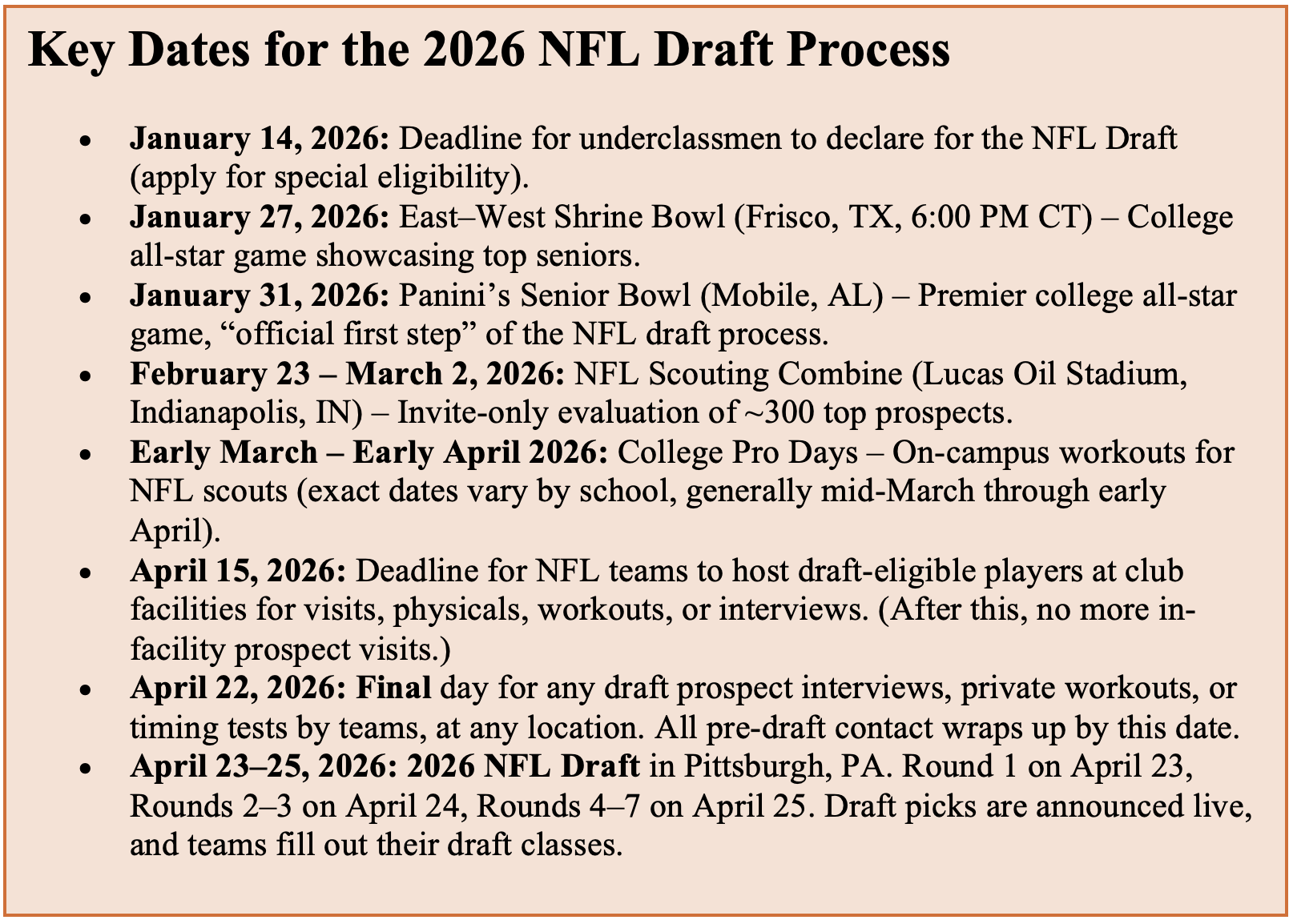
Below, we’ve compiled a timeline of major 2026 NFL Draft events, a compliance checklist to avoid any eligibility pitfalls, a step-by-step checklist for the entire process, and a short narrative of a fictional player’s journey to illustrate how it all comes together.
©2026 Ball 'N Play™ Sports Agency PLLC
(Note: Dates are subject to change if NFL schedule shifts, but these are the planned 2026 dates. The general timeline – declaration in Jan, all-star games late Jan, Combine late Feb, pro days March, draft late April – is consistent each year.)
Checklist: Road to the NFL Draft
Use this step-by-step checklist to track progress through the draft pipeline. You can print this page and literally check items off as you go.
Maintain NCAA Eligibility Fall–Winter
During your season, avoid any agent agreements or extra benefits. Keep focused on playing your best. If you’re considering leaving early, do not publicly declare or sign anything until ready.
Evaluate Your Draft Potential December
Solicit feedback from coaches and, if eligible, the NFL Draft Advisory Board (for underclassmen). Understand whether you are a likely draft pick and in what range (Day 1, Day 2, Day 3). Use this to inform your decisions.
Finish the Season & Graduation Tasks (If Applicable) Postseason
Complete your final college game (bowl game, championship, all-star if invited while still eligible). If you can graduate or finish classes early, great—otherwise coordinate academic responsibilities if you’ll be training elsewhere in the spring.
Decision Time (Underclassmen) Late Dec–Early Jan
Decide by early January whether you will declare for the draft. Discuss with family and mentors. Submit NFL special eligibility paperwork by the mid-January deadline if going pro. If staying in school, pause agent contact and consider injury insurance.
Select an Agent (After Season) January
Once eligibility is done (or you’ve declared), interview and sign with a reputable NFLPA-certified agent. Understand the contract (standard fee no more than 3% of your NFL contract; often 10–20% of marketing). Notify compliance (agent should also notify by law). Set a draft prep plan immediately.
Set Up Training January
Choose a training facility/program (often arranged via agent). Relocate if needed and begin Combine/pro day prep. Plan around all-star game commitments. Address injuries (surgeries/rehab) in consultation with agent and doctors.
All-Star Game Week Late January
If invited to Shrine Bowl or Senior Bowl, attend and compete. Check off: practices, evening interviews, game participation, and networking. If not invited, continue training uninterrupted.
Combine Invite & Prep Jan–Feb
If invited to the NFL Scouting Combine, complete NFL paperwork. Continue intense training. Do Combine-specific prep: mock interviews, Wonderlic practice, and ensure workout gear meets Combine guidelines.
NFL Scouting Combine Late Feb
Complete medical exams, attend interviews/meetings, participate in psychological tests, and perform in agreed drills (or notify teams if skipping due to injury). Aim to meet or exceed goals in each test. Maintain a positive, professional demeanor.
Pro Day Scheduling Post-Combine
Confirm your school’s pro day date and participation. Decide which drills you’ll do with your coaches and agent. If you didn’t go to the Combine, plan a full workout. If you did, decide what to repeat or skip.
Pro Day Performance March
Complete measurements and planned testing (40, vertical, etc.) plus positional drills. Emphasize any improvement areas from the Combine. Accommodate reasonable scout requests. Network respectfully, and thank your college staff.
Team Communications March
Respond promptly to phone/video interviews. Keep a log of interested teams and keep your agent informed. Maintain peak condition—don’t coast after pro day.
Private Workouts & Visits March–April
Coordinate workouts with your agent and be physically ready. Clarify equipment/setup needs. For Top-30 visits: follow travel instructions, review team notes (scheme, coaches), prepare questions, dress presentably, and follow up with a thank-you.
Medical Re-check (If Applicable) Early April
If invited back to Indianapolis for a medical re-check, attend. Bring updated medical info and doctor’s notes from your physicians.
Final Weeks Pre-Draft Mid-April
After April 15, new visits stop. Stay in shape, avoid risky activities, and keep communication open with your agent. Stay sharp on football knowledge for any remaining calls. Organize essential documents and personal logistics.
Draft Week Prep Late April
Finalize draft weekend plans. If attending the draft, confirm travel and outfit. If staying home, set up your watch environment. Compile team phone numbers, keep chargers ready, and prioritize sleep.
NFL Draft Day(s) Apr 23–25, 2026
Answer every call—even unknown numbers. Keep your agent looped in on team chatter. If not selected Day 1 or Day 2, reset mentally for Day 3 and the UDFA window. If drafted: celebrate, then execute—capture instructions and prepare for media calls.
Undrafted Plan (If Not Drafted) Immediately After
Pivot quickly. Evaluate offers by fit and bonus. Verbally commit, then honor the commitment. Announce as desired. Prepare for rookie minicamp—fast turnaround.
Post-Draft & Ready to Report Next 1–2 Weeks
Thank your support system, then coordinate with team liaisons on minicamp travel, playbook access, and paperwork (ID, banking info, etc.). Stay in shape and study the playbook to make a strong first impression.
This checklist might seem long, but the draft process itself is long. Tackle it step by step, and it will feel manageable. Communication and preparation are your best allies at every stage. And remember, your support system (family, coaches, advisors) should use this checklist too – they can help you stay on top of things so you can focus on performing your best.
One more thing: Enjoy the journey. It’s a once-in-a-lifetime experience. Yes, it’s high-stakes and stressful, but it’s also the bridge to your professional dreams. Years from now, you’ll look back on these months with stories to tell.
BNP™ Podcast Network
Triple A Ball ’N Play Podcast • BNP™ Fast Break • BNP™ Legal Watch • BNP™ IP Playbook • Chalk Talk™ Book Club • Character Corner
📩 bnppodcast@bnpsportsagency.com
🌐 bnpsportsagency.com
⚠️ Educational and informational content only. Not legal advice. No attorney-client relationship. Not an agent solicitation. Eligibility and draft outcomes are fact-specific.