Title IX “Surveys Are Not Tryouts” — Niblock v. Kentucky
Executive Summary
Background: In Niblock v. University of Kentucky (6th Cir. 2026), a class of female students challenged the University of Kentucky’s failure to offer varsity teams in equestrian, field hockey, and lacrosse. They argued this violated Title IX, a federal law prohibiting sex discrimination in federally funded education programs (including athletics)[1][2]. Title IX’s athletics regulations use a “three-prong test” to gauge compliance (see Title IX Compliance Framework below). The plaintiffs claimed UK did not meet any prong – particularly that it wasn’t fully accommodating women’s athletic interests and abilities. After a bench trial, the district court ruled in the university’s favor. In January 2026, the Sixth Circuit Court of Appeals affirmed that ruling, finding the students hadn’t proven enough interest and ability on campus to require adding these sports[3][4]. A concurring opinion questioned the long-standing Title IX framework in light of recent legal shifts on agency deference (like Loper Bright), suggesting future cases might revisit how Title IX is interpreted[5][6].
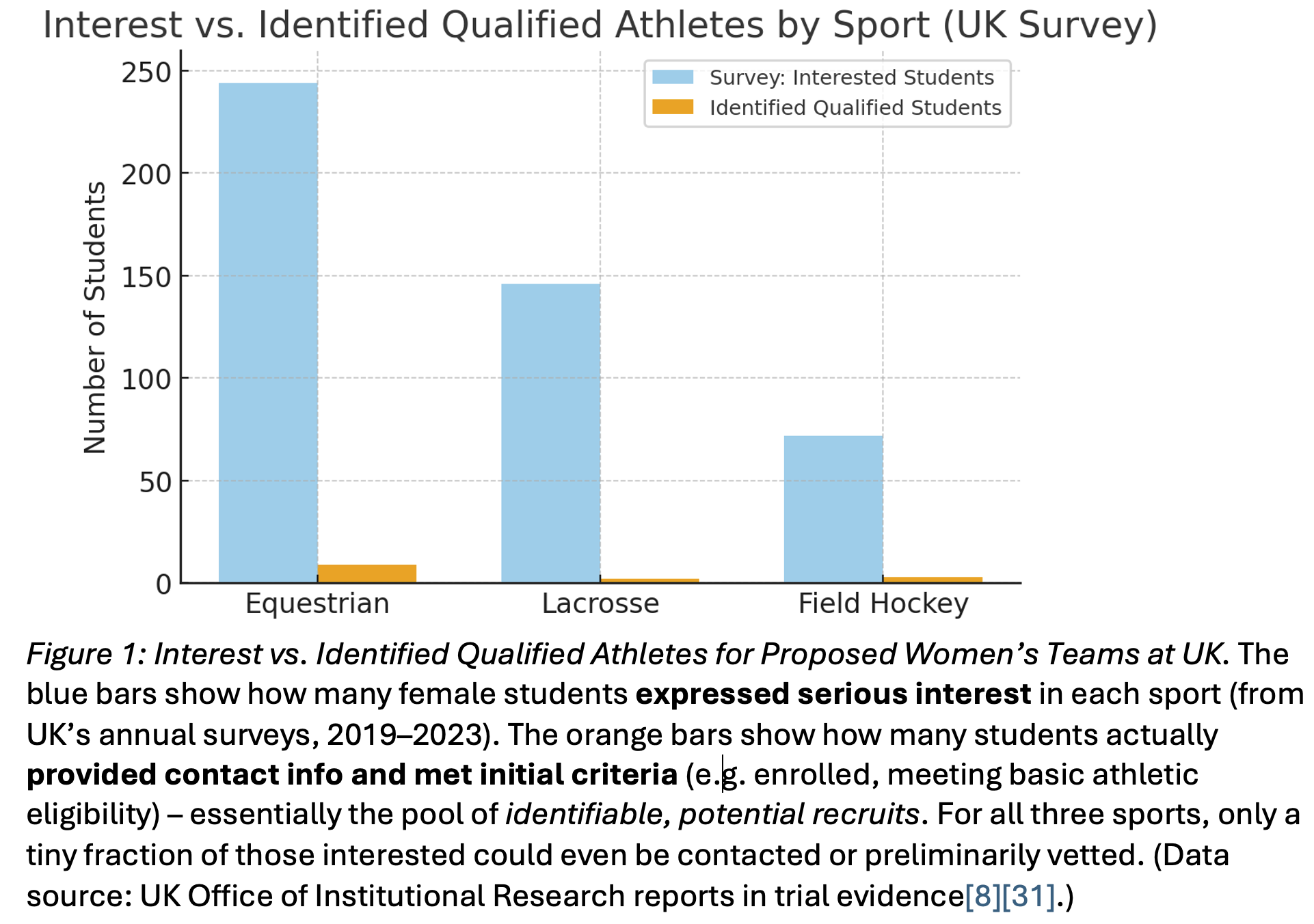
Key Findings: The courts acknowledged women were slightly underrepresented in UK’s varsity athletics relative to enrollment, but focused on whether a sufficient pool of capable athletes for the proposed sports existed. The trial evidence showed only 1 student ready to compete in equestrian and 2 in lacrosse, far short of viable team rosters[7]. UK’s annual interest survey indicated many women said they were interested – e.g. 244 for equestrian – but very few (only 9 in equestrian) provided contact information or could be verified as Division I-caliber athletes[8][9]. The courts held that interest surveys alone cannot compel a school to add a varsity team without concrete evidence that enough students have the requisite ability to compete[10]. They emphasized that Title IX doesn’t mandate creating teams “unable to compete at a meaningful level.”Instead, schools must “fully and effectively” accommodate interests and abilities – meaning a new team is required only if there’s proven demand and talent to sustain it[10][11].
Implications: The decision clarifies that under Title IX’s third prong, quality of interest matters as much as quantity. Schools can’t ignore genuine interest, but they are not expected to “manufacture” it either[10]. For advocates, the case highlights the importance of building evidence of athletic ability (not just interest) when seeking new women’s teams. The Sixth Circuit’s concurrence also fires a “warning shot” that the decades-old Title IX framework may be on shaky ground[5][6]. Citing Loper Bright, it questioned whether courts should continue deferring to the 1979 Policy Interpretation that created the three-prong test. If agency interpretations lose influence, Title IX compliance could shift toward a stricter reading of the statute’s nondiscrimination mandate, possibly affecting how proportional opportunities are measured (or even whether impact alone is actionable).
Wider Context: This case comes amid significant changes in collegiate sports. The NCAA’s recent approval of women’s flag football as an emerging sport gives schools a new way to expand female athletic opportunities. At the same time, the rise of Name, Image, and Likeness (NIL) rights – and a major settlement in House v. NCAA – are raising fresh Title IX questions about how athletes are compensated. The Housesettlement (currently under appeal) would allocate millions to athletes for past NIL use, but 90% would go to men, sparking objections that it undermines gender equity[12][13]. Going forward, colleges may face Title IX scrutiny not just in the distribution of roster spots and scholarships, but also in benefits like NIL-related payments, should those be considered part of an “education program or activity.”
Conclusion: Niblock v. University of Kentucky underscores that Title IX athletic compliance is a balancing act – schools must continually gauge student interest, but also ensure any new teams can genuinely compete. The case reaffirms the current standards for proving unmet demand, while hinting at potential legal shifts that could redefine those standards. For stakeholders, it offers both practical guidance (e.g. the weight given to surveys vs. objective evidence) and a prompt to stay tuned as Title IX jurisprudence evolves in light of broader legal and policy developments.
Case Overview (Plain Language)
In 2019, a group of female students at the University of Kentucky filed a lawsuit claiming the university was violating Title IX by not offering women’s varsity teams in equestrian, field hockey, and lacrosse[14]. Title IX is the law requiring schools to provide equal athletic opportunities for men and women. At UK, women made up slightly more than half of the undergraduate student body, but (at that time) significantly less than half of the varsity athletes. In practical terms, the plaintiffs argued there were hundreds of women “missing” from UK’s sports programs – that is, UK would need to add dozens or even a few hundred female roster spots to reach parity with male participation[15][16].
The university had several women’s club teams (including club equestrian, club field hockey, club lacrosse), but none at the varsity level in those sports[3]. The plaintiffs – led by students Elizabeth Niblock and Ala Hassan – wanted UK to elevate these sports to varsity status. They claimed there were plenty of interested and capable female athletes on campus to field competitive teams, citing a student survey where many women expressed serious interest in those sports[17][18]. The lawsuit sought to force UK to start varsity teams in each of the three sports to comply with Title IX. UK, however, disagreed – it argued that it was already meeting Title IX requirements and that the students had overestimated both the interest and the skill level available for new Division I teams.
District Court Proceedings: The case went to a bench trial (no jury) before Judge Karen Caldwell in the Eastern District of Kentucky[19]. Over three days, the court heard from nine witnesses and reviewed extensive evidence, including the survey data, testimony from students and coaches, and UK’s athletic participation records[20]. The central question was whether UK was fully accommodating its female students’ athletic interests and abilities. Title IX regulations give schools three different ways to comply (often called the “three-part test” or three prongs – see the sidebar below). The plaintiffs contended UK failed all three, but prong three (accommodating interests/abilities) became the focus, since UK clearly hadn’t met prong one (proportional numbers) and did not convincingly show prong two (a history of expanding opportunities)[21][22].
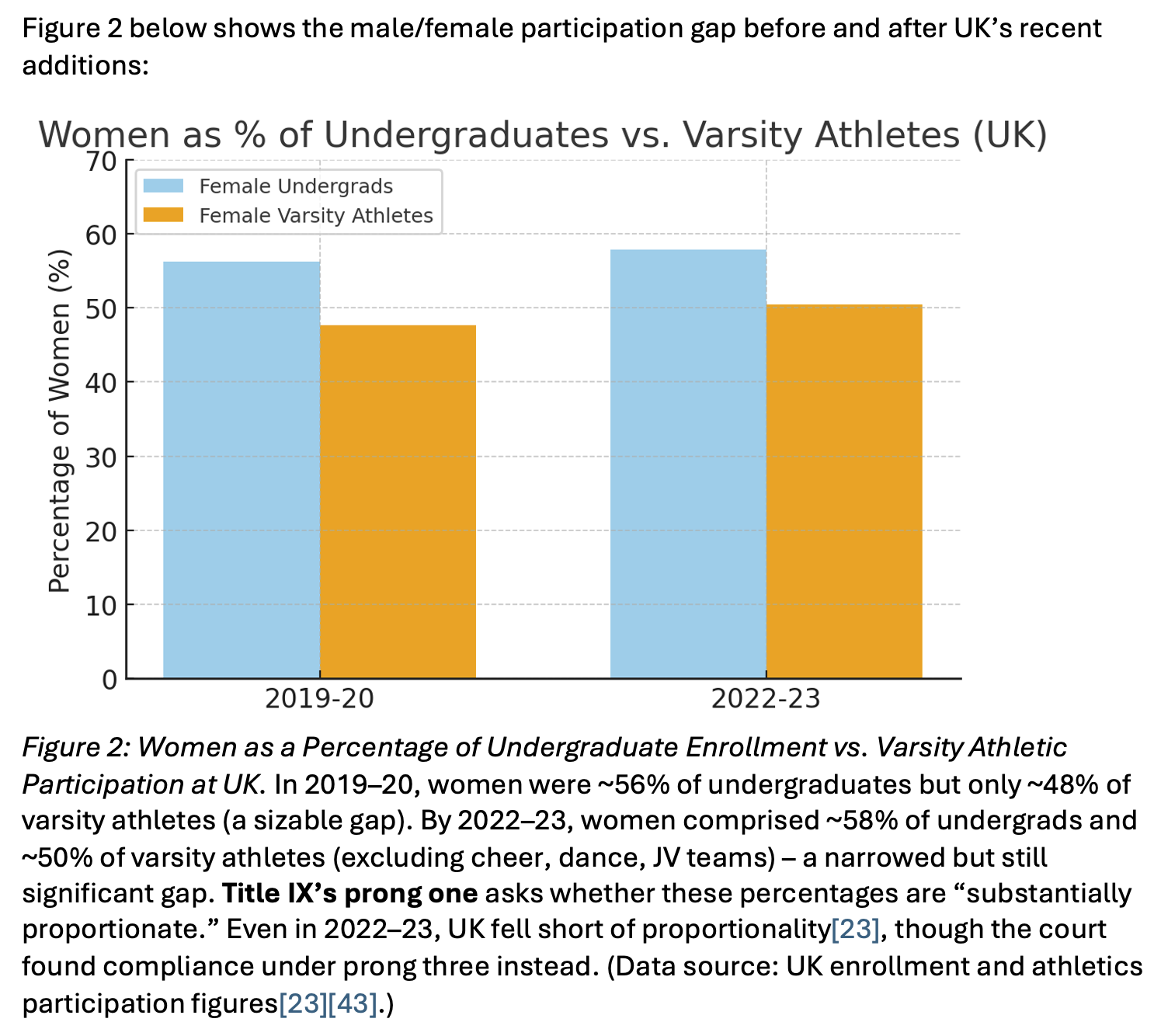
Judge Caldwell ultimately ruled for UK on October 28, 2024, finding no Title IX violation. She agreed that women were underrepresented in UK’s varsity athletics – for example, in 2022-23 women were about 57.8% of undergraduates but only 50.4% of varsity athletes (excluding certain teams)[23]. This meant UK failed prong one (substantial proportionality). She also found UK did not meet prong two, since it lacked a steady track record of adding women’s teams; any sporadic expansions hadn’t kept pace with rising female enrollment[24][25]. However, the crucial third prong went in UK’s favor: the judge concluded the plaintiffs did not prove there was an unmet interest and ability sufficient to require new varsity teams[26][4]. In other words, even though fewer women were playing varsity sports than expected, the evidence didn’t show that enough women at UK both wanted to and could play on new Division I teams.
Appellate Outcome: The plaintiffs appealed, but the Sixth Circuit Court of Appeals affirmed the lower court in January 2026[27][28]. Chief Judge Jeffrey Sutton wrote the opinion, joined by Judges Eric Murphy and Rachel Bloomekatz. The appellate court largely deferred to the trial court’s fact-finding – because whether a school has enough interested and able students for a new team is considered a factual question, the Sixth Circuit only reversed if the trial court “clearly erred”, which it found was not the case here[29]. In plain terms, the appeals panel agreed that the students hadn’t met their proof burden. The Sixth Circuit echoed that Title IX doesn’t guarantee perfectly proportional sports participation[27][30]; instead, it requires schools to accommodate genuine interest and ability. The panel concluded UK had done enough to gauge and accommodate interest – and that there simply weren’t enough ready-to-go athletes on campus to justify forcing UK to add the teams at that time.
The Evidence on Interest & Ability: A major point in the case was how to interpret UK’s annual student interest survey. Each year, UK surveys its students about what sports they’re interested in playing. Many students indicated interest in equestrian, field hockey, and lacrosse – for instance, 195–244 women said they were seriously interested in equestrian each year from 2019–2023[17]. On the surface, those numbers are more than enough to fill a typical equestrian roster (~40). However, a closer look showed potential issues. The survey was anonymous unless students chose to leave their contact info for follow-up. Most did not leave contact information. In fact, from 2019–2023, only at most 9 students total left their info for equestrian, 3 for field hockey, and 2 for lacrosse – far too few to form entire teams[8][31]. UK argued (and the court agreed) that it can’t treat anonymous survey responses as equivalent to actual recruits. If students don’t identify themselves, the school can’t verify their skills or even reach out to them to join a new team[31][32].
Trial testimony further cast doubt on the immediate viability of the teams. The coaches of the club teams testified about the current skill and commitment levels. According to Judge Sutton’s summary, the club lacrosse coach described participation as “very lackadaisical,” and the club field hockey team was poorly organized[33]. The equestrian club lacked high-level training opportunities, raising safety concerns about jumping straight to NCAA competition[33]. These details suggested that, while interest existed, the pipeline of talent ready for Division I competition was thin. Sutton’s opinion highlighted that at trial only one female student testified she “wanted to and could compete” in equestrian, and two for lacrosse – “far short of the numbers to field each team” in those sports[34]. Essentially, the evidence showed a wish for teams, but not a critical mass of varsity-capable players. Figure 1 below illustrates the disparity between expressed interest and identified recruits for each sport at issue, based on the survey data:
©2026 Ball 'N Play™ Sports Agency PLLC
Given this evidence, both courts found that UK had effectively accommodated female students’ interests – not by providing the teams plaintiffs wanted, but by showing that the lack of those teams did not leave a proven, unmet demand. The Sixth Circuit agreed that an anonymous “snapshot” of interest is not enough on its own[11]. There must be objective indications that a sufficient number of students have the ability to form a competitive team (or at least could develop that ability with reasonable recruiting). Judge Sutton noted the survey was still “probative” – it gave a clue that interest was out there – but by itself it didn’t establish that UK had Division I-ready athletes waiting in the wings[11]. And because so few students identified themselves, UK could not be faulted for failing to follow up individually with the anonymous respondents[9]. Sutton put it bluntly: the survey results, being anonymous and unverified, could not overcome the “glaring” lack of hard evidence that enough women on campus could compete at the required level[9].
UK’s Actions: Notably, after the lawsuit was filed, UK did take steps that boosted its female athlete numbers (though these moves were controversial in the litigation). In 2020–21, UK started counting its cheerleaders and dance team members as varsity athletes, and in 2021–22 it added a women’s junior varsity (JV) soccer team (a non-NCAA team) and even a varsity “stunt” team (competitive cheer)[35][36]. These additions dramatically increased the official count of female participants, narrowing the participation gap on paper. For example, including cheer and dance, UK’s percentage of female varsity athletes jumped from ~48% in 2019 to ~54.5% in 2022[23]. However, the court was skeptical of counting those teams for Title IX. Cheerleading and dance are not recognized as varsity sports by the NCAA or the U.S. Department of Education[37][38]. And the JV soccer team, while providing additional women’s roster spots, wasn’t a full varsity program. Judge Caldwell ultimately decided not to count cheer and dance in the Title IX analysis[39][40]. Excluding them meant the female athlete percentage was only ~50% in 2022–23, leaving a gap of about 7.4 percentage points below female enrollment[39][40]. This translates to needing roughly 116 more female roster positions to reach parity[41][42].
©2026 Ball 'N Play™ Sports Agency PLLC
Despite these numbers, the courts didn’t penalize UK for the remaining gap because of prong three. Essentially, Judge Caldwell and the Sixth Circuit said: Yes, there is a statistical underrepresentation of women, but Title IX doesn’t demand a quota. It demands that schools accommodate all the interest and ability that are present. In this case, they found UK was already accommodating what they saw as the existing interest/ability (through its current women’s teams and perhaps the stunt/JV additions), and that there wasn’t a demonstrable surplus of talent being left on the sidelines.
Bottom Line of the Ruling: UK did not have to add varsity equestrian, field hockey, or lacrosse. The plaintiffs “failed to satisfy the third prong” because they couldn’t show enough ready, willing, and able women to form those teams[44][34]. The Sixth Circuit underscored that Title IX “does not require proportional representation of students on sports teams”[27][30] or the creation of new teams based on interest surveys alone[45][46]. Instead, schools must fully and effectively accommodate female students’ athletic interests to the extent those interests are present and demonstrable. In Sutton’s words: “Title IX does not require schools to manufacture interest in a team or field teams unable to compete at a meaningful level. … It is not the role of federal courts to make a university create varsity teams when the evidence fails to show that its student body currently can fill their ranks.”[10]
The plaintiffs, understandably, were disappointed. Their attorney, Lori Bullock, stated they were exploring further appeals[47]. However, absent an en banc rehearing or Supreme Court review (both of which are discretionary and relatively rare), the Sixth Circuit’s decision is likely the final say in this case. It serves as a notable precedent within the Sixth Circuit (which covers Kentucky, Ohio, Michigan, Tennessee) for how courts should handle Title IX claims seeking new sports teams.
Title IX Compliance Framework: The Three-Prong Test (Legal Commentary)
Title IX’s athletics regulation (45 C.F.R. § 86.41(c)) requires schools to “provide equal athletic opportunity for members of both sexes.” But how do we measure “equal opportunity”? In 1979, the Department of Health, Education, and Welfare (predecessor to today’s Dept. of Education’s Office for Civil Rights, OCR) issued a Policy Interpretation that introduced the famous three-part test[48][49]. This test gives schools three separate ways (prongs) to prove they are accommodating students’ athletic interests and abilities:
Proportionality (Prong One): Are participation opportunities for male and female students provided in numbers substantially proportionate to their respective enrollments?[50] If women are 55% of the undergraduate population, are about 55% of the varsity athletes women (give or take a small margin)? If yes, the school is in compliance. This is often seen as a “safe harbor” – meet prong one, and no one can argue you’re shortchanging one sex. But if there’s a significant gap (like women 55% of students but only 45% of athletes), the school fails prong one[43][51].
Continual Expansion (Prong Two): If one sex is underrepresented, has the school demonstrably and continuously expanded its athletics programs for that sex in recent history?[52][2] This prong gives credit for a “history and continuing practice of program expansion” for the underrepresented sex. For example, if a university added women’s soccer in 2018, women’s golf in 2020, and is planning women’s lacrosse next year, it can show a pattern of growth. The idea is that the school is actively working to catch up to student interest. If such a track record exists, the school can be found compliant even if proportionality isn’t met yet. In Niblock, UK tried to invoke prong two, but the court found the evidence lacking – any expansions were too little, inconsistent, or too late[24][35].
Full Accommodation of Interest (Prong Three): If a school can’t show proportional numbers or expansion, the third prong asks: Is the school fully and effectively accommodating the interests and abilities of the underrepresented sex (usually women) with its current programs?[49] In essence, are there women on campus who want to play a sport (and have the ability to compete) but cannot because the school doesn’t offer that opportunity? If the answer is no – i.e. all interested/able women are being accommodated by existing teams – then the school is in compliance. If the answer is yes – there is a sport (or sports) for which there is sufficient unmet interest and ability among women – then the school likely needs to add that sport or otherwise provide those opportunities. This prong often boils down to whether there is a “viable team” worth of athletes not being served[53][54]. Courts have described this as a “high standard: it demands not merely some accommodation, but full and effectiveaccommodation” of female athletes’ interests[55].
A school only needs to satisfy one of these prongs at any given time[56]. Think of them as three doors to compliance – open any door, and the school is safe from a Title IX effective accommodation claim[56]. For example, many large football schools rely on prong one by balancing football’s huge male numbers with lots of women’s teams (or large rosters on women’s teams). Other schools, especially smaller colleges, might not have proportional numbers but have been steadily adding women’s sports over time, using prong two as a defense. Prong three is a catch-all: a school that hasn’t reached proportionality and isn’t expanding can still argue that it meets student demand with what it has (as UK did here).
Burden of Proof: In a Title IX lawsuit, the plaintiffs (usually female students) carry the burden to first show that prong one isn’t met – essentially, a significant participation gap[21][57]. If they can’t even show that, the case fails (since if opportunities are proportional, by definition interests are effectively accommodated). If they do show a gap, the burden shifts to the school to prove prong two (a history of expansion)[22]. If the school can prove prong two, the plaintiffs lose. If the school does not, plaintiffs then must prove prong three – that there is a sport (or sports) for which there is unmet interest/ability among women[58][59]. In Niblock, prong one was clearly not met (UK had a gap of either 59 or 116 female spots, depending on what counted[60][61]). UK did not convince the court on prong two (no sufficient “continuing practice” of adding women’s teams)[24][35]. Thus the decisive issue was prong three, and the burden was on the plaintiffs to prove a substantial unmet interest and ability. The courts found they failed to meet that burden.
It’s worth noting that the three-prong test has been upheld by multiple courts over the years against various attacks. Schools sometimes criticize it as imposing a “de facto quota” (especially prong one). Title IX’s statute even has a clause (section 1681(b)) saying nothing requires preferential treatment or numerical quotas[62][63]. But courts (like the First Circuit in Cohen v. Brown Univ.) have consistently held the three-part test is not a quota, but a flexible standard[64][65]. Prong one doesn’t require exact proportionality – only that any disparity is not significant enough to field another team[51][66]. In UK’s case, even a 3% or 7% gap translated to dozens of roster spots – which is enough to field a new team, so UK couldn’t claim proportionality. But if a school’s gap is, say, 5 athletes, that would likely be deemed “substantially proportionate.”
Key precedents cited in Niblock include Horner v. Kentucky High School Athletic Ass’n (6th Cir. 1994), which established that plaintiffs under prong three must show sufficient unmet interest and ability to form a team[53][54]. Another is Roberts v. Colorado State Board of Agriculture (10th Cir. 1993), a case where women sued after a women’s team was eliminated – it underscored that the inquiry focuses on current, not potential or future, interest[67]. Cases like Cohen and Portz v. St. Cloud State Univ. (8th Cir. 2021) describe prong three’s standard as “high but not absolute” – schools aren’t required to add a team for every small pocket of interest, but they must for clear unmet demand[68][69]. The upshot is that prong three sets a high bar: if there’s a viable team’s worth of women who have interest and ability that’s not being met, the school is expected to accommodate them, unless it can point to prong one or two as justification.
Analysis of the Sixth Circuit’s Decision
The Sixth Circuit’s opinion in Niblock was relatively narrow, sticking to the specifics of the case rather than making sweeping new law. However, it included a separate concurring opinion (by Chief Judge Sutton, joined by Judge Murphy) that raised big-picture questions about Title IX athletics jurisprudence. We’ll break down the main points:
Affirming on the Facts: Interest and Ability Under Prong Three
The core of the Sixth Circuit’s majority opinion was that Judge Caldwell’s fact findings were not clearly erroneous[29]. The appellate court agreed that plaintiffs had not proven the existence of a sufficient number of interested and able female students to field varsity teams in equestrian, field hockey, or lacrosse[26][4]. This aligns with earlier cases like Pederson v. LSU (5th Cir. 2000) which treat the “sufficient interest and ability” question as factual. The Sixth Circuit emphasized a few things:
Standard of Review: Because the trial judge’s determination of interest/ability is a factual matter, the Sixth Circuit reviewed it under the clear error standard[29]. This deferential standard means the trial court’s finding stands unless a significant mistake is evident. The plaintiffs had tried to argue that whether a team is “viable” might be a legal question (which would get closer scrutiny on appeal), but the Sixth Circuit rejected that, citing precedent that it’s factual[70].
Burden and Definition of “Viable Team”: The panel quoted the Horner case from the Sixth Circuit and others to reaffirm that plaintiffs must show (i) sufficient interest and ability among the underrepresented sex, (ii) not already met by existing programs, and (iii) in numbers sufficient to form a team “to compete.”[53][54] It stressed the phrase “to compete,” meaning the team could compete at a typical collegiate level, not just exist in name. This implicitly rejects an “if you build it, they will come” approach; instead, there must be evidence the team would be viable now (or in the very near term) with students already on campus[71][72]. In Sutton’s words, the inquiry focuses on “levels of interest and ability extant in the student body,” not hypothetical future recruits[73].
Evaluation of Evidence: The Sixth Circuit ticked through the categories of evidence:
· Student Testimony: Only a handful of students testified to being ready and willing to play at the varsity level (1 for equestrian, 2 for lacrosse). That was deemed insufficient[34].
· Club Teams: The status of the club teams did not show an existing competitive bench of athletes. Testimony about lackluster commitment in club sports hurt the plaintiffs’ case[33].
Surveys: While the interest survey indicated many women wanted the teams, the court agreed it “did not establish Division I ability” – especially given the lack of follow-up info and verification[11]. The majority was convinced by evidence that only a few students left contact info or had competitive experience, and that UK can’t be expected to rely on unsubstantiated survey checkboxes to create a new team[74][75].
Expert Testimony: The plaintiffs had proffered an expert witness to interpret the survey data (presumably to argue it showed significant unmet demand). However, the trial court excluded that expert under the Daubert standard (see Expert Testimony Sidebar below). The Sixth Circuit upheld this exclusion, noting the expert admitted she was not a survey design specialist[76]. Without that expert analysis, the plaintiffs had to rely on the raw numbers, which the court found unpersuasive without context.
All told, the Sixth Circuit agreed that UK’s approach to assessing interest was reasonable (if not perfect). The university’s interest survey was one tool, and the court faulted UK a bit for focusing too narrowly on the few students who left contact info[74][77]. But importantly, even counting broader indications (like students saying they were recruited by other colleges – dozens reported that for equestrian[75]), the court found no clear error in Judge Caldwell’s conclusion: that the interest wasn’t coupled with sufficient present ability to mandate a new team. The message: schools can use surveys to gauge interest, but they are not obliged to create a team unless interest is backed by evidence of ability and commitment. Anonymous, one-click expressions of interest are not enough.
Sutton’s Concurrence: Questioning the Three-Part Test Post-Loper Bright
While the majority “assumed” the validity of the three-prong framework (because the case could be decided on prong three regardless)[26][4], Chief Judge Sutton wrote a separate concurrence casting doubt on that framework for the future[5]. This is a nuanced but important part of the decision, especially for legal observers. Here’s what the concurrence argued:
Chevron Deference and Loper Bright: The three-part test comes from a 1979 interpretive rule by OCR, not directly from the Title IX statute itself. Traditionally, courts have often deferred to such agency interpretations (under the doctrine of Chevron deference for statutes and Auer/Seminole Rockdeference for agency interpretations of their own regs). However, in the recent Supreme Court case Loper Bright Enterprises v. Raimondo, 144 S. Ct. 2244 (2024), the Court signaled a retreat from Chevron deference[78][79]. The concurrence in Niblock seizes on this: it notes that modern doctrine “no longer reflexively defers” to agency interpretations of statutes[6]. Sutton pointed out that Loper Bright and another case, Kisor v. Wilkie, 588 U.S. 558 (2019) (which limited Auer deference), suggest courts should interpret statutes and regulations based on text and not simply bow to longstanding agency practices[80][6].
1979 Policy Interpretation in Jeopardy?: Sutton’s concurrence basically invites a re-examination of the 1979 three-part test. He noted that the Sixth Circuit (and others) have applied it for years, but in light of Loper Bright and Kisor, one could question whether the test goes beyond what Title IX or its regulations actually require[79][81]. Importantly, Title IX itself never mentions athletic proportionality or interest accommodation – those concepts come from regulations and policy guidance. If courts take a “text-focused” approach, as Sutton urges, they might find that Title IX guarantees equality in a narrower sense (e.g. no intentional discrimination) rather than requiring these detailed balancing acts.
Major Questions Doctrine: Judge Caldwell had actually addressed this in the trial opinion, noting that the three-part test didn’t trigger the “major questions” doctrine (a doctrine that prevents agencies from making big policy decisions without clear congressional authorization)[82][83]. But Sutton’s concurrence hints that Title IX’s current application – especially prong one’s implicit push toward proportionality – could be seen as agency overreach in today’s judicial climate[84][85]. Sutton pointed out that Title IX was enacted under Congress’s Spending Clause power (like a contract with schools accepting federal funds), so its terms must be clear. A school might argue that nothing in the statute clearly says “thou shalt have gender-balanced sports participation,” so imposing that via guidance is questionable after Sandoval (which limited private suits to cases of intentional bias)[86][87].
Anti-Quota Principle: The concurrence also highlighted Title IX’s intent requirement and its anti-quota clause (mentioned above). Sutton referenced Supreme Court decisions (like Alexander v. Sandoval, 532 U.S. 275 (2001) and Jackson v. Birmingham Bd. of Ed., 544 U.S. 167 (2005)) that focus Title IX’s private right of action on intentional discrimination[86][88]. He mused that forcing schools to juggle numbers to achieve gender proportionality might stray from Title IX’s core, even raising a specter of “reverse discrimination” if, for instance, schools cap men’s teams to comply (something that has happened, e.g., cutting men’s wrestling or gymnastics – which he cited as a concern)[89][90].
In short, Sutton (joined by Judge Murphy) signaled that the next time a case squarely raises the issue, the Sixth Circuit might be open to revisiting whether the 1979 three-part test should be given binding deference or any deference at all[78][79]. It was a concurrence, so it’s not law – the majority explicitly did notdecide this question, because the plaintiffs “accept[ed] the validity” of the three-part test for purposes of this case[91]. Sutton himself wrote that the court would wait for an “appropriate case” to reconsider the framework[92][79]. But the mere fact he wrote this concurrence is telling. Chief Judge Sutton is a well-known jurist whose opinions often influence the Supreme Court; his skepticism suggests that the days of Chevron-like deference in Title IX athletics may be numbered.
For practical purposes, unless and until a court actually throws out the three-prong test, schools should still follow it – it remains the OCR’s operative guidance and the test used by courts. But the concurrence indicates a possible future shift: perhaps a move toward focusing solely on whether schools intentionally treat sexes differently in athletics (like denying women a team even if they demonstrate they want one and can field one), rather than these formulaic tests.
Handling of Survey Evidence and Expert Testimony
Another notable aspect was how the courts handled survey evidence and expert testimony, which has implications beyond this case. The Sixth Circuit affirmed that courts can be critical of survey data in Title IX cases, especially if not tied to objective measures. UK’s survey was a key piece of evidence; interestingly, it was UK itself that designed and used the survey to monitor interest. But when the results showed interest in sports UK didn’t sponsor, a question arose: how much weight should those results carry?
The courts drew a line between interest and ability: - A survey can effectively measure interest (since a student is the best judge of her own interest). On that front, Judge Caldwell actually found the plaintiffs “easily” proved unmet interest – citing the dozens of women who indicated serious interest in each sport[17][18]. But interest alone isn’t enough; Title IX demands interest and ability. - Ability is harder to gauge via survey. As Caldwell noted, a student’s self-report of her skill or experience is only one indicator[74][31]. OCR’s 2010 clarification letter (cited in the trial) recognizes this, advising schools to look at things like competitive experience or tryouts. In Niblock, because the survey was anonymous, UK couldn’t verify who among the interested students had real playing experience or talent. The few data points it did have – e.g. some students said they had been recruited by other colleges in these sports – suggested there were indeed some skilled individuals (for equestrian, 28–46 women said they’d been recruited elsewhere)[75]. The plaintiffs argued that was a sign of latent ability on campus being ignored. The court, however, wasn’t willing to jump from “X students said they were recruited” to “therefore a full team can be fielded.” They would have liked to see those recruits identified and perhaps evidence like “this student was All-State in lacrosse,” etc. Absent that, the survey remained a rough tool.
On expert testimony: The plaintiffs had an expert witness ready to interpret the survey data, likely to testify about survey methodology or statistical significance of the interest levels. But UK challenged her under Daubert v. Merrell Dow Pharmaceuticals (1993) – the case setting the standard for admissibility of expert evidence. The trial court excluded the expert, agreeing with UK that her expertise in survey design was lacking[76]. This left the plaintiffs without an expert to bolster the survey findings. The Sixth Circuit upheld that exclusion, suggesting it was within the trial judge’s discretion (these decisions are reviewed for abuse of discretion, a high bar)[76].
Expert Testimony Sidebar: The Daubert Standard
In federal courts, judges act as “gatekeepers” for expert evidence[93]. Under Daubert, an expert’s testimony must be both relevant and reliable. Relevant means it will help the judge or jury understand something useful about the case[93]. Reliable means the expert’s methodology is scientifically valid and properly applied to the facts[93]. If an expert is not qualified in the specific area, or if their analysis is not based on sound methods, the judge can exclude it. Here, UK argued that the plaintiffs’ survey expert was not actually an expert in survey design/analysis (perhaps her expertise was in another field, like education or sociology, but not the nitty-gritty of survey science). The expert apparently admitted survey design was not her specialty[76], undermining her reliability on that topic. The court’s exclusion of her testimony is a reminder: bringing in a qualified expert is crucial, especially in data-heavy Title IX cases. A well-qualified statistician or social scientist might have been able to persuade the court that the interest numbers were statistically significant evidence of unmet demand. But without that, the raw survey data was more easily discounted as informal and inconclusive.
Other Legal Cross-Currents
The Sixth Circuit’s opinion, particularly Sutton’s concurrence, touched on broader legal concepts that inform how Title IX cases are approached:
Intent vs Impact: There’s an ongoing debate whether Title IX (like Title VI in race cases) only prohibits intentional discrimination or also covers disparate impact (policies that aren’t intentionally biased but result in unequal outcomes). Courts have allowed Title IX athletics claims without proof of discriminatory intent – effectively disparate impact claims (e.g., women underrepresented). Sutton’s concurrence flagged cases like Alexander v. Sandoval which held no private right of action for disparate impact under Title VI (and by extension Title IX, some argue)[86][88]. If courts were to adopt that view, then plaintiffs might have to show a school intentionally favored men or ignored women, a much higher bar than showing a statistical disparity. Sutton hinted that offering more spots to men (because of football, etc.) might not be intentional discrimination so much as a consequence of different levels of interest – a contentious proposition, but one that could gain traction in courts less inclined to enforce equity via impact alone.
Cutting Men’s Teams (“Reverse” Discrimination): Title IX is often criticized for causing schools to cut men’s teams to comply with prong one. The concurrence cited cases and a well-known concurrence by Justice Scalia in Ricci v. DeStefano (a race case) warning that trying to equalize outcomes can lead to discrimination against the overrepresented group[89][90]. For example, some schools eliminated men’s wrestling or track to help meet proportionality. Sutton’s point was to highlight the tension: if Title IX enforcement pushes too hard for proportional numbers, schools might achieve it by capping men’s opportunities – raising the question, is that really what Title IX intended? (Legally, courts have generally said it’s permissible for schools to make such choices; Title IX doesn’t protect men from cuts if it’s done to accommodate women’s interests. But politically and socially, it’s a sensitive issue.)
Sex-Segregated Sports: Interestingly, the concurrence even touched on the fundamental fact that sports are segregated by sex, something that, as a constitutional matter, is unusual (imagine separating college classes or clubs by gender – impermissible in most contexts). Sutton referenced United States v. Virginia (the VMI case) and even Brown v. Board of Education analogies, musing on the “oddity” of sex-segregated teams[94][95]. This is more of an academic point – no one is seriously arguing right now to integrate most sports by sex – but it shows the concurrence’s theme of re-examining assumptions. If we strictly applied anti-discrimination principles, we might have co-ed teams (which in practice would likely mean far fewer women playing, given physiological differences in many sports). Title IX’s regulations explicitly allow sex-separate teams for contact sports and where selection is based on competitive skill. The concurrence isn’t suggesting changing that, but it’s highlighting the legal paradox: to provide equal opportunity, we separate by sex, but then we have to balance those separate opportunities. It’s a complexity at the heart of Title IX athletics compliance.
Broader Implications of Niblock
For schools: This decision provides a roadmap to defending against Title IX expansion claims. If an institution is not proportional and hasn’t been adding teams lately (so prongs one and two are out), it should be prepared to demonstrate how it knows it’s already accommodating women’s interests. Conducting regular interest surveys (as UK did) is one tool. But equally important is what a school does with the results. A lesson from Niblock is that schools might want to follow up on survey indications – for instance, if dozens of women show interest in a sport, a proactive school could hold tryouts or informational meetings to gauge ability and seriousness. If UK had done a well-publicized tryout for, say, lacrosse, and only a handful of qualified women showed up, that would be powerful evidence supporting what the court found. Conversely, if 30 skilled women showed up, that would undercut UK’s case. In Niblock, UK’s approach of relying on anonymity worked out for them legally, but it was somewhat risky (and drew criticism from the plaintiffs and even Judge Caldwell for “ignoring” other data[74][77]). The safer path for schools is: when you find interest, explore it. If you find insufficient ability or numbers, document that – it could save you in court. If you find sufficient interest/ability, adding the team is the better move (or you’ll likely face a losing lawsuit).
For students and advocates: Niblock shows the evidentiary hurdle they must clear. It’s not enough to point to a participation gap and student interest. They should gather evidence of feeder talent – e.g., highlight club sport achievements, high school stats of current students, or instances of women leaving the school to play elsewhere due to lack of a team. Expert testimony can be crucial to interpret surveys or demonstrate that a team could be competitive (for instance, an expert could testify that other schools started a team and quickly became competitive, implying the same could happen at UK). Also, engagement with the athletic department’s process is key – here, some students had directly requested varsity teams and were turned down[96], which helped show they tried the normal channels.
Another implication: the case might prompt OCR to revisit its guidance. Sutton’s concurrence is a shot across OCR’s bow. With the Supreme Court’s direction in Loper Bright, agencies might preemptively adjust policies to ensure they’re on solid footing. It’s possible (though by no means certain) that OCR could update Title IX athletics guidance in the future, perhaps clarifying use of surveys or the definition of “effective accommodation.” Under the Trump administration in early 2020s, OCR actually issued (and then rescinded) some guidance on surveys – e.g., a controversial 2005 OCR clarification (later withdrawn) allowed email surveys with non-responses counted as lack of interest. If deference wanes, OCR might be cautious with any guidance that tilts too far in one direction.
Finally, Niblock may have an influence beyond athletics. It resonates with a broader judicial trend of scrutinizing agency-driven doctrines. We see this in debates about Title IX’s application to areas like sexual harassment procedures (where courts question some guidance) and, relevant here, in how NIL and athlete compensation might be handled under Title IX.
Connection to Current Developments in College Sports
The Niblock case sits at the intersection of traditional Title IX athletics equity and the rapidly evolving landscape of college sports. Let’s examine a few timely connections:
1. NCAA’s Approval of Women’s Flag Football as an Emerging Sport
In January 2026, the NCAA officially added women’s flag football to its Emerging Sports for Womenprogram[97][98]. This is significant because flag football is a fast-growing sport that could help schools like UK address participation gaps. Emerging sports status is a pathway to full championship status once enough schools sponsor the sport (minimum 40). As of 2025, about 40 schools already had women’s flag football teams (mostly at NAIA or club level), and the NCAA projected 60 by spring 2026[99][100]. Even a powerhouse like Nebraska announced it will add women’s flag football as a varsity sport (the first Power-5 school to do so)[100][101].
Impact on Title IX compliance: Flag football’s emergence gives universities a new option to expand women’s opportunities. For schools struggling with prong one proportionality (especially those with large football programs for men), adding women’s flag football could be attractive. It’s a sport that can carry a decent roster (20–30 athletes)[102][103], and interest is high thanks to the sport’s popularity and even its upcoming debut in the 2028 Olympics. An emerging sport is often appealing because NCAA rules allow some leeway and support in developing the program. UK, for instance, could consider adding flag football instead of, or in addition to, the sports plaintiffs asked for. If interest exists on campus (and given many high schools are starting girls’ flag football, it likely will soon, if not already), doing so could help UK fulfill any unmet demand and improve its prong one standing.
More broadly, the NCAA’s move underscores a positive trajectory: instead of cutting men’s sports to comply with Title IX, schools and the NCAA are trying to grow women’s sports. The NCAA’s Emerging Sports program has been a success in the past (it helped sports like rowing, women’s ice hockey, and women’s wrestling gain championship status over the years[104][105]). Flag football might similarly become an NCAA championship sport in a few years. For Title IX, each new sport is a new avenue for women’s participation. It reflects Title IX’s influence too: many of these emerging sports are chosen specifically because they can attract participants and help schools balance numbers. (E.g., rowing was added at many schools in the 1990s largely to provide large roster spots for women to offset football’s huge rosters for men.)
2. Name, Image, Likeness (NIL) Rights and Title IX Equity
The advent of NIL rights in 2021 allowed college athletes to earn money from endorsements, sponsorships, and other uses of their name, image, or likeness. While NIL deals are between athletes and third parties (not the schools), there’s growing discussion about whether NIL impacts Title IX considerations. By law, schools cannot directly pay athletes for performance (outside of scholarships and cost-of-attendance stipends), and NIL was seen as outside Title IX because the money isn’t coming from the school. However, schools do facilitate NIL opportunities to some extent (through education, connecting athletes with resources, etc.).
The key Title IX issue is whether schools must ensure equal access to NIL resources and whether disparities in NIL earnings could trigger Title IX scrutiny if the school is involved. For instance, if a school’s booster collective predominantly funnels deals to football and men’s basketball players, could female athletes claim the school is effectively sponsoring unequal benefits? There isn’t a clear answer yet, but the Department of Education under the Biden administration signaled that all financial assistance to athletes – potentially including NIL-related benefits – should be considered under Title IX[106][107]. In fact, a fact sheet in January 2025 suggested exactly that, although it was quickly rescinded by the next administration[106][108].
Consider also future scenarios: There are lawsuits and movements pushing for athletes to be deemed employees or for revenue-sharing models (where schools would pay athletes a share of sports revenue). The House v. NCAA settlement, discussed below, even includes an option for schools to create revenue-sharing arrangements going forward[109][110]. If schools start paying athletes directly – whether as employees or via stipends – those payments would almost certainly be subject to Title IX equal treatment rules. That means schools couldn’t, for example, pay every football player $50,000 and every female swimmer $5,000 without a strong nondiscriminatory justification. Equality or at least proportionality in pay would become a major issue. Some college sports leaders have mused about needing to create collective bargaining or other systems, and Title IX will be a piece of that puzzle[111][112].
Right now, NIL has already shown disparities: male athletes, especially in football and men’s basketball, have generally garnered the largest deals. Women athletes in a few sports (notably basketball, volleyball, gymnastics) have done well too, and in some cases, female social media influencers in college sports out-earn many men. But if a pattern emerges that male athletes as a group are deriving significantly more benefit and the school is implicated in facilitating those opportunities, expect advocacy groups to push for remedies.
The Niblock case itself doesn’t deal with NIL, but its context – ensuring equal opportunities – could extend conceptually. One could imagine an argument: Title IX required schools to provide equal scholarship money (within proportionality to participation) historically; perhaps it should also ensure equal NIL support or equal shares if schools move to pay athletes. For now, schools should be mindful: any program they run to assist athletes with NIL (like workshops, access to sponsors, etc.) should be offered equally to women and men athletes.
3. House v. NCAA Settlement – Gender Equity in Athlete Compensation
The reference to House v. NCAA is highly pertinent. This was a federal antitrust lawsuit (actually a consolidation of cases: House, Oliver, and others) where current and former athletes sued the NCAA for capping athlete compensation (like NIL earnings, etc.). In June 2025, a proposed $2.8 billion settlement was reached[113]. Importantly, how that money would be distributed raised Title IX red flags. The settlement formula based payouts on the sport’s share of revenue – meaning athletes from revenue-heavy sports (football, men’s basketball) would get the largest shares[13]. It turned out that approximately 90% of the money would go to male athletes, and only ~10% to female athletes[114][115]. For example, many women would get token amounts (as low as $125 per year they played) while some men could get tens of thousands[115].
This disparity prompted objections from women athletes and advocacy groups (like the National Women’s Law Center) who argued the settlement violates Title IX’s mandate of gender equity[114][116]. They contend that because the payments are being facilitated through schools (it’s essentially compensation for athletes for educational participation that was previously restricted by NCAA rules), Title IX should require that women athletes get equal treatment. In other words, if schools are now allowed to pay athletes via this settlement, they must do so in a nondiscriminatory way[117].
In August 2025, Judge Claudia Wilken (who oversees the case and is known for the O’Bannon/Alston decisions) approved the settlement, but notably held that the back-payments to athletes were not subject to Title IX[118][119]. She reasoned that distributing the lump sum to athletes for past damages doesn’t in itself create a Title IX violation at the moment of distribution[119][120] – essentially, it’s remedial, not an ongoing program benefit. However, she did not give a definitive answer on future payments (like if schools set up revenue-sharing going forward), except to say Title IX could still apply in those scenarios[121][122].
That hasn’t ended the debate. A group of women athletes (10 of them) have appealed the settlement approval to the Ninth Circuit, with NWLC filing an amicus brief urging the settlement be rejected for failing to apply Title IX[114][117]. They argue Title IX does apply to any benefits athletes get through the school, including these payments, and thus the split should be equitable[117]. They also warn of perverse effects: some schools might cut women’s teams to afford these payouts to men (since the settlement allows that possibility)[123]. In fact, NWLC pointed to early signs of that – they claim some schools have used the formula to plan payments and ended up considering cutting women’s sports to fund large sums for men[123].
What does this mean going forward? If the appeal succeeds and the settlement is overturned or modified, there could be a precedent linking Title IX to athlete compensation. If it stands, the immediate distribution might go ahead but expect further litigation if/when schools implement revenue-sharing. In any case, schools should brace for Title IX compliance to extend into the financial realm of sports. We might see, for example, if a school decides to pay football players a stipend from TV revenue, they will likely need to fund something comparable for female athletes (perhaps investing similarly in women’s sports or direct payments). Otherwise, they’d risk a Title IX challenge.
For Title IX coordinators and college counsel, House is a wake-up call that Title IX isn’t static. It began with equal access to teams and scholarships; it’s evolved to cover equal amenities, coaching, facilities, etc. The next frontier is equal economic treatment in the age of NIL and athlete monetization. The principles from Niblock – equal opportunity and accommodation of interest/ability – could analogously apply: if female athletes have equal interest and ability to monetize their NIL or to benefit from programs, schools must ensure they’re not left behind in the new economy of college sports.
4. Continued Push for Gender Equity and Support for Women’s Sports
Beyond lawsuits, it’s worth noting the cultural and administrative momentum behind women’s sports right now. The popularity of women’s collegiate sports (like basketball, which saw record TV viewership in 2023–2024) is growing. That can translate to greater interest at the college level to invest in women’s programs, which ironically would make it easier to comply with Title IX (as interest and ability further increase, schools can justify more teams).
We also see more settlements and enforcement actions around Title IX. For example, the U.S. Department of Education has been active in investigating colleges for Title IX athletics disparities (many of those get resolved with the school agreeing to add teams or increase roster spots for women). The House case, while about money, also shines light on how far women’s sports have to go in revenue and respect – something Title IX alone can’t mandate, but certainly has improved by forcing equal support in education settings.
In summary, Niblock v. University of Kentucky is a snapshot of Title IX in 2026: a mature legal framework being tested by new attitudes in the courts and new challenges in college athletics. While the plaintiffs did not get their teams this time, the case clarifies the evidence needed for future Title IX claims. It also sits alongside other developments that together will shape the next decade of gender equity in sports. Whether it’s adding emerging sports like flag football, ensuring women benefit from NIL and any pay models, or adjusting compliance strategies post-Loper Bright, universities must navigate both the longstanding rules and the new currents.
The broader lesson from Niblock is that compliance is not a one-time checklist but an ongoing process. Schools must continuously assess their student body’s interests – a moving target – and be ready to respond. Title IX was passed in 1972, but its enforcement is very much alive and adapting to the times. If courts like the Sixth Circuit pivot to a stricter statutory approach, schools might get more flexibility in how they comply, but the fundamental mandate of Title IX – to not deny participation or benefits on the basis of sex – remains a lodestar. And as long as disparities persist, students and advocates will undoubtedly continue to use all tools available, from internal complaints to lawsuits, to push for equity on the field.
Sources:
· 1979 Policy Interpretation, 44 Fed. Reg. 71413 (Dec. 11, 1979).
· Elizabeth Niblock et al. v. University of Kentucky, No. 5:19-cv-00394-KKC (E.D. Ky. Oct. 28, 2024) (Findings of Fact & Conclusions of Law)[48][49][23][43].
· Niblock v. University of Kentucky, No. 24-6060 (6th Cir. Jan. 20, 2026) (slip opinion)[27][7][10].
· Courthouse News Service, “Lack of Division I talent dooms Kentucky female athletes’ push for varsity teams,” Jan. 20, 2026[124][125].
· NWLC, “Women Athletes Are Once Again Getting Shortchanged: ... House v. NCAA ...”, Nov. 6, 2025[114][115].
· Duane Morris LLP Alert, “Navigating the Title IX Implications of the NCAA Settlement on NIL,” June 26, 2025[118][120].
· NCAA News Release, “NCAA adds flag football to Emerging Sports for Women program,” Jan. 16, 2026[97][98].
· ESPN (AP), “NCAA tabs flag football as an emerging sport for women,” Jan. 16, 2026[99][100].
· Casemine Commentary, “Title IX Athletics (Third Prong): ‘Interest and Ability’ Must Be Demonstrated… – 6th Cir.,” Jan. 21, 2026[11][6].
· Michigan Bar Journal, “Daubert challenges to expert testimony: overview,” June 2022[93].
[1] [2] [15] [16] [17] [18] [20] [21] [22] [23] [24] [25] [31] [32] [35] [36] [37] [38] [39] [40] [41] [42] [43] [48] [49][50] [51] [52] [55] [56] [57] [58] [59] [60] [61] [62] [63] [64] [65] [66] [74] [75] [77] [82] [83] [96] Microsoft Word - 19-394 Niblock Post 10-15 Discussion
https://legal.uky.edu/sites/default/files/2024-11/niblock-v-university-of-kentukcy-e.d-ky-2024.pdf
[3] [4] [5] [6] [11] [26] [29] [53] [54] [67] [68] [69] [70] [71] [72] [73] [76] [78] [79] [80] [81] [84] [85] [86] [87] [88][89] [90] [91] [92] [94] [95] Title IX Athletics (Third Prong): “Interest and Ability” Must Be Demonstrated by Extant, Objective Evidence—Anonymous Self-Reports Alone Do Not Show a Viable Division I Team: 6th Cir. | CaseMine
[7] [8] [9] [10] [14] [19] [27] [28] [30] [33] [34] [44] [45] [46] [47] [124] [125] Lack of Division I talent dooms Kentucky female athletes' push for varsity teams | Courthouse News Service
[12] [13] [113] [114] [115] [116] [117] [123] Women Athletes Are Once Again Getting Shortchanged: How a Settlement Reached With the NCAA Benefits Men at Women’s Expense - National Women's Law Center
[93] Daubert challenges to expert testimony: Legal overview and best practices
[97] [98] [104] [105] NCAA adds flag football to Emerging Sports for Women program - NCAA.org
[99] [100] [101] [102] [103] [111] [112] NCAA tabs flag football as an emerging sport for women - ESPN
https://www.espn.com/college-sports/story/_/id/47633348/ncaa-tabs-flag-football-emerging-sport-women
[106] [107] [108] [109] [110] [118] [119] [120] [121] [122] Duane Morris LLP - Navigating the Title IX Implications of the NCAA Settlement on NIL
https://www.duanemorris.com/alerts/navigating_title_ix_implications_ncaa_settlement_nil_0625.html