The Rodman Mandate and the Jurisdictions of Power: A Strategic Analysis of the NWSL Labor War
The professional landscape of women’s association football in the United States has transitioned from a period of rapid commercial expansion into a state of acute legal and structural volatility. This transformation reached a critical inflection point on January 14, 2026, when the National Women’s Soccer League Players Association (NWSLPA) initiated a formal grievance against the National Women’s Soccer League (NWSL), characterizing the environment as an "active warzone" of labor relations. This conflict, conducted through the private arbitration channels mandated by Article 18 of the 2024 Collective Bargaining Agreement (CBA), centers on the league’s unilateral implementation of the High Impact Player (HIP) rule—colloquially termed the "Rodman Rule". While the public narrative has been dominated by the record-breaking contract signed by Trinity Rodman on January 22, 2026, the underlying dispute is not merely a matter of financial compensation; it is a fundamental struggle over the hierarchy of governance, the sanctity of negotiated labor terms, and the definition of a player’s fair market value in an increasingly globalized economy.

©2026 Ball 'N Play™ Sports Agency PLLC
The Architectures of the 2024 Collective Bargaining Agreement
To comprehend the severity of the 2026 grievance, one must analyze the foundational pillars of the 2024 CBA, a document that was heralded at its inception as the "gold standard" for athlete sovereignty in professional sports. This agreement sought to align the NWSL with the international standards set by the FIFA Regulations on the Status and Transfer of Players, primarily through the elimination of the NWSL Draft and the implementation of unrestricted free agency. This shift was intended to grant players unprecedented autonomy over their professional trajectories, effectively ending the era where teams held perpetual "playing rights" over individuals whose contracts had expired.
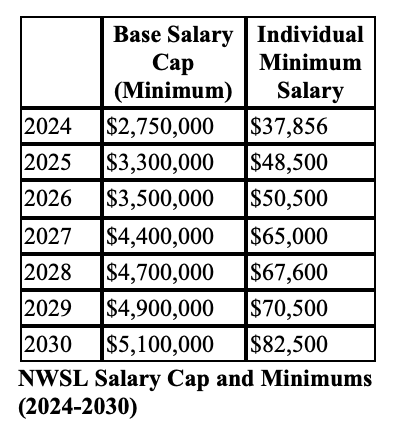
The financial architecture of the 2024 agreement was built upon a progressive escalation of the salary cap and the introduction of a revenue-sharing model that linked player compensation to the league’s commercial success. For the 2025 season, the base salary cap was established at $3.3 million, with a mandate for teams to meet a minimum spend threshold to prevent the suppression of wages through cap hoarding.
©2026 Ball 'N Play™ Sports Agency PLLC
The stability of this system was predicated on the understanding that any modification to the compensation structure—particularly one that creates a "parallel pay system"—must be the subject of mandatory collective bargaining. The NWSLPA asserts that the league’s move to introduce the HIP rule outside of this process constitutes a "flagrant violation" of the CBA and federal labor law.
The Trinity Rodman Paradox: Rejection and Reinvention
The specific friction point of the current labor war originated with the Washington Spirit’s attempt to re-sign Trinity Rodman following the conclusion of her 2022 extension. In late 2025, the Spirit, under the ownership of Michele Kang, reached a multimillion-dollar agreement with Rodman that utilized a backloaded structure to navigate the immediate constraints of the 2025 and 2026 salary caps. The team and Rodman’s representation maintained that the deal was fully compliant with the existing rules, as the significant increases in compensation were slated for the later years of the contract, coinciding with an anticipated explosion in league revenue following the next media rights cycle.
Commissioner Jessica Berman vetoed this contract in November 2025, asserting that the deal violated the "spirit" of the league’s rules and constituted salary cap circumvention. This intervention by the league office was the first major test of the 2024 CBA’s free agency provisions and revealed a significant ideological rift. The NWSLPA immediately filed a grievance on behalf of Rodman, arguing that the league was interfering with a player’s right to negotiate a cap-compliant contract. The league’s rejection of the initial Rodman deal signaled an underlying fear: if one wealthy owner could use backloaded contracts to secure elite talent, the league’s parity-driven model might collapse before the 2030 cap increases could level the playing field.
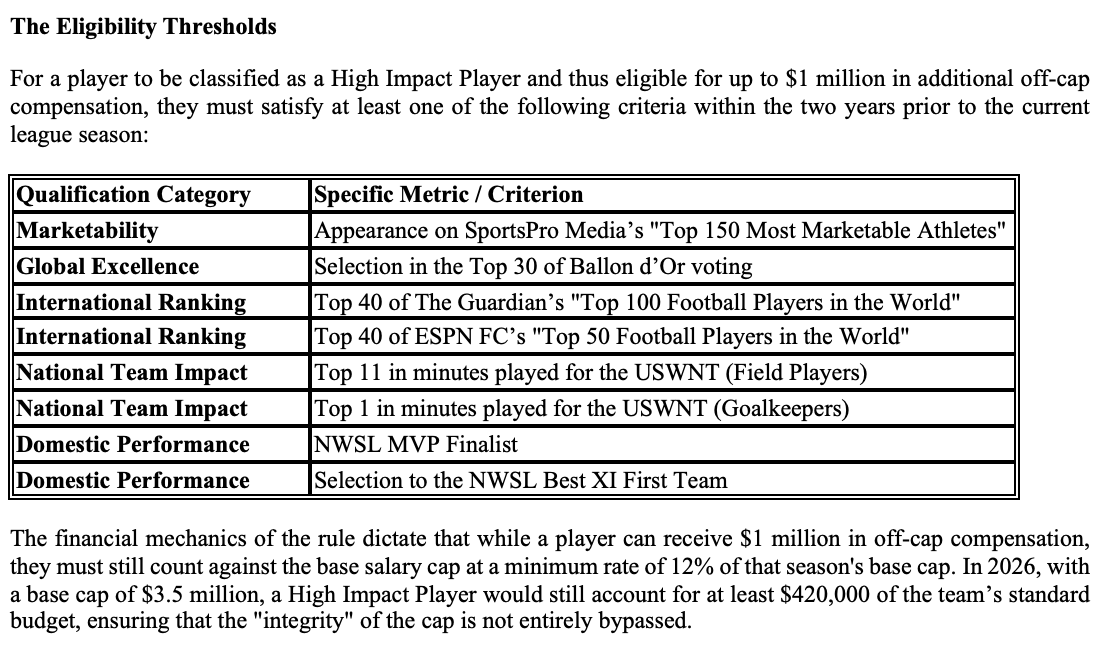
To resolve the impasse and prevent Rodman from defecting to European leagues—where clubs like Chelsea, OL Lyon, and Manchester City operate without salary caps—the NWSL Board of Governors announced the High Impact Player (HIP) rule on December 23, 2025. This mechanism was designed to "unlock" additional compensation for a specific class of players, thereby allowing the Spirit to pay Rodman her perceived market value without technically violating the team’s total salary cap.
Anatomy of the High Impact Player (HIP) Mechanism
The HIP rule represents a surgical attempt to inject capital into the top tier of the player market while maintaining a rigid ceiling for the remainder of the workforce. It is a "targeted mechanism" intended to preserve the league’s competitive balance while ensuring it can attract and retain "marketable icons". However, the specificity of the qualifying criteria is exactly what the union identifies as a violation of the CBA’s bargaining mandates.
The Eligibility Thresholds
©2026 Ball 'N Play™ Sports Agency PLLC
The Legal and Ethical Basis of the Union Grievance
The NWSLPA’s grievance, filed on January 14, 2026, rests on the premise that the HIP rule is a "unilateral decision" that bypasses the mandatory collective bargaining process. Meghann Burke, the Executive Director of the NWSLPA, has articulated a vision of labor rights where the league cannot "invent a parallel pay system" without union consent, regardless of the perceived benefits to individual stars.
The "Parallel Pay System" Argument
The union’s primary objection is that the HIP rule creates a stratified labor market: one where value is determined by the open negotiation process (within the cap) and another where value is "unlocked" by league-controlled metrics. By tying compensation to external rankings and national team minutes, the league is effectively "putting its thumb on the scale" of individual contract negotiations, thereby dictating who is allowed to be a high-earner based on criteria that were never negotiated with the players.
The legal foundation for this argument is rooted in the National Labor Relations Act (NLRA). Under federal labor law, compensation is a mandatory subject of bargaining. While the league points to CBA Section 8.16—which allows the NWSL to reduce cap charges for "certain roster classifications" after consultation—the union contends that "consultation" is not "bargaining" and that the HIP rule is not a valid roster classification under the existing agreement.
The Unilateral Implementation Doctrine
The grievance invokes the principle that an employer cannot make significant, discretionary changes to the terms and conditions of employment without bargaining with the representative union. Recent Labor Board decisions, such as Wendtand Tecnocap, have significantly curtailed an employer’s power to act unilaterally during a contract’s term. The Board has held that such changes unfairly weaken a union’s bargaining position. The NWSLPA argues that the league’s move to implement the rule effective July 1, 2026, while allowing signings to proceed immediately, is a calculated attempt to present the rule as a fait accompli before the arbitration process can conclude.
The Criteria Controversy: Bias, Subjectivity, and Global Exclusion
A significant portion of the NWSLPA’s grievance focuses on the "biased and flawed" nature of the criteria used to identify High Impact Players. The union argues that by relying on media lists like The Guardian’s Top 100 or ESPN FC’s Top 50, the league is outsourcing its compensation decisions to organizations that have historically demonstrated a "Euro-centric bias".
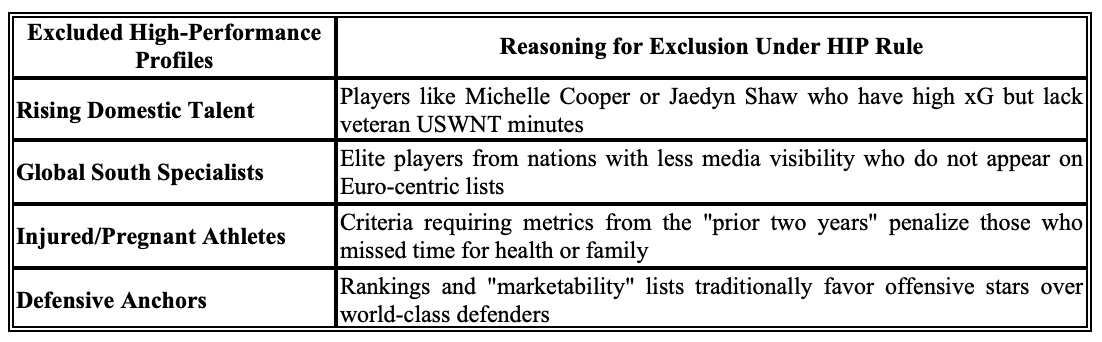
The Erasure of Non-Western Stars
The criteria heavily favor players who are already established in the European media ecosystem or who play for the United States Women’s National Team (USWNT). This creates a systemic disadvantage for elite talent from the Global South—specifically players from Brazil, Africa, and Japan who play in the NWSL. The union points out that players like Barbra Banda (Zambia) and Temwa Chawinga (Malawi) might qualify under current forms, but many other "sub-elite" players who are on the cusp of stardom are excluded simply because they lack the requisite "marketability" scores or national team minutes.
©2026 Ball 'N Play™ Sports Agency PLLC
The union argues that NWSL general managers and sporting directors are best positioned to make judgment calls on a player’s fair market value. By creating a "handful of bullet points" to dictate salary caps, the league is stripping clubs of the ability to invest in the players they believe are truly impactful to their specific rosters and communities.
The National Team Conflict
Perhaps the most controversial criterion is the one tying compensation to USWNT minutes. USWNT head coach Emma Hayes has publicly stated that she was not consulted on this rule and will not allow it to dictate her tactical decisions or roster selections. However, the union argues that the mere existence of the rule puts "undue pressure" on the national team coach, as her decisions now carry a direct financial consequence of up to $1 million for her players. This creates a potential conflict of interest and "muddies the waters" of international sport with domestic labor economics, as a player’s NWSL earning potential is now inextricably linked to their status in the eyes of the national team coach.
The Milestone of January 22: Record Pay, Unresolved Conflict
On January 22, 2026, the Washington Spirit announced that Trinity Rodman had signed a new three-year contract through 2028. The deal is worth in excess of $2 million annually including bonuses, making Rodman the highest-paid women’s soccer player in history. Rodman, who was "narrowly avoiding a foray into European soccer," cited her desire to build a legacy in the D.C. area and her belief in the Spirit’s project under owner Michele Kang.
Why the Union Persists
The signing of the deal—which was made possible by the very HIP rule the union is challenging—has not led to the withdrawal of the grievance. This is the central "twist" of the current labor war: the NWSLPA is continuing its legal challenge to rescind a rule that just made their most prominent member a multi-millionaire.
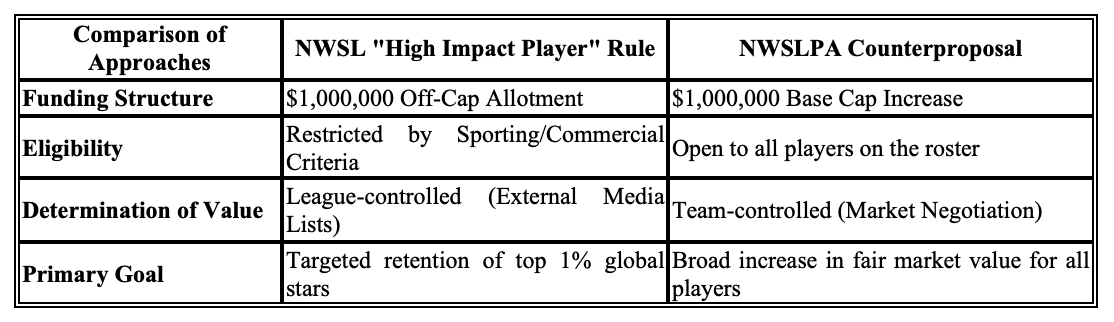
The union's rationale is one of long-term strategic defense. They argue that this is not about Trinity Rodman, but about the precedent of league control. If the league can unilaterally "break the rules" to pay a player today, they can unilaterally "break the rules" to cut a player, reduce benefits, or restrict movement tomorrow. To the NWSLPA, this is a battle about "power, not money". They maintain that the $1 million in additional funding should have been applied as a flat increase to the base salary cap for all teams, allowing for true market competition rather than a league-curated list of "approved" earners.
©2026 Ball 'N Play™ Sports Agency PLLC
The Single-Entity Paradox and Global Competition
The NWSL’s resistance to a flat cap increase is rooted in its "single-entity" structure. Unlike European clubs that operate as independent businesses in an open labor market, NWSL clubs are investors in a centralized league that owns all player contracts. The league’s veto of Rodman’s original deal was an exercise of this centralized control, intended to prevent "runaway spending" by wealthy owners that might alienate less-capitalized franchises.
The HIP rule is the league’s attempt to find a middle ground: allowing big-market owners like Michele Kang or expansion teams like the Denver Summit to spend on stars, but only if those stars meet "objective" criteria that the league can monitor. This prevents teams from "gaming the system" through backloaded contracts or other creative accounting that the 2024 CBA did not explicitly prohibit.
However, the global market for women’s talent is moving faster than the NWSL’s internal bureaucracy. Following the departure of stars like Naomi Girma and Alyssa Thompson to Chelsea earlier in 2025, the NWSL felt an "urgent need" to approve the HIP rule to stem the tide of defections. The league argues that without this targeted mechanism, it would be unable to compete with European giants that have no spending limits, potentially relegating the NWSL to a "feeder league" status for the English WSL or the French Arkema Première Ligue.
The Arbitration Process and Future Trajectories
The current arbitration, which remains an "active warzone," will likely serve as a referendum on the "Management Rights" vs. "Mandatory Bargaining" conflict that has plagued North American professional sports for decades. If the arbitrator finds that the league overstepped its bounds by unilaterally creating the HIP rule, the rule could be rescinded.This would potentially throw existing contracts—including Rodman’s—into a state of legal limbo, though the union is seeking "make-whole relief" to ensure no player is financially penalized for the league's actions.
The union’s demand for a flat $1 million cap increase is viewed by some owners as a threat to the league's fiscal stability.A flat increase would force all teams to choose whether to match that spending, whereas the HIP rule is optional and targeted to those who can afford it. Yet, the union contends that the "stability" argument is a smokescreen for "less rich owners" who want to suppress the growth of wages across the league even as valuations and revenues soar.
The Precedent of the "Thumb on the Scale"
Meghann Burke’s assertion that the league is "putting their thumb on the scale" of negotiations is perhaps the most resonant point for the players. By defining who is "High Impact," the league is essentially telling a player like Reilyn Turner or Michelle Cooper—who performed at an elite level in 2025—that they are objectively worth less than a player with more "marketable" credentials or USWNT minutes. This interference in the "natural" valuation of talent is what the NWSLPA finds most egregious, as it undermines the very free agency rights that were the centerpiece of the 2024 CBA.
Conclusions and Strategic Outlook
The "Labor War" between Trinity Rodman, the NWSLPA, and the NWSL is a watershed moment in the professionalization of women’s sports. It marks the transition from a league focused on "survival" to one focused on "sovereignty". The resolution of this grievance will establish the boundaries of league authority for the remainder of the decade and into the 2030s.
The immediate signing of Rodman’s contract provides the league with a short-term public relations victory and secures its most marketable asset through the 2027 World Cup and 2028 Olympic cycles. However, the residual grievance serves as a stark reminder that the players’ union is no longer content to let the league "invent" solutions to labor problems without their direct involvement.
As the NWSL approaches the 2027 media rights negotiations, the pressure to maintain a stable, talent-rich environment will only increase. The outcome of the arbitration will determine whether that stability is achieved through a centralized, metric-driven hierarchy (the League’s vision) or a decentralized, bargained-for market (the Union’s vision). The "Rodman Rule" may have kept a superstar in the United States, but it has simultaneously ignited a conflict over the very definition of professional power that will resonate long after the current contracts have expired.