The Business of Winter: Inside the MLB Winter Meetings
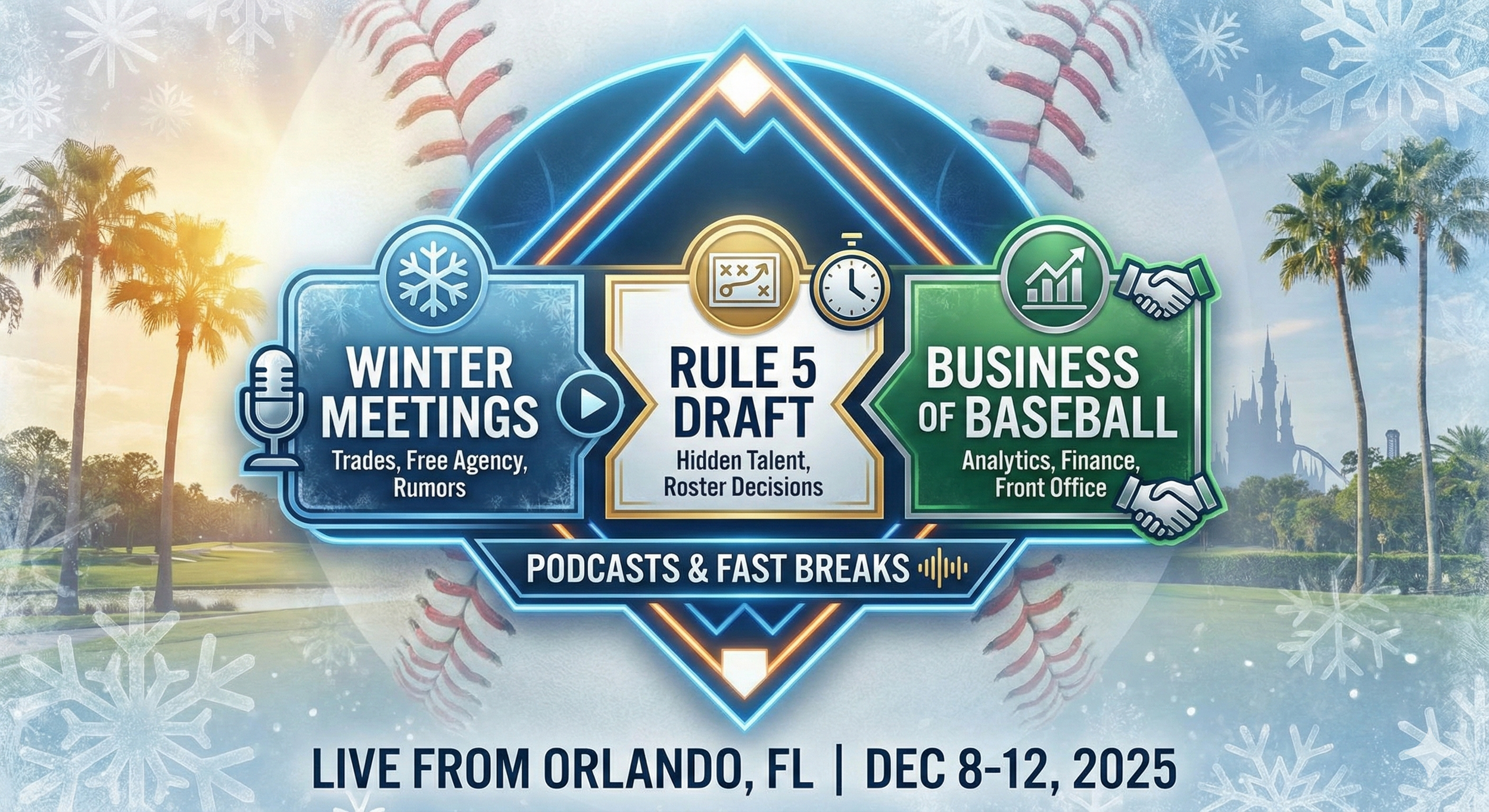
©2025 Ball 'N Play™ Sports Agency PLLC & The Ball ‘N Play™ Family
The rest of the world is winding down for the holidays. Baseball, meanwhile, is pouring a fresh cup and tightening its cleats. December is not an off-season; it’s an ecosystem, and the MLB Winter Meetings sit at its center.
For fans, the MLB Winter Meetings are a spectacle experienced through screens: a flurry of "breaking news" notifications on X (formerly Twitter), rumors from mystery accounts, and the dopamine hit when a nine-figure contract drops out of nowhere.
But inside the sprawling hotel complexes of Nashville, San Diego, or Orlando, the reality is much more tangible. It is physical. Loud. Constant. It is the annual convergence of the entire baseball industry. Executives, scouts, media, agents, and job seekers crowd into a single location for 96 hours of high-stakes poker played over hotel coffee and late-night drinks - 96 hours of controlled frenzy—corporate chess mixed with athletic ambition, all playing out over lukewarm lobby coffee and midnight strategy sessions.
Here’s the real anatomy of the business of winter—and why everyone, from casual fans to high-school prospects dreaming of Day One draft nights, should be paying attention.
The Lobby Economy: Where Deals Actually Happen
Television will show you bright sets, polished suits, rehearsed sound bites.
The real action is 40 feet away in the lobby.
This is the Hot Stove in its physical, unfiltered form—where baseball’s power brokers literally run into each other.
The dynamic is unique in professional sports. General Managers and Presidents of Baseball Operations do not just text each other; they run into one another at the elevator bank. A conversation that starts with "How’s the family?" at the hotel bar at 11:00 PM can evolve into a trade framework by 2:00 AM.
For the fans, the focus is the signings. But for the industry, the meetings are about information exchange. Teams are constantly gauging the market and in these hallways, information is currency:
Who’s bleeding for pitching
Who needs to dump payroll
Who’s suddenly listening on their cost-controlled shortstop
Who might “eat money” to get out from a contract
And here’s the secret insiders know:
The “blockbuster deal” that gets announced in a breathless 15-second segment on MLB Network?
It often began as a passing lobby conversation two winters ago.
The Agent’s Grind: The Ultimate High-Wire Sales Act
People love to imagine agents as walking calculators, bickering over decimals and incentives.
The Winter Meetings will cure you of that misconception immediately.
For agents, these four days are a whirlwind trade show layered with psychology, performance science, and negotiation theory.
During these four days, an agent is part salesperson, part therapist, and part strategist:
Salesperson: shaping demand, framing comps, pushing narratives.
Therapist: calming anxious players who refresh their phones 400 times a day.
Strategist: mapping which franchises align with client goals, windows, and fit.
The agent’s job description expands dramatically with a To-Do List that looks like this:
Creating Markets
If one team is genuinely interested, an agent’s first mission is to make it look like three are circling. Perception becomes leverage. Leverage becomes dollars.
Damage Control
Every player has a blemish somewhere—injury, slump, bad BABIP luck.
Good agents walk into GM meetings with elite-level data: hard-hit profiles, pitch-shape stability, xERAcorrections, and biomechanical notes proving the player is trending up, not fading out.
The “Mystery Team”
Fans think this is myth.
Front offices know it is a weapon.
The “mystery team” is code for “close the deal now, or someone else will.” And is usually an agent's masterful tactic to panic the frontrunners into closing the deal before someone else "steals" the player. It works more often than you’d think.
The Player’s Purgatory: Training Through Uncertainty
Agents may wear the suits, but the players endure the psychological gauntlet in sweatpants, checking their phones every five minutes..
For a free agent, the Winter Meetings are a strange psychological test. They are training in their home gyms, hitting off tees, and throwing bullpens, all while having no idea what city they will call home in February. A signing isn’t just a uniform change. It’s:
A new house
A new community
A new set of coaches, philosophies, and expectations
A cross-country move executed in days, not months
Meanwhile, players must stay physically peaked—maintaining mechanics, timing, and conditioning—while mentally floating through economic uncertainty.
It’s a paradox:
Stay steady, even though everything around you is in motion.
Why High School Recruits Absolutely Must Watch the Market
I say this as an attorney who lives between tax tables and talent evaluation:
If you’re 16, 17, or 18 years old and dreaming of the draft, these deals are not background noise.
They’re the blueprint for your future.
If you are a top-tier high school or college prospect, you might think MLB free agency is a lifetime away. You are wrong.The money being spent today dictates the draft bonuses of tomorrow. Basically, today’s spending shapes tomorrow’s draft slot values.
Positional Leverage
When shortstops command $300M contracts, it tells the entire industry something:
Premium defensive positions retain premium financial gravity.
That trickles into the draft, influencing who goes top-10 and who gets overslot bonuses.
The “Business” Training Decision
Pitchers must watch how front offices value durability vs. pure velocity.
If elite command and body stability are paying more right now than max-effort gas, a young pitcher should adjust their developmental model accordingly.
College vs. Pro
Veterans spend years navigating service-time manipulation, option years, and arbitration.
High-school recruits don’t need to memorize the CBA—
but they do need to understand leverage:
Sign now and start the clock early?
Or go to college, develop, and hit the draft again with negotiating power?
The smartest prospects study the market long before they enter it.
The Winter Meetings Dictionary
To understand the business of winter, you have to speak the language. Here are the terms you’ll hear thrown around the hotel lobby:
Arbitration Eligible (Arb-Eligible)
Players with roughly 3–6 years of service time can negotiate their salary via arbitration rather than accept the league minimum. If no agreement is reached, a hearing panel chooses one figure—team or player, nothing in between.
Super Two
A small subset of players just short of 3 years of service who fall into the top ~22% of their service-time class. They get four arbitration years instead of three—massive for earnings, stressful for tight-budget clubs.
DFA (Designated for Assignment)
A roster purgatory. A team removes a player from its 40-man roster and has seven days to trade him, waive him, or release him. Careers pivot quickly in this window.
Non-Tender
Occurring in late November/early December, a team can choose not to tender a contract to an arbitration-eligible player. That player immediately becomes a free agent.
Rule 5 Draft
The exclamation point of the Meetings.
Teams can pluck eligible minor leaguers from organizations that haven’t placed them on the 40-man roster.
If drafted, the player must stay on the selecting club’s Major League roster all season.
It protects players from being buried in the minors without opportunity.
The Winter Meetings are where the romanticism of baseball collides with the cold hard math of business. It’swhere dreams are made, rosters are built, and the blueprint for the next World Series champion is drafted on a cocktail napkin.
Yet, beyond the headlines and the technical jargon, the meetings pulse with the energy of possibility. A single conversation in a crowded hallway can shift the fate of a franchise. The days are an endless loop of negotiations and whispered rumors, but beneath the surface, every handshake carries the weight of seasons to come. In this crucible of ambition and uncertainty, the business of winter is relentless, and the echoes of these meetings will be felt long after the last suitcase is wheeled out of the lobby.