2025 MLB Rule 5 Draft: Final Breakdown, Verified Picks, and Who Will Stick
Major League Phase: 13 (12 out of 13 are RHP)
Minor League Phase: 55
Draft Total: 68 Players Selected
The Major League Phase
The Major League Phase of the 2025 MLB Rule 5 Draft concluded yesterday afternoon with 13 total selections, all but one of them pitchers. As usual, teams hunted for undervalued arms who might survive a full season on a 26-man roster — the annual search for diamonds in the rough.
Below is the list of players selected, updated transaction details, and an analysis of which picks are most likely to remain in the big leagues for all of 2026.
Top Confirmed Selections
1. RJ Petit (RHP) — Colorado Rockies
From: Detroit Tigers
Bio: A literal giant at 6'8", 300 lbs, Petit generates extreme downhill plane. He posted a 2.44 ERA with 79 strikeouts in 66.1 IP across Double-A and Triple-A in 2025.
Niche: Groundball Specialist / Middle Relief
The Rockies desperately need pitchers who can keep the ball out of the air. Petit’s profile — weak contact, groundballs, durability — is tailor-made for Coors Field. He’ll get every opportunity to stick.
2. Jedixson Paez (RHP) — Chicago White Sox
From: Boston Red Sox
Bio: Only 22, Paez dominated High-A Greenville in 2025 with elite command and a walk rate closer to 4–5%, not overpowering velocity. He mixes multiple secondaries with advanced feel for pitching.
Niche: Multi-Inning Bulk Reliever
On a rebuilding White Sox roster, Paez is the perfect low-leverage innings sponge — a strike-thrower who can follow an opener or absorb early exits from young starters.
3. Griff McGarry (RHP) — Washington Nationals
From: Philadelphia Phillies
Bio: Once a top prospect, McGarry owns closer-caliber stuff — mid-90s fastball, wipeout slider — but has suffered from extreme control issues. He struck out 124 in 83 IP, paired with one of the highest walk rates in pro baseball.
Niche: High-Leverage Wildcard
The Nationals are betting they can harness the stuff. If he throws strikes, he’s a late-inning weapon. If not, he’s an easy return.
Full 2025 Rule 5 Draft — Major League Phase
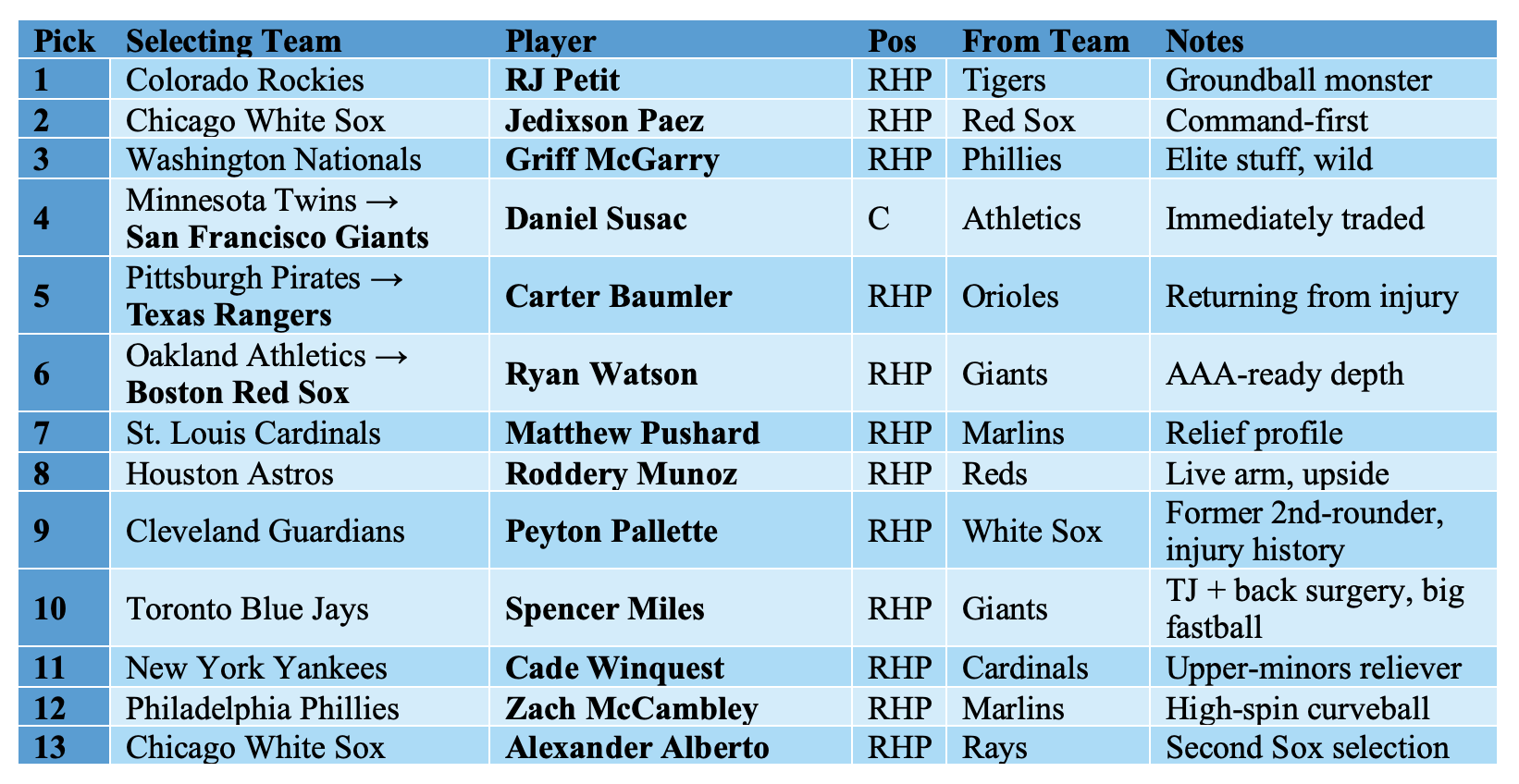
©2025 Ball 'N Play™ Sports Agency PLLC & The Ball ‘N Play Family
Roster Requirements Reminder
All 13 players must:
Remain on the active 26-man roster or MLB Injured List for the entire 2026 season,
ORBe offered back to their former clubs for $50,000.
WHO IS MOST LIKELY TO STICK?
Understanding Rule 5 outcomes requires zooming out.
A recent Baseball America analysis found that in the 2020s, roughly 50% of Rule 5 picks have stuck with their new teams, but the rate varies year by year.
MLB Pipeline, previewing the 2025 draft, notes that only three of 15 picks from last year’s Rule 5 are still with their new organizations (Shane Smith, Liam Hicks, Angel Bastardo), which is 20% of that class, but some others (Vasil, Lavender, Thomas) did satisfy Rule 5 requirements and then moved on.
So, historically, about one-third (~33%) of Major League Rule 5 selections successfully remain with their new team for the entire required season. Although, recent drafts have produced a higher retention rate — closer to 40–50% — for two main reasons:
26-man rosters give clubs an extra bullpen seat.
Teams are smarter about targeting specific pitch shapes, command arms, or role fits that translate quickly to MLB usage.
Three of last year’s 15 picks are still with their organizations: Shane Smith (White Sox), Liam Hicks (Marlins), Angel Bastardo (Blue Jays). Mike Vasil, Nate Lavender, and Connor Thomas did complete a full Rule 5 year but are NOT all still with the original selection club.
Most Likely to Stick (“Safe Bets”)
1. RJ Petit — Rockies (RHP, Tigers)
Coors Field needs groundballs, and Petit produces them in bulk. First overall Rule 5 picks traditionally get a long leash.
2. Jedixson Paez — White Sox (RHP, Red Sox)
Young, elite command, low walk rate, and joining a club with nothing to lose. A perfect developmental stash.
3. Daniel Susac — Giants (C, Athletics)
Backup catchers are the easiest Rule 5 profile to carry. Susac has pedigree, AAA production, and fills an actual roster need.
4. Zach McCambley — Phillies (RHP, Marlins)
High-spin, deceptive breaking ball; fits modern bullpen trends; good enough K/BB to slot into middle relief immediately.
High-Risk Gambles (“Stuff Plays”)
Players with elite tools but major red flags.
1. Griff McGarry — Nationals (RHP, Phillies)
If the BB/9 stays above ~6.0 in spring, he’s gone. If he throws strikes? He’s electric.
2. Peyton Pallette — Guardians (RHP, White Sox)
Former top prospect, now a bullpen convert. Command will determine his fate.
3. Spencer Miles — Blue Jays (RHP, Giants)
Upper-90s heat in the AFL, but minimal innings the past two years due to back surgery + Tommy John. High-risk for a contender.
FINAL OUTLOOK FOR 2026
Projected to Stick (4–5 players):
RJ Petit — Rockies
Jedixson Paez — White Sox
Daniel Susac — Giants
Zach McCambley — Phillies
Wildcard: Peyton Pallette — Guardians
Most Volatile Picks:
Griff McGarry — Nationals
Spencer Miles — Blue Jays
Alexander Alberto — White Sox
Spring Training is the crucible. Rebuilding teams (Rockies, White Sox, Nationals) have the most flexibility to absorb rough patches, while contenders (Blue Jays, Astros) will have tighter margins.
Final MLB Rule 5 Draft Survival Projection
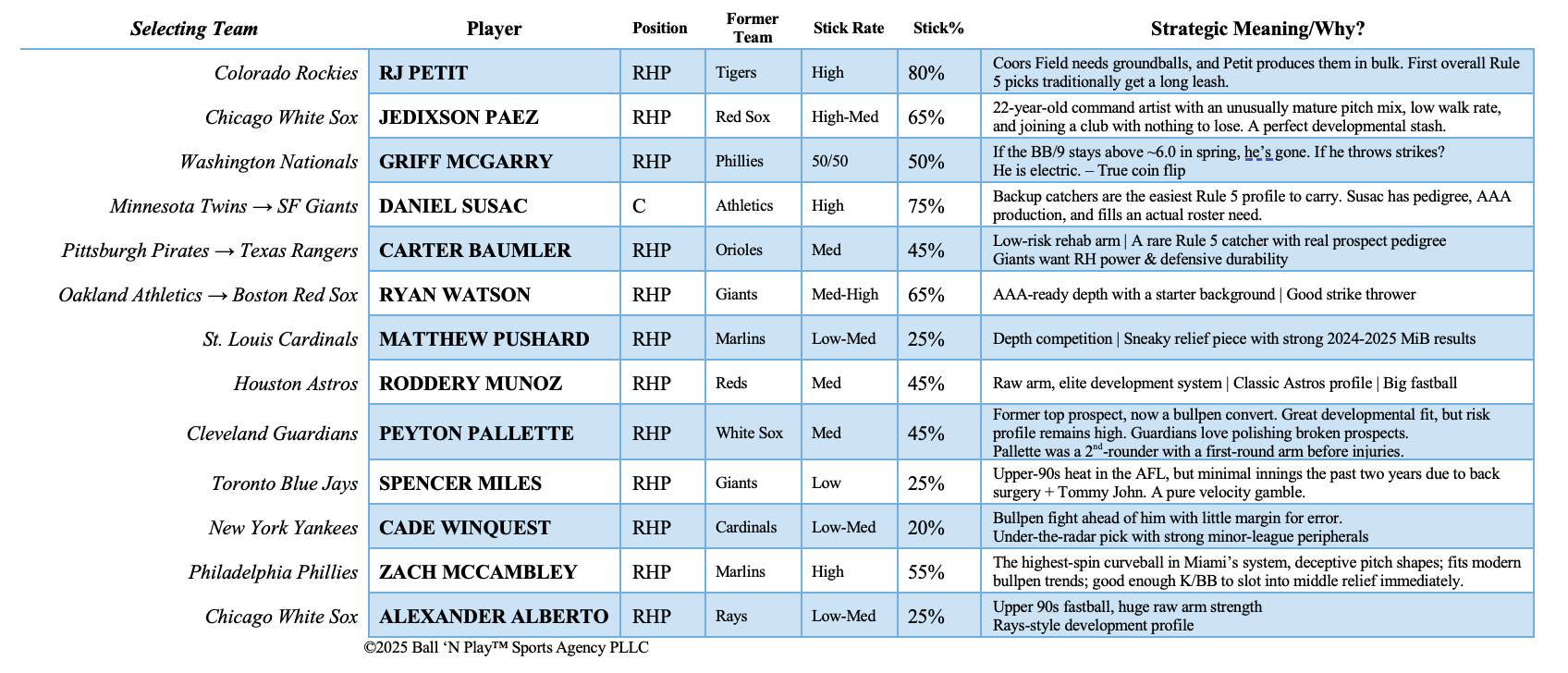
2025 MLB RULE 5 DRAFT:
MINOR LEAGUE PHASE (ALL 55 PICKS)
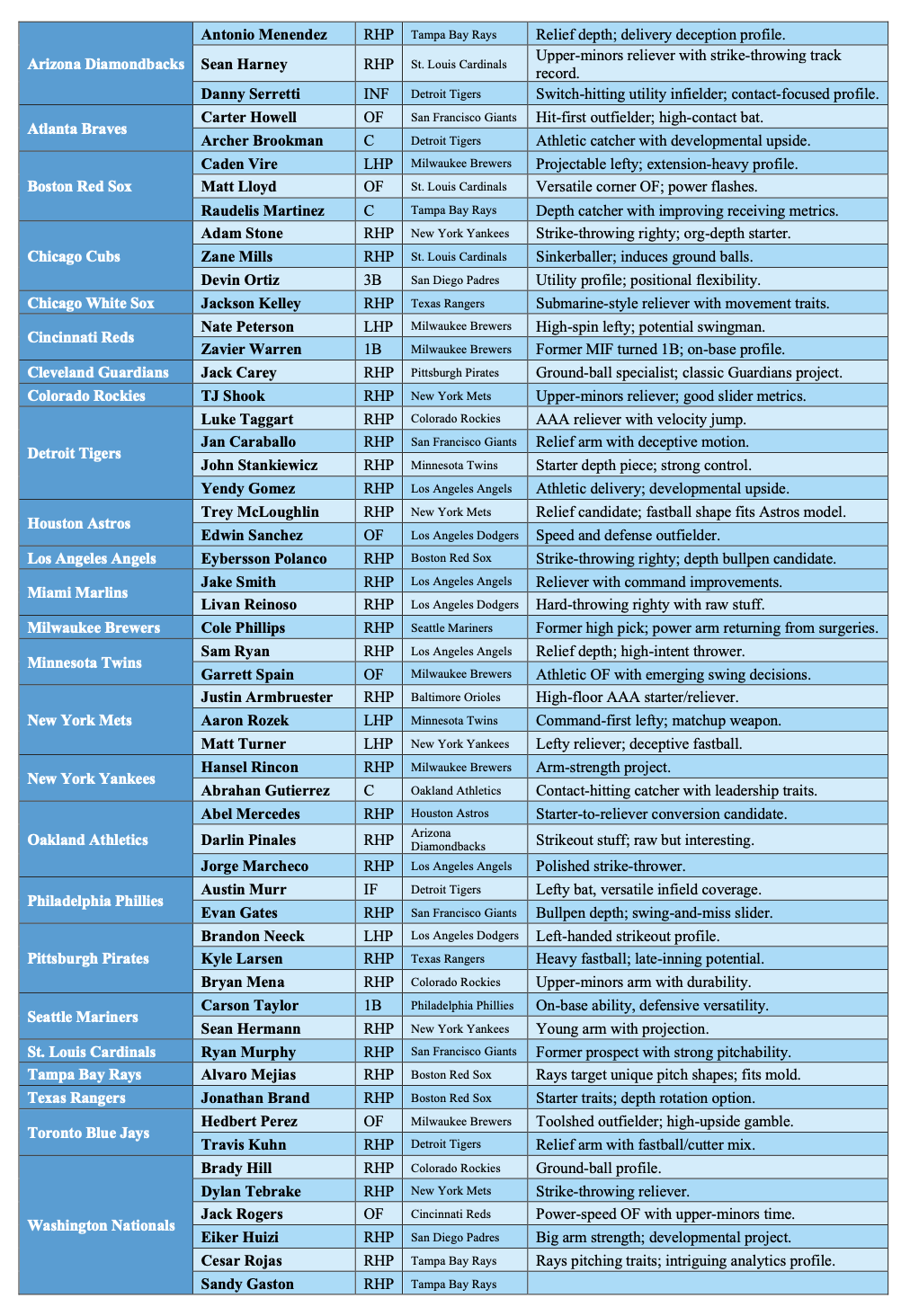
©2025 Ball 'N Play™ Sports Agency PLLC & the Ball 'N Play™ Sports Family
1. Nationals = Volume Kings
Washington selected six players, all pitchers except one outfielder — the highest total of any club.
2. Brewers = Biggest System Hit
Milwaukee lost six players (Perez, Vire, Peterson, Spain, Rincon, Warren) — the deepest talent drain of any organization.
3. Pitching Dominated the Draft
Well over two-thirds of the minor-league phase picks were RHPs, consistent with modern org strategies emphasizing:
Relief depth
Injury insurance
Pitch-lab development projects
Low-cost Triple-A bullpen inventory
2025 RULE 5 DRAFT (MINOR LEAGUE PHASE)
TEAM-BY-TEAM IMPACT ANALYSIS
The Minor League Phase is the most underrated depth-building mechanism in baseball. Teams don’t owe roster spots, don’t have to offer players back, and can simply plug these players directly into Double-A or Triple-A.
Below is a team-by-team breakdown of what each club gained, what they lost, and how their organizational strategy came into focus during the draft.
AL WEST
Houston Astros
Adds: RHP Trey McLoughlin (NYM) & OF Edwin Sanchez (LAD)
Impact: Houston targeted two undervalued skill sets: relief command and outfield athleticism. McLoughlin is a logical fit for their pitch-design pipeline. Sanchez adds a speed-and-defense profile that fits Houston’s preference for versatile depth at AAA Sugar Land.
Net Effect: Mild upgrade in depth with upside for bullpen innings.
Los Angeles Angels
Adds: RHP Eybersson Polanco (BOS)
Impact: A small but meaningful addition. Polanco is a command-first arm — unusual for Anaheim, which has leaned on power pitching. He gives them a stable strike-thrower they can move quickly to AAA.
Net Effect: Low-volume, low-risk arm who could see Anaheim in 2026 as injury insurance.
Oakland Athletics
Adds: RHP Abel Mercedes (HOU), RHP Darlin Pinales (ARI), & RHP Jorge Marcheco (LAA)
Impact: Oakland loaded up on three pitchers, each embodying different upside:
Mercedes: projection frame, raw power.
Pinales: miss-bats potential.
Marcheco: polished pitchability.
Net Effect: One of the most quietly effective pitching hauls of the day.
Seattle Mariners
Adds: 1B Carson Taylor (PHI) & RHP Sean Hermann (NYY)
Impact: Seattle rarely participates heavily in Rule 5, but they targeted a specific need:
Taylor brings on-base ability & corner infield depth.
Hermann is a young, moldable arm who fits their development style.
Net Effect: Balanced positional and pitching reinforcement.
Texas Rangers
Adds: RHP Jonathan Brand (BOS)
Impact: Brand fits perfectly with the Rangers’ need for upper-minors pitching stability. He’ll likely open at AAA Round Rock as rotation insurance.
Net Effect: Subtle but valuable depth addition.
AL CENTRAL
Chicago White Sox
Adds: RHP Jackson Kelley (TEX)
Impact: Sidearm, funk, deception. Chicago targeted a movement-profile reliever who can compete immediately at AAA while giving the MLB bullpen something different.
Net Effect: Low-cost bullpen experiment with an unusually high probability of use.
Cleveland Guardians
Adds: RHP Jack Carey (PIT)
Impact: Cleveland continues to do Cleveland things: find an under-the-radar, groundball-heavy arm and run him through their pitching lab.
Net Effect: One of the safest picks in the entire phase.
Detroit Tigers
Adds: RHP Luke Taggart (COL), RHP Jan Caraballo (SF), RHP John Stankiewicz (MIN), & RHP Yendy Gomez (LAA)
Impact: Detroit went for volume and versatility:
Taggart: AAA-ready relief.
Stankiewicz: starter depth.
Caraballo/Gomez: project arms with upside.
Net Effect: Tigers executed one of the best depth-building hauls in the AL.
Kansas City Royals
Adds: None (passed)
Impact: KC is unusually deep in the upper minors, so skipping this phase aligns with internal confidence in their existing player pool.
Minnesota Twins
Adds: RHP Sam Ryan (LAA) & OF Garrett Spain (MIL)
Impact: Spain is the key here: athletic outfielder with hit-tool questions but real upside. Ryan adds bullpen stability to AAA St. Paul.
Net Effect: Low-volume but strategically targeted additions.
AL EAST
Baltimore Orioles
Adds: None (passed)
Impact: Their 40-man and Triple-A depth is already so strong that they simply didn’t have innings or roster space to justify new acquisitions.
Boston Red Sox
Adds: LHP Caden Vire (MIL), OF Matt Lloyd (STL), & C Raudelis Martinez (TB)
Impact: Boston rebuilt its AAA Worcester depth at three positions:
Vire: upside lefty with extension.
Lloyd: outfield insurance.
Martinez: catching depth behind Wong/McGuire pipeline.
Net Effect: One of the more balanced and smart hauls in the AL.
New York Yankees
Adds: RHP Hansel Rincon (MIL) & C Abrahan Gutierrez (OAK)
Impact: Gutierrez is a meaningful add — a polished catcher with leadership and contact skills. Rincon is a raw arm, but NY loves velocity projects.
Net Effect: Subtle but solid contributions to AAA Scranton.
Tampa Bay Rays
Adds: RHP Alvaro Mejias (BOS)
Impact: Rays took only one player, but a quintessential Rays pick: a pitcher with atypical pitch shapes and a high chance of breaking out under their development system.
Net Effect: Classic Rays efficiency.
Toronto Blue Jays
Adds: OF Hedbert Perez (MIL) & RHP Travis Kuhn (DET)
Impact: Perez is one of the highest-upside grabs of the entire phase — former top prospect with elite tools. Kuhn brings bullpen pop.
Net Effect: Toronto was one of the biggest winners of the Minor League Phase.
NL WEST
Arizona Diamondbacks
Adds: Menendez, Harney, Serretti
Impact: D-backs added three quality depth pieces, two pitchers and a multi-positional infielder. Smart, high-value shopping.
Colorado Rockies
Adds: RHP TJ Shook (NYM)
Impact: One pick, but a solid one: Shook has MLB-adjacent experience and fits the Rockies’ need for groundballers in altitude.
Los Angeles Dodgers
Adds: None
Impact: Dodgers’ minor league depth is so strong that adding players wasn’t necessary.
San Diego Padres
Adds: None
Impact: San Diego went into the draft with limited room at Double-A/Triple-A, so passing was expected.
San Francisco Giants
Adds: None
Impact: After years of heavy minor-league churning, SF stood pat — a sign of roster stability and strategic restraint.
NL CENTRAL
Chicago Cubs
Adds: Stone, Mills, Ortiz
Impact: Three picks, all with realistic Triple-A utility. They plugged holes in depth rather than banking on lottery tickets.
Cincinnati Reds
Adds: Peterson, Warren
Impact: Two ex-Brewers:
Peterson: legit LH swingman candidate.
Warren: on-base bat.
Net Effect: Quiet but meaningful upgrades to Louisville.
Milwaukee Brewers
Adds: RHP Cole Phillips (SEA)
Impact: Phillips is a high-upside flier — perfect project arm. But...
Losses: Vire, Peterson, Perez, Spain, Rincon, Warren
Milwaukee lost six players, the most of any club.
Net Effect: Brewers were the biggest system bleed of 2025.
Pittsburgh Pirates
Adds: Neeck, Larsen, Mena
Impact: Pittsburgh went hard after arms. All three could realistically pitch at AAA Indianapolis in 2026.
Net Effect: Big replenishment for a shallow upper-minors system.
St. Louis Cardinals
Adds: RHP Ryan Murphy (SF)
Impact: Polished starter depth; a safe, low-variance pickup.
Net Effect: Small but efficient.
NL EAST
Atlanta Braves
Adds: Carter Howell, Archer Brookman
Impact: Braves targeted two hitters, unusual in a pitcher-heavy draft. Howell is a legit sleeper bat.
Miami Marlins
Adds: Jake Smith, Livan Reinoso
Impact: Two relief arms with velocity; Miami continues loading up on pitchability projects.
New York Mets
Adds: Armbruester, Rozek, Turner
Impact: One of the steadiest hauls: three AAA-ready pitchers. The Mets now have emergency depth behind a fragile MLB rotation.
Philadelphia Phillies
Adds: Murr, Gates
Impact: Murr is an on-base utility type; Gates a solid reliever. Two smart additions for a club contending but still depth-conscious.
Washington Nationals
Adds: Hill, Tebrake, Rogers, Huizi, Rojas, Gaston
Impact: Washington was the volume king with six picks.
All six selections fill immediate AAA needs, especially in the bullpen.
Net Effect: Nationals made the most aggressive system overhaul of any team in the draft.
FINAL SUMMARY — WHO WON THE MINOR LEAGUE PHASE?
1. Washington Nationals — Volume + Strategy = Clear Winner
Six picks, all with realistic paths to Triple-A impact.
2. Toronto Blue Jays — Highest Upside
Landing Hedbert Perez alone is a potential steal.
3. Detroit Tigers — Best Pitching Haul
Four arms, all usable, all projectable.
4. Boston Red Sox — Most Balanced Draft
Filled catcher, OF, LHP needs in one tidy sweep.
5. Brewers — Biggest System Loss
Milwaukee lost six players, including multiple former high-pedigree prospects.
Final 2025 Rule 5 Draft Breakdown:
Organizations That Lost the Most
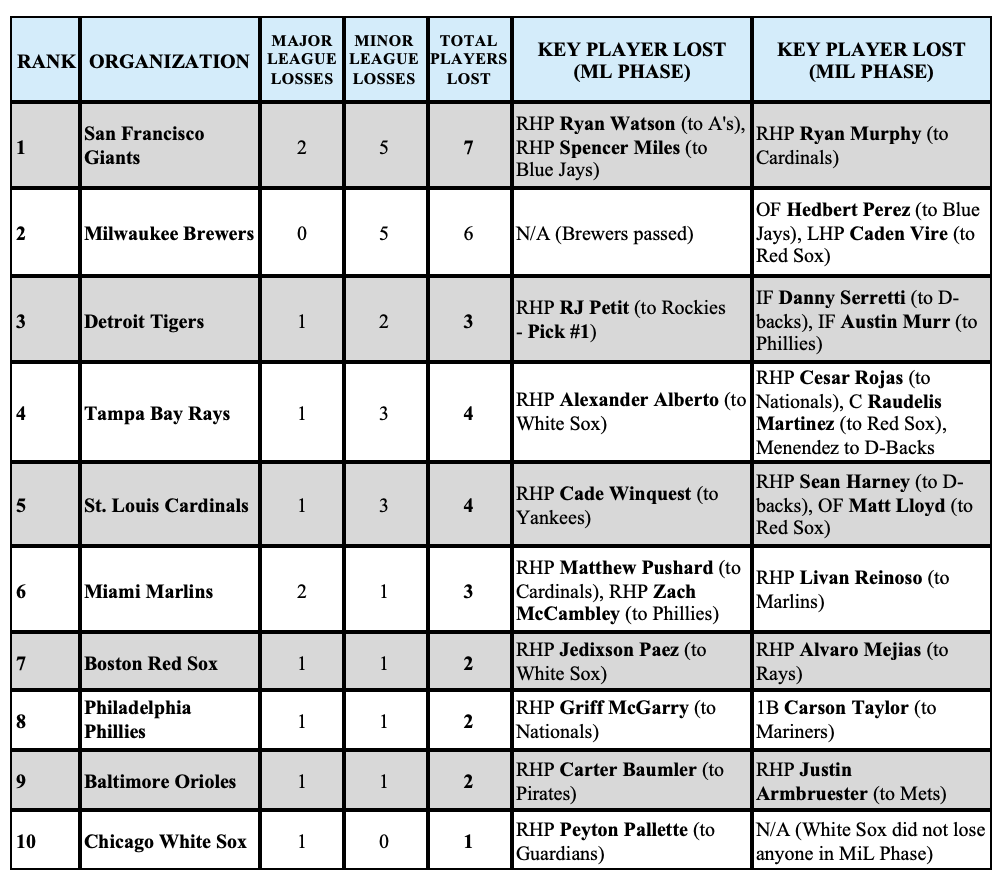
©2025 Ball 'N Play™ Sports Agency PLLC & the Ball 'N Play™ Sports Family. All Rights Reserved.