WNBA/WNBPA 2026 CBA Deep Dive
Executive Summary
A new collective bargaining agreement has been reached in principle / verbally between the league and the players’ union as of March 18, 2026, following 100+ hours of intensive in-person bargaining. The agreement is not yet in final written form: a term sheet and full legal document still must be completed, then ratified by players and approved by the league’s Board of Governors. [3]
The headline change is structural: the parties say the new CBA ties player compensation to a meaningful share of league revenue, in a way intended to drive “exponential” salary-cap growth and raise professional standards around facilities and support. [4]
Key reported economics (not yet published in an official term sheet): multiple outlets citing ESPN sourcing have reported a ~$7M team salary cap starting in 2026, ~20% average revenue share, a supermax starting ~ $1.4M, average salaries in the ~$600K range, and minimum salaries above $300K. These figures should be treated as reported until the term sheet is released. [5]
Public statements from union leadership emphasize expanded or strengthened housing and retirement, and added resources for family planning and parental leave. Specific healthcare and mental-health line items are not yet public. [4]
Context matters: the league’s new national media-rights agreements begin in 2026 (running through 2036) and distribute 125+ games nationally across partners; a source told ESPN the core package is valued at ~$2.2B (~$200M/year). The league has also publicly referenced expansion (bringing the total to 15 franchises), which increases total roster spots and revenue potential. [6]
Primary sources and high-quality reporting used most heavily include the league’s official communications and releases plus coverage from Reuters[7], ESPN[8], Associated Press[9], Front Office Sports[10], and Sports Business Journal[11]. [12]
Negotiation Timeline and Implementation Status
The arc of this negotiation is unusually long and unusually public, with a clear “business inflection” backdrop (expansion + new media rights + record attention) and two recurring flashpoints: revenue sharing definitions and housing. [13]
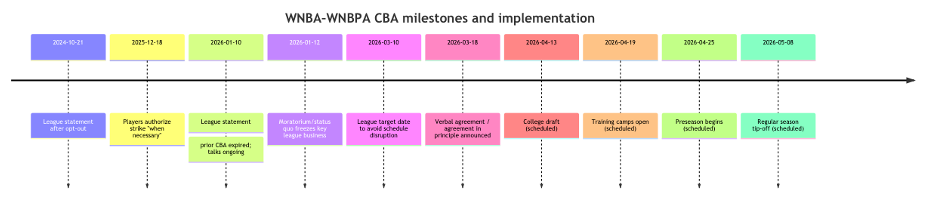
Milestones and dates
The opt-out process began publicly in October 2024, with the league signaling it expected to work with the union on a new deal. [14]
By December 2025, the league issued an official statement responding to the players’ strike-authorization vote and emphasized that it was proposing “significant immediate salary increases” and a new “uncapped revenue-sharing model.” [15]
After the prior agreement formally lapsed (and extensions ended), the league acknowledged the CBA had expired and negotiations were ongoing. [16]
In January 2026, the parties entered a “status quo” period with a moratorium that froze key offseason business (notably free agency mechanics) while negotiation continued. [17]
A major operational constraint was the league’s off-ramp deadline for preventing schedule disruption; reporting framed March 10 as a critical target date to avoid preseason/training-camp disruptions. [18]
On March 18, 2026, the parties announced a verbal agreement in the early morning hours. Specific final terms were not disclosed, and the agreement remains pending a finalized term sheet, ratification, and Board approval. [3]
Economics: Salary Caps, Maximums, Revenue Sharing, and Team-Level Impact
What is confirmed in public statements
Union leadership framed the settlement as a fundamental economic shift:
“For the first time player salaries are tied to a truly meaningful share of league revenue…” [4]
The union also stated the deal strengthens housing and retirement and expands resources for family planning and parental leave. [4]
League leadership emphasized the agreement as a “transformative step forward,” and both sides stated the 2026 calendar will proceed (camp April 19; preseason April 25; season May 8). [19]
Reported headline numbers
Because the term sheet is not yet public, these must be treated as reported:
2026 team salary cap: ~$7M (reported) [20]
Average revenue share: ~20% across the deal (reported) [20]
Supermax salary: starts ~ $1.4M (reported) [20]
Average salary: ~$600K range (reported) [20]
Minimum salary: above $300K (reported) [20]
Separately, a confirmed public datapoint from the union president is that the average salary will be more than $500,000. [19]
How big a swing is that?
For context, pre-agreement proposals and baseline 2025 figures frequently cited in reporting had the cap around $1.5M per team and max salaries around $249K under the prior system. [21]
Even before the final deal, proposals had already moved into the “massive jump” territory; for example, an AP-sourced report described an offer with a $5.75M first-year cap and $1.3M max salary (proposal-stage), underscoring how far the negotiations had progressed before the final breakthrough. [22]
Revenue definition, transparency, and why it mattered
One of the most legally consequential hinges is gross vs. net revenue—players argued gross is clearer and less subject to accounting maneuvering, while the league preferred net (after expenses). A sports-business expert described the difference starkly to Reuters: “Gross revenue means dollar for dollar,” while net introduces the risk of “creative accounting” through deductions. [23]
In the final week before agreement, reporting still described the union having reduced its ask from 40% to roughly the mid‑20s on gross revenue, while the league proposed over 70% of net revenue. [24]
Revenue runway: media rights + expansion + product investment
The league has an unusually strong forward revenue story:
New national media rights deals begin in 2026 and run through 2036, distributing 125+ games annually across partners. [25]
A source told ESPN the deals are valued at about $2.2B (~$200M/year), with additional partner possibilities. [26]
The league’s own impact materials cite adding two more franchises, bringing the total to 15. [27]
At the same time, costs are real. Charter travel alone required major investment; reporting in 2024 indicated the league planned to commit $50M over two years to provide full-time charter service. [28]
That cost pressure is relevant because, during negotiations, league statements described some union proposals as “unrealistic” and projected large losses for teams under certain models. [29]
Competitive balance mechanisms
A key open question is whether the CBA keeps the WNBA’s historically hard-cap character or introduces new exceptions / luxury-tax-style tools. No luxury tax mechanism has been publicly confirmed yet, so it remains unspecified. (Historically, the hard cap itself has operated as the league’s primary competitive-balance tool, creating roster “gymnastics” even for elite teams.) [30]
Player Benefits and Working Conditions
Housing
Housing became both a practical and symbolic issue. Reporting describes players viewing housing as a professional standard that should remain in place, at least through early years of the agreement. [24]
Historical baseline: reporting notes teams have been required to provide housing since the first CBA era, and—under the previous agreement—housing could be provided via an apartment or stipend. [29]
The new agreement has been described publicly as strengthening housing, but the precise eligibility rules, stipend structures, and phase-out triggers (if any) remain unspecified until the term sheet becomes public. [31]
Healthcare, maternity, family planning, mental health
The public union statement explicitly references expanding resources for family planning and parental leave and strengthening benefits. [32]
However, specific healthcare and mental-health clause language is not yet public, so those details are unspecified.
For context and comparison, the 2020 CBA’s publicly summarized features included fully paid maternity leave, childcare support, and family-planning reimbursements—plus improved mental-health resources. [33]
Travel, safety, and scheduling
The league has already moved on travel in recent years, announcing full charter programs for 2024–2025 and citing the long-term business work required to sustain that model. [34]
During negotiations, reporting indicated charter flight travel was expected to be codified in the new agreement—turning policy into a contractual right. [35]
The agreement was announced as avoiding calendar shifts: training camp April 19, preseason April 25, regular season May 8. [31]
In-season tournaments
The league already has an in-season tournament, the WNBA Commissioner's Cup[36], and official league materials describe its prize pool and format. [37]
Whether the 2026 CBA expands tournament prize pools or adds additional in-season competitions is unspecified as of March 18, 2026. [19]
Roster Rules: Free Agency, Contracts, Rookies, Development, International Players
Free agency and offseason mechanics
This CBA was negotiated under significant operational pressure: the league still must hold an expansion draft (two teams), conduct free agency for a large player pool, and hold the college draft April 13. [38]
A moratorium/status‑quo period earlier in 2026 limited key league business while negotiations continued, compressing the eventual offseason timeline. [17]
Core designation, contract guarantees, and term structure
The future of the “core” designation (a franchise-tag style device limiting movement) was repeatedly identified in reporting as a negotiation issue late in the process, and the final rule is unspecified publicly as of the agreement announcement. [39]
Likewise, contract term limits, salary protection rules, and guaranteed-contract minimums cannot be stated definitively until the term sheet is public. Those details are unspecified.
That said, proposals and reporting during negotiations discussed: - More guaranteed contracts per team (proposal-stage). [40] - Added developmental roster spots (proposal-stage). [41]
Rookie scale and draft-related changes
Rookie economics were a major public pressure point because the league’s recent growth has been driven by young stars.
An AP-sourced report described a league proposal that would allow elite rookies—e.g., players who make first or second team All‑WNBA—to become eligible for a max contract in their fourth season (proposal-stage example names included Caitlin Clark[42] and Paige Bueckers[43]). [22]
Whether this fast-track pathway (or any modified rookie-scale structure) is included in the final 2026 agreement is unspecified until the term sheet is released. [19]
Player development and “G League-style” pathways
The WNBA does not currently operate a full minor league equivalent to the NBA’s development system. But multiple negotiation reports described adding developmental roster slots—an incremental but meaningful “pipeline” move that could establish paid development opportunities and expanded roster flexibility. [41]
International player implications and prioritization
The 2020 CBA introduced the “prioritization” concept, describing firm reporting dates for training camp/season intended to encourage players to prioritize the WNBA as compensation grew. [44]
Later reporting described the rule becoming punitive for late reporting (fines and then season-long suspension). [45]
Because the new term sheet is not public, whether the new CBA modifies, softens, or preserves prioritization is unspecified—but the interaction between higher minimums and overseas play is a clear intended pressure release valve. [46]
Quotes and reactions
League and union leadership framed the agreement as both immediate and forward-looking:
“This deal is going to be transformational.” [47]
A sports-business analyst, speaking before the deal was reached, captured the late-stage stakes:
“We are on the verge of a lockout.” [23]
And from a player-negotiator’s perspective on the labor process itself, Brianna Turner[48] wrote that the bargaining process was “eye-opening” and that it was an honor to advocate for “past, present and future” players. [49]
Major Changes vs the Prior CBA
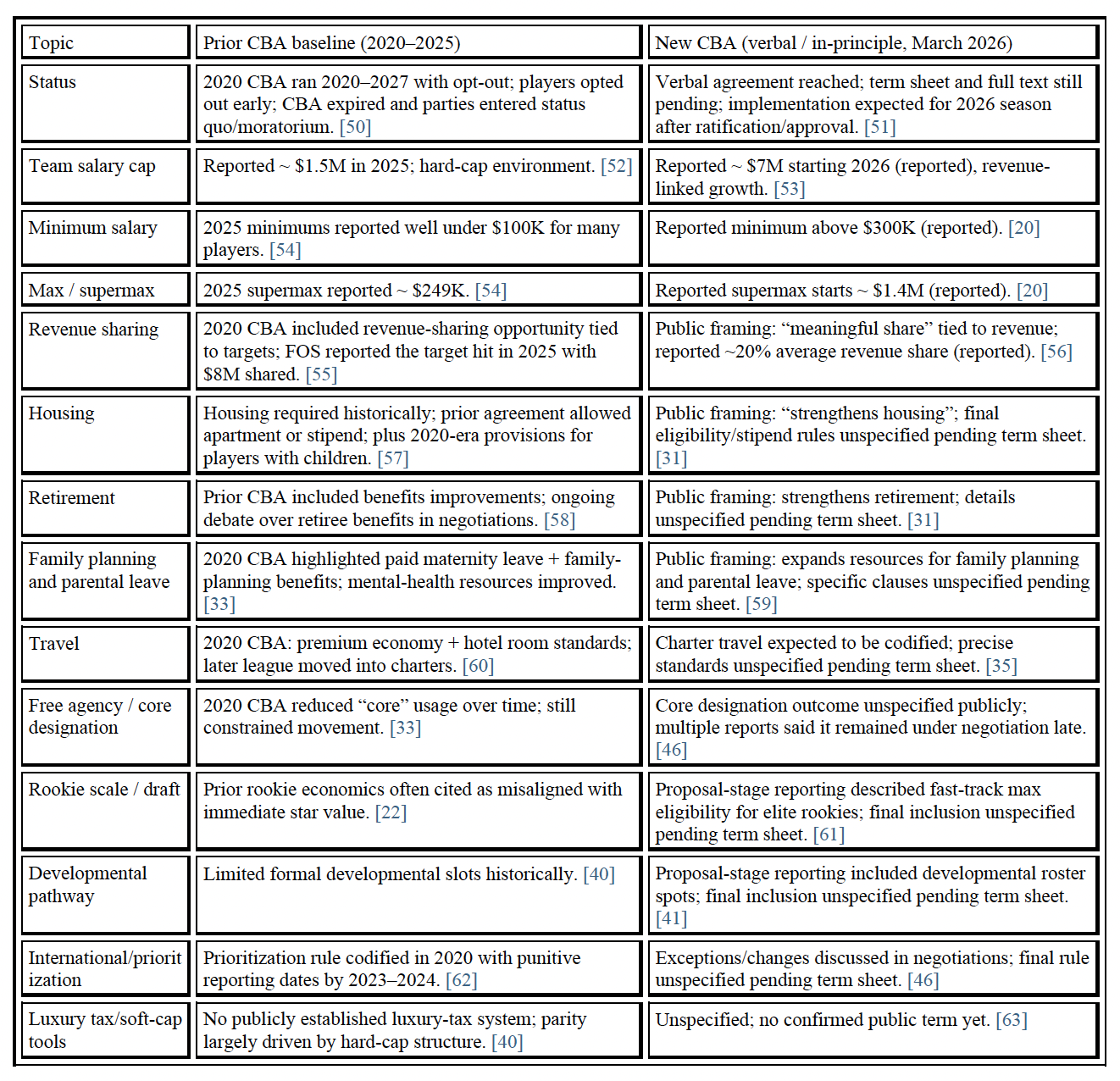
The table below compares (a) the prior CBA framework and widely reported 2025 baselines with (b) the new March 2026 agreement as publicly stated and/or reported. Items marked unspecified are not publicly confirmed in final, written form yet.
[1][5][20][53][64][68] https://www.cbssports.com/wnba/news/wnba-cba-news-deal-details-salaries-explainer/
https://www.cbssports.com/wnba/news/wnba-cba-news-deal-details-salaries-explainer/
[2][44][62][78] https://www.wnba.com/news/transcript-wnba-wnbpa-conference-call
https://www.wnba.com/news/transcript-wnba-wnbpa-conference-call
[3][11][12][19][51][63][66][72][81] https://www.reuters.com/sports/wnba-players-union-reach-agreement-new-cba-terms--flm-2026-03-18/
https://www.reuters.com/sports/wnba-players-union-reach-agreement-new-cba-terms--flm-2026-03-18/
[4][7][10][31][32][38][42][47][48][56][59][65][73][82] https://www.espn.com/wnba/story/_/id/48237252/wnba-players-union-agree-principle-new-collective-bargaining-agreement
[6][25] https://www.wnba.com/news/media-rights-deal-disney-prime-nbc
https://www.wnba.com/news/media-rights-deal-disney-prime-nbc
[8][33][36][50][55][58][60] https://www.espn.com/wnba/story/_/id/28480768/new-wnba-cba-include-salary-bump-other-cash-compensation-increases
[9][28][71] https://www.espn.com/wnba/story/_/id/40102075/wnba-begin-full-charter-flights
https://www.espn.com/wnba/story/_/id/40102075/wnba-begin-full-charter-flights
[13][23][67] https://www.reuters.com/sports/wnba-teeters-edge-cba-talks-fail-yield-deal-season-hangs-balance-2026-03-11/
[14] https://pr.nba.com/wnba-statement-opt-out/
https://pr.nba.com/wnba-statement-opt-out/
[15] https://pr.nba.com/wnba-statement-wnbpa-strike-authorization-vote/
https://pr.nba.com/wnba-statement-wnbpa-strike-authorization-vote/
[16] https://pr.nba.com/wnba-statement-cba/
https://pr.nba.com/wnba-statement-cba/
[17] https://www.reuters.com/sports/reports-wnba-wnbpa-agree-moratorium-league-business--flm-2026-01-13/
https://www.reuters.com/sports/reports-wnba-wnbpa-agree-moratorium-league-business--flm-2026-01-13/
[18] https://www.espn.com/wnba/story/_/id/48201275/wnba-sees-urgent-need-reach-new-cba-monday-not-impact-season
[21][22][52][61] https://apnews.com/article/wnba-cba-d4306962d1aa5eeb07a10dedea5fa90c
https://apnews.com/article/wnba-cba-d4306962d1aa5eeb07a10dedea5fa90c
[24] https://www.reuters.com/sports/wnba-commish-were-going-keep-making-progress--flm-2026-03-16/
https://www.reuters.com/sports/wnba-commish-were-going-keep-making-progress--flm-2026-03-16/
[26] https://www.espn.com/wnba/story/_/id/40634341/wnba-secures-monumental-media-deal-disney-amazon-nbcu
https://www.espn.com/wnba/story/_/id/40634341/wnba-secures-monumental-media-deal-disney-amazon-nbcu
[27][70] https://cdn.wnba.com/sites/4/2025/03/2024-WNBA-Impact-Report.pdf
https://cdn.wnba.com/sites/4/2025/03/2024-WNBA-Impact-Report.pdf
[29][35][41][57][79] https://www.espn.com/wnba/story/_/id/47959643/wnbpa-counterproposal-includes-some-concessions-revenue-share-housing
[30][40][54][69][76] https://frontofficesports.com/wnba-cba-max-salaries-share/
https://frontofficesports.com/wnba-cba-max-salaries-share/
[34][74] https://www.wnba.com/news/charter-flight-program-2024
https://www.wnba.com/news/charter-flight-program-2024
[37][77] https://www.wnba.com/commissioners-cup/2025/about-the-cup
https://www.wnba.com/commissioners-cup/2025/about-the-cup
[39][43][46][75][80] https://frontofficesports.com/wnba-cba-no-financial-concessions/
https://frontofficesports.com/wnba-cba-no-financial-concessions/
[45] https://www.espn.com/wnba/story/_/id/33740278/wnba-prioritization-overseas-play-how-impact-league-players-going-forward
[49] https://www.sportsbusinessjournal.com/Articles/2026/03/18/wnba-and-union-reach-verbal-cba-deal-season-to-start-on-time/