The “CBA Blueprint” Is a Trojan Horse: Why Athletes.org’s Plan Fast-Tracks the Professionalization of College Sports
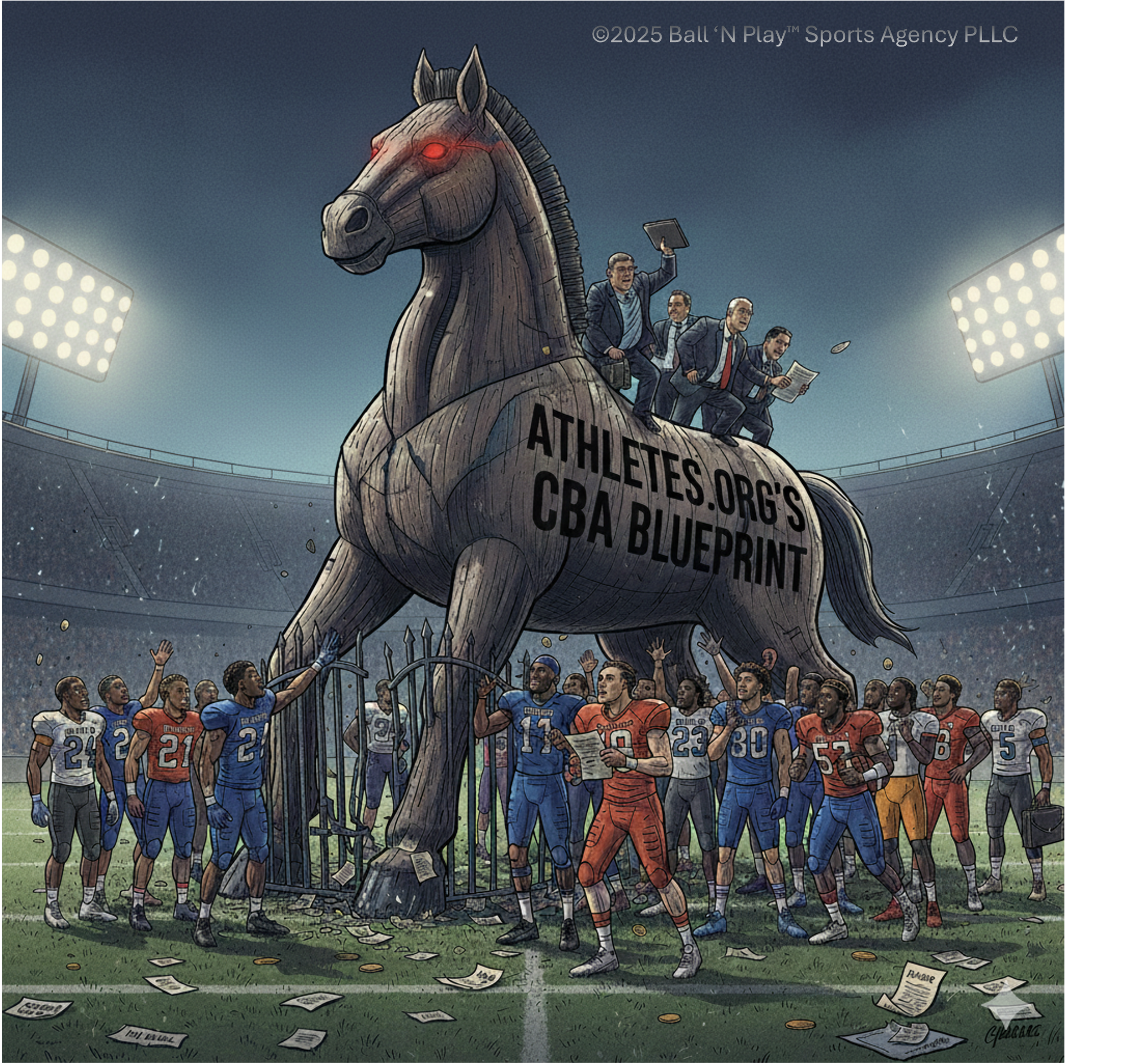
ATHLETES.ORG’s CBA BLUEPRINT SUMMARY
Athletes.org’s (AO) Collective Bargaining Agreement (CBA) Framework aims to replace the current NIL compensation model with a system that pays athletes for their athletic services, effectively treating them as employees. This shift towards a professional model raises concerns about athlete protections, centralized control, and the impact on non-revenue sports. While the framework includes athlete-forward proposals, it also establishes a framework for league-like governance and enforcement.
College athletics isn’t just “changing.” It’s being re-built into something else entirely—using legal duct tape, revenue spreadsheets, and an increasingly bold refusal to call a professional model what it is.
Athletes.org (AO) just dropped their Collective Bargaining Agreement (CBA) Framework discussion draft (dated December 8, 2025). They pitch it as the “only path” to stability: national baselines, reduced litigation exposure, and a structured partnership between athletes and institutions.
But here’s the issue: when you read the actual language, AO isn’t merely proposing “NIL reform.” They are proposing a system that replaces NIL as the main engine and swaps in something far closer to institution-paid athletic labor.
Here is what the fine print actually says—and what it means for you.
“ This isn’t NIL cleanup. It’s payroll in a letterman jacket.”
1. The Big Pivot: “NIL” Out, “Athletic Services” In
AO states their intention is to replace “the fragmented NIL compensation model” with a single income stream, explicitly shifting away from “strictly NIL-based payments.”
Later, they get even more direct: compensation paid by schools “for team participation” would be consolidated, and standard agreements would pay athletes for “their athletic services,” not merely NIL rights.
The Legal Translation: This is not a semantic tweak. This is the difference between:
· “You can profit from your fame.”
· “You are being paid to perform.”
If you are paying for athletic services, the system is walking and quacking like employment. AO is trying to build a payroll system without triggering the "employee" tax/labor bomb.
2. The “Non-Employee CBA” Move: A Legal Shield
AO explicitly floats the idea that collective bargaining could exist under a non-employee model, describing a “special status” approach—likening it to representation models where members might be treated as independent contractors (similar to how some gig-economy unions are attempting to form).
The Agent’s Take: Read this with a lawyer’s eye: this isn’t just about athlete protections. It’s about building a structure that gives schools a labor-based antitrust defense. If the athletes "agree" to a cap via a CBA, the schools can't be sued for antitrust violations. They are trading your right to sue for a "seat at the table."
3) Transfer Portal: They Call It What It Is
AO doesn’t dance around it. The transfer portal window is described as “college athletics’ version of free agency.”
The Reality Check: That’s a worldview shift. Once you adopt “free agency” as the frame, you’re no longer guarding the student-athlete model. You’re normalizing a professional labor market for teenagers. That means year-round roster churn, recruiting as retention, and culture as a quarterly deliverable.
“Once you call it free agency, you start treating athletes like assets—because that’s what free agency is for.”
4. Money Mechanics: The League-ification of Campus
AO proposes using the House settlement amounts as the framework for the first four years. But then they drop the hammer:
· The Floor: Institutions must allocate and spend no less than 89% of the “Athletes’ Program Compensation Budget” on direct athlete compensation over a rolling four-year period.
· The Enforcement: They propose removing the CSC’s current Fair Market Value (FMV) system and replacing it with collectively bargained cap-circumvention enforcement.
The Bottom Line: Floors, compliance windows, shortfall distributions? That isn't college sports. That is League Governance 101.
5. The Quiet Power Grab: Athletes Inc.
AO explicitly says it will collect membership dues and consolidate group licensing rights through its for-profit sister company, Athletes Inc.
The Red Flag: This isn't automatically evil—pro players’ associations (like the NFLPA) have for-profit licensing arms (NFL Players Inc.). But it creates an unavoidable tension. The organization proposing the structure is also positioning itself to be the gatekeeper for the most valuable collective NIL assets moving forward. If you control the CBA, you control the licensing. If you control the licensing, you control the money.
6) The Agent Trap: “Certification” Sounds Fine… Until It Becomes Control
AO proposes agent certification and a registry: exam, background checks, certification. The draft states the registry would confirm representation and “control fee regulations and certification requirements.”
The Warning: As an attorney and agent, I am zero percent against professionalism. But I will be blunt: a registry can protect athletes, but it can also become an access choke-point.
And the draft (as written) does not clearly differentiate between:
an agent negotiating a small local endorsement for a non-revenue athlete such as a local car dealership deal for a softball player, and
representation tied into conference-wide group licensing, roster-wide commercial rights, and institutional compensation ecosystems.
When the same entity influences the pay structure, the free-agency rules, and the licensing marketplace, the risk is obvious: a new centralized power that rhymes with the old one—just with different branding.
What This Means for Parents, Athletes, and Agents
1) “Free money” is a myth.
If compensation is tied to athletic services, you are entering a world of contracts that behave like pro contracts.
2) The compliance era is here.
Caps, floors, enforcement mechanisms, registries—this is the infrastructure of a league.
3) Centralization has winners and losers.
Even if athlete protections improve, gatekeepers can still emerge—especially around licensing and representation.
4) Non-revenue sports feel the pressure first.
Any model that intensifies monetization incentives increases the squeeze on programs that do not directly generate revenue (even if no one says it aloud).
Health & Safety: Some of the Best Pages… and Still a Power Trade
To be fair, the framework includes meaningful athlete-protection concepts (including medical-related protections and independent-process ideas).
Those are athlete-forward proposals. But delivering them requires governance and enforcement—meaning you are building a parallel authority structure inside athletic departments to carry it out.
The Line in the Sand
AO’s proposal is coherent. It is also a line in the sand: college sports as we knew it (the myth, the nostalgia, the senior-day continuity) is being replaced with a model that behaves like a pro league—contracts, spending floors, “free agency” windows, cap enforcement, grievance/arbitration structures, licensing arms, and agent credentialing.
If the sport is going professional, we should at least be honest about it—and fight like hell to protect:
Olympic and non-revenue sports from being squeezed by monetization pressure,
athletes from being treated like short-term assets, and
due process from being “handled internally” by whoever the new gatekeeper becomes next.
Because the Trojan Horse is not the idea of paying athletes.
It’s who gets to control the entire system once we admit we are paying them.
SOURCES
Athletes.org — Collective Bargaining Agreement Framework (Dec. 8, 2025; 38 pages).
Relevant Video: ... The SCORE Act Explained: The Future of College Sports with Jim Cavale ...